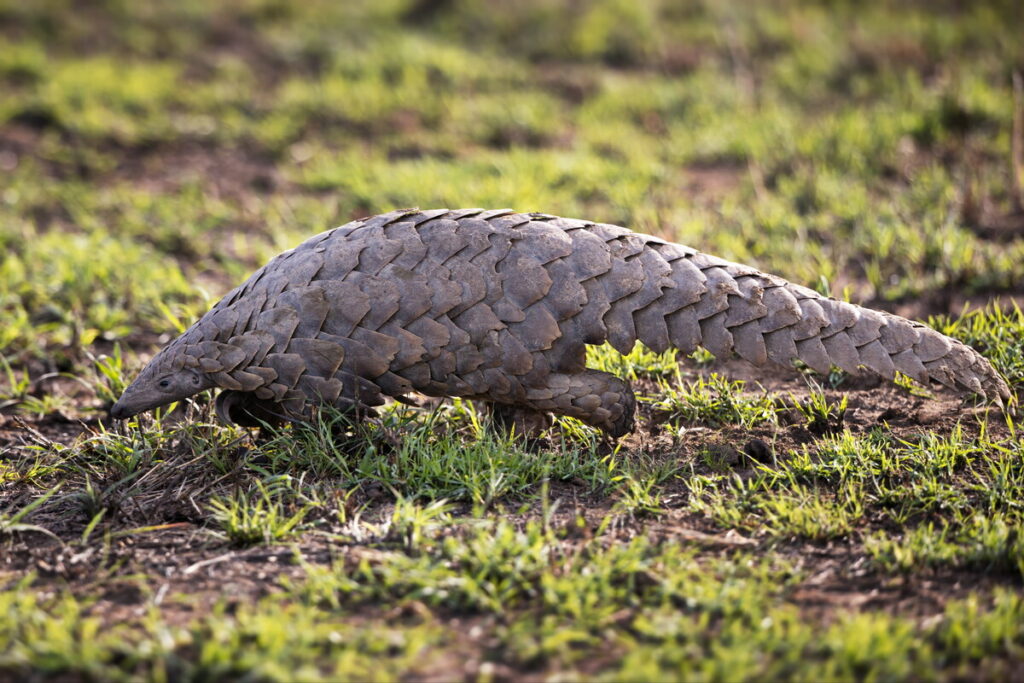
Pangolins are among the most heavily trafficked mammals on Earth, and scientists have now confirmed that one of them was hiding in plain sight. DNA from a specimen collected nearly 190 years ago shows that the Himalayan pangolin, Manis aurita, is a species in its own right.
Pangolins look almost prehistoric. These medium-sized mammals live only in Africa and Asia. They have long, powerful tails, large curved claws and bodies covered in overlapping scales that look a bit like a pinecone. Those scales are also a big reason pangolins are in danger, because poachers target them heavily.
A name that got lost and found again
The new work, published in Communications Biology, confirms that a previously unrecognized Asian pangolin species lives in Nepal and northern India. The story starts with a puzzle about names. In 2025, another research team found that animals once lumped together as Chinese pangolins were really two species. One lives mainly in China. The other lives in the Himalayan foothills across parts of Nepal, India, Bhutan and Myanmar. That team called the mountain form Manis indoburmanica, the Indo-Burmese pangolin.
But scientific naming follows a rule of priority. When one species has been given more than one name, the earliest valid name wins. The researchers behind the new study had spent about a decade studying pangolin evolution, and they knew of an older name: Manis aurita, described in 1836. Over time it had been folded into the Chinese pangolin as a subspecies.
That left a riddle. “What is the relationship between indoburmanica and aurita? Are they the same species or different species?” asked Kai He, a researcher at the South China Biodiversity Research Center at Guangzhou University and a co-corresponding author of the study.
The answer came from a museum drawer
The Natural History Museum in London helped solve it. Its team sequenced DNA directly from the original specimen of the Nepalese form, which is nearly 190 years old. Modern Himalayan pangolin samples matched that old specimen. So the animals described in 2025 were already known by an earlier name, and Manis aurita is the correct one.
The Himalayan pangolin differs from the Chinese pangolin in subtle ways. “Compared to the Chinese pangolin, the Himalayan pangolin has a bigger body, a longer tail, and smaller ears,” said Anderson Feijó, the Negaunee Assistant Curator of Mammals at the Field Museum and a co-corresponding author. The name aurita even refers to the animal’s distinctive ears. The known ranges of the two species do not overlap.
Why the right name matters for protection
Pangolin scales are believed to be a powerful aphrodisiac in traditional Chinese medicine, which helps drive a large illegal trade. Stopping it is hard in part because officials usually find scales, not whole animals. “In the marketplaces you basically only find pangolin scales, not the whole animals, which makes it hard to know which species are being hunted and where they are coming from,” Feijó said.
The DNA methods used in the study could change that. Scientists may be able to test confiscated scales, work out which species they came from and spot regions where poaching pressure is especially high. Conservationists and law enforcement could then work backward from seized material to the populations being targeted.
Clear species boundaries also matter for bringing pangolins back to places where they once lived. “Before, you might have introduced Chinese pangolins into Nepal, because you didn’t know the difference,” Feijó said. “By defining the differences between the species and the limits of where each species is found, we can make better conservation decisions.”
What this means
Narayan Koju, a researcher at the Nepal Engineering College at Pokhara University and the study’s first author, said the result came after more than five years of work that began in Nepal. He called it proof of how much long-term research, international teamwork and museum collections matter.
Feijó made a similar point. Pangolins are so rare in the wild that fresh samples are hard to find. Museum specimens collected over many decades let scientists sample animals across a much wider range than they could ever catch today. “We can’t protect what we do not know,” he said, and the confirmed existence of this pangolin gives conservationists something concrete to protect.
Source: ScienceDaily