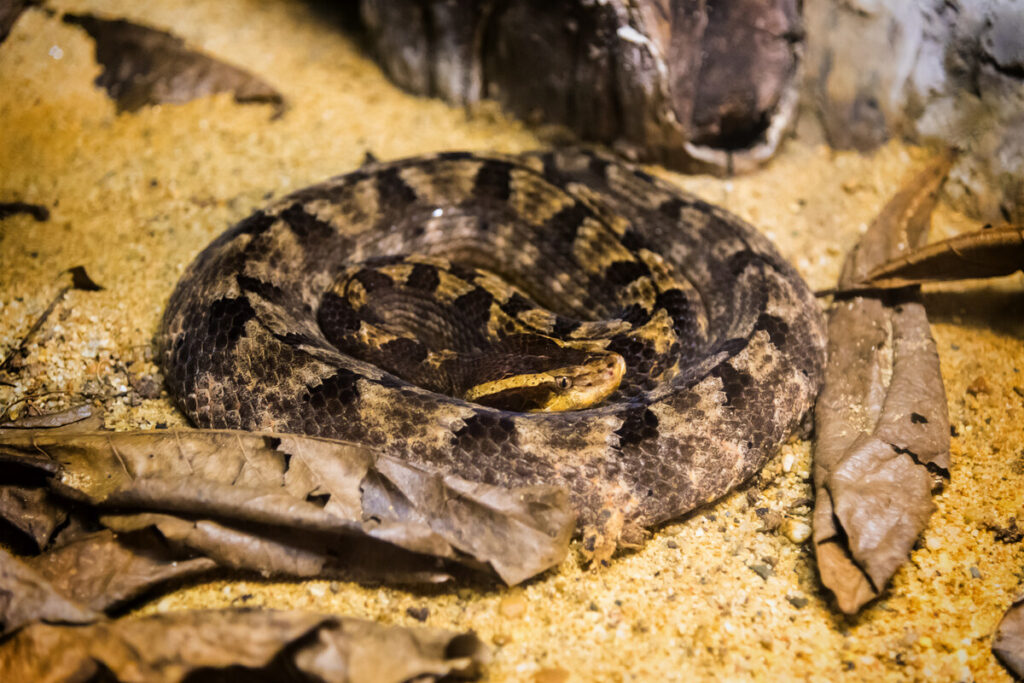
A venomous snake long treated as one widespread species across the Himalayas turns out to be five. An international team says the group includes three species that science had never recognized before.
One snake name hid several lineages
The Himalayan pit viper was first described in 1864, and for more than a century it was assumed to live across a broad stretch of mountain country as a single species. Researchers have now taken a second look using several kinds of evidence at once: genetic analysis, skeletal studies, physical features and notes on ecology.
The result, published in the open access journal ZooKeys, is that the group splits into five species-level lineages. One is the Himalayan pit viper in the strict sense. Another is Gloydius chambensis, described in 2022. The other three are newly recognized and live in different regions of Pakistan and Nepal. Beyond their DNA, the snakes also differ in their skeletons and outward traits.
Old museum specimens held the answer
A key part of the work relied on DNA taken from museum specimens collected in the 19th and early 20th centuries. That included the original type specimen of the Himalayan pit viper, which let the team confirm which animal the scientific name truly belongs to.
Sylvia Hofmann of the Museum Koenig, part of the Leibniz Institute for the Analysis of Biodiversity Change, says the evidence was waiting all along: “Some of the key evidence had been sitting in museum collections for more than a hundred years. We just didn’t have the tools to recognize it.”
Daniel Jablonski of Comenius University Bratislava, who has done research in Pakistan and Afghanistan for many years, describes the approach this way: “By combining modern field sampling with data from historical museum specimens, we uncovered evolutionary lineages that had remained hidden for more than a century.”
Why it matters
Pit vipers are among the top predators in these rugged mountain environments, and reptiles and amphibians more broadly act as ecological indicators and natural controllers of pest populations. Even so, scientists have historically studied the Himalayan pit vipers very little.
The study also raises conservation questions. Jablonski notes that “each of the newly recognized species seems to occupy a relatively restricted range in fragile mountain environments.” Without knowing how many species really exist, researchers cannot accurately assess threats or build effective protection plans. Counting one snake as five changes that picture.
Remote mountains, quiet surprises
The team says the findings show how much remains undiscovered in parts of Asia that have been hard for scientists to reach for decades. Rafaqat Masroor of the Pakistan Museum of Natural History, one of the country’s leading herpetologists, puts it simply: “Pakistan’s high mountains are still full of biological surprises.”
Frank Tillack of the Museum für Naturkunde Berlin, who has worked with colleagues in Nepal for 35 years, says the aim is to “lay the groundwork and provide inspiration for further, in-depth studies” on this ecologically and medically relevant group of snakes.
The work is a reminder that a well-known animal can still hide unfinished science, sometimes in a drawer in a museum.
Source: ScienceDaily