Sea pigs, a kind of deep-sea cucumber, carry a hidden passenger. A team in Japan found that one bacterium makes up most of the microbes living in their body wall, and its genome is surprisingly small.
Meet the sea pig
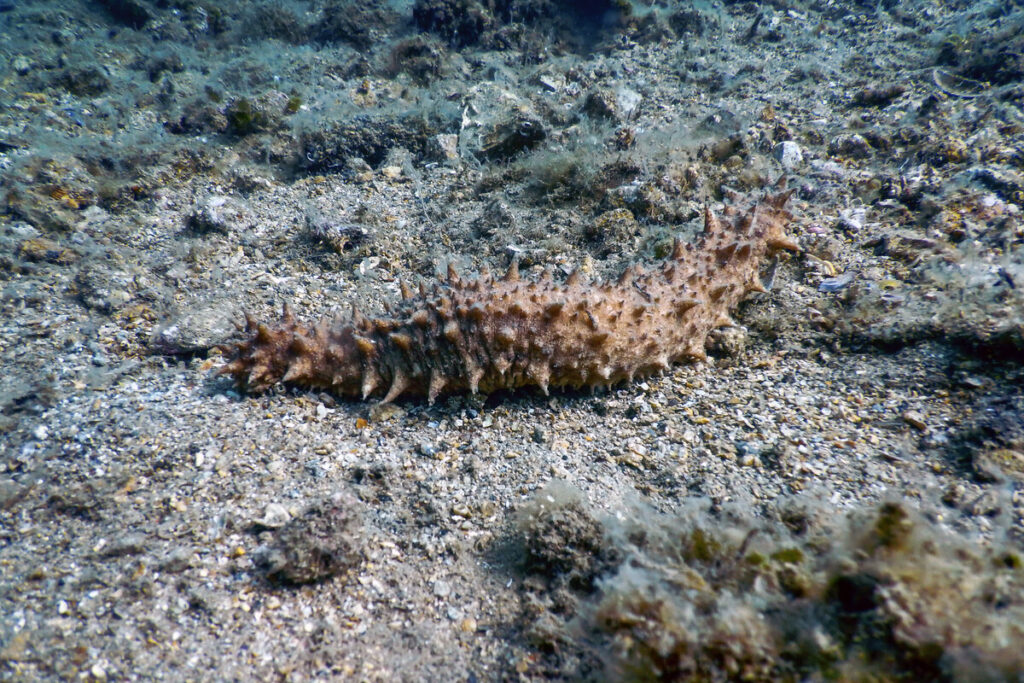
Despite the name, a sea pig is not a pig at all. It is a soft, jelly-like sea cucumber that lives in the deep ocean. It creeps across the seafloor on tube-shaped feet and uses special tentacles to pick up bits of decaying matter and bring them to its mouth.
That job matters. By eating dead organic material, sea pigs help recycle nutrients that other deep-sea life can use. Young king crabs have even been seen sheltering against them to stay safe from predators. Still, much about sea pigs is unknown, including how long they live and why they have long, antenna-like projections on their heads.
A bacterium that dominates the body wall
Researchers from several Japanese institutions, including the University of Tokyo, studied eight sea pigs collected on deep-sea expeditions. They pulled DNA from different tissues, rebuilt the genomes of the most common bacterial groups, and used fluorescence imaging to see exactly where the microbes sat inside the animals.
One bacterium stood out. In body-wall samples from three sea pig species, a single bacterium accounted for more than 70% of the bacterial gene sequences the team used for identification. Lead author Yu Yoshida, a Ph.D. student at the University of Tokyo’s Graduate School of Frontier Sciences, said it “truly dominated the body wall.”
The microbe belongs to a wider group known to live closely with marine invertebrates, but its genes differ a lot from those of known relatives. So the team proposed naming it as a new genus and species, Candidatus Abyssoplasma scotoplanesicola.
A tiny genome with giant proteins
The bacterium’s genome holds only 649,000 DNA bases. The well-studied gut bacterium E. coli has a genome about seven times larger. The small size was not the only surprise. Genes for some of the common energy-making pathways in bacteria were missing.
More than a quarter of the genome, 27.6%, is devoted to proteins tied to the cell surface. Some of these proteins are longer than 5,000 amino acids, while the average bacterial protein is about 300. The researchers think such giant proteins could help the bacterium interact with its host or stick together in clusters, but what they actually do is still unknown.
What do sea pigs get out of it?
The stripped-down genome hints at a lifestyle that leans heavily on the host. The team believes the bacterium depends on the sea pig for things it cannot easily make itself, such as amino acids, the building blocks of proteins, along with lipids, mineral nutrients and the raw materials for DNA and RNA.
Whether the sea pig gains anything in return is an open question. One possibility is that the bacteria help defend the animal against disease-causing microbes. The researchers stress that this has not been shown.
Why it matters
Sea cucumbers make up more than 90% of the biomass of large animals on the seafloor in some deep-ocean areas, so their microbes may matter more than they first appear. Few studies of deep-sea species have also pinned down where bacteria live inside host tissue, which makes this work a useful step.
Yoshida said the team wants to learn how the bacterium became so dominant, what its giant proteins do, what competition it faces from other microbes and how it affects its host. “We would really like to understand how this bacterium could become so dominant in the body wall,” he said. Answers could shed light on how bacteria settle into hosts and come to depend on them.
The study appears in ISME Host Microbe.
Source: ScienceDaily