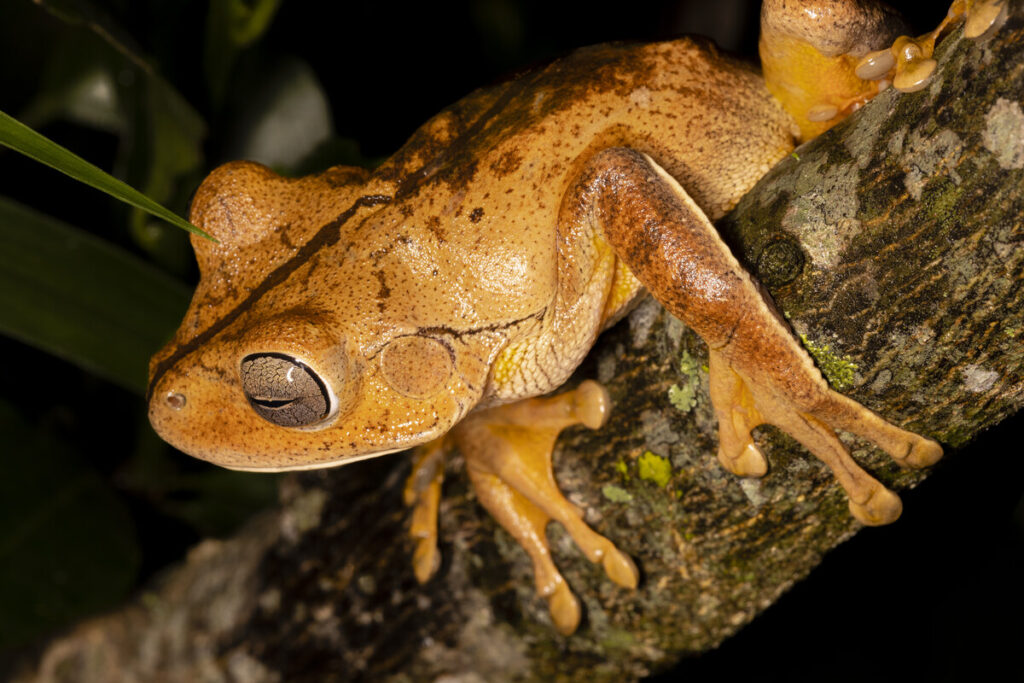
Frogs crashed at a research station in Brazil’s Atlantic Forest between 1979 and 1982, and for almost five decades nobody could say for sure why. Now scientists have tested frogs preserved in a museum collection and found strong signs that a fungus moved in just as the populations crashed.
The study, published in the journal Molecular Ecology, was led by researchers at the Smithsonian’s National Zoo and Conservation Biology Institute (NZCBI) and Pennsylvania State University. It also has a hopeful twist: most species at the site appear to have recovered.
A cold case in one of the richest frog forests on Earth
Brazil’s Atlantic Forest is one of the best places in the world to find amphibians, the group of animals that includes frogs, toads and salamanders. In the 1970s, scientists there began recording steep drops in frog numbers.
One place stood out. At the Boracéia Biological Station, amphibian populations dropped hard between 1979 and 1982. Some researchers suspected extreme weather or climate change.
Jack Boyette, a graduate fellow at NZCBI and a doctoral candidate at Penn State, led the new work. “After almost 50 years, we still aren’t confident what caused many historical amphibian die-offs,” he said.
Meet the suspect, a tiny fungus called chytrid
The prime suspect is a disease known as chytridiomycosis, or chytrid for short. It is caused by a fungus so small you need a microscope to see it, with the tongue-twisting name Batrachochytrium dendrobatidis.
Scientists think this fungus started out in Asia and then traveled across the globe in the 1970s and 1980s. The catch is that it was only formally described in 1999. By that time, hundreds of amphibian species around the world had already been pushed toward extinction, and some were gone for good.
That timing created a real headache. How do you prove a killer was at the scene when nobody knew it existed yet?
Frogs in jars become time travelers
The answer was sitting in the Smithsonian’s National Museum of Natural History. Decades ago, a former curator of amphibians and reptiles named William Ronald Heyer made five collecting trips to Boracéia. Two of those trips happened in the 1970s, before the crash. The other three took place in the 1980s, after it.
The team tested more than 370 preserved amphibians from 17 species, looking for traces of the chytrid fungus.
The difference was stark. Not a single specimen collected before 1979 showed signs of infection. In the 1980s batch, more than half carried the fungus. That jump suggests chytrid arrived and swept through the local frogs right as their numbers were collapsing.
“While environmental factors could have played a role, our findings most directly implicate the chytrid fungus,” Boyette said.
The twist: the hardest-hit frogs looked clean
Here is where it gets strange. The species that declined the most showed no sign of the fungus in the museum samples. The species that held steady, on the other hand, often tested positive.
At first, that seems to point away from chytrid. But the researchers think it comes down to how each species copes with the disease. Some frogs may be able to live with the infection. Others may get sick and die so fast that almost no infected animals were around to be collected.
“The species that declined most dramatically may have been so susceptible that infected frogs died before Heyer could collect them,” Boyette explained.
Good news from today’s forest
Working with scientists from the University of São Paulo, the team went back to Boracéia six times between 2022 and 2024. Of the 17 species in Heyer’s old collection, they found 12. The other five did not turn up, so their fate at the site is still unknown.
Still, most of the species have bounced back since the early 1980s. The fungus has not gone away, and local frogs still carry it. But the infection pattern hints that species once hit hard may have grown more tolerant of chytrid over many generations.
That shows an important idea. Carrying a germ is not the same as dying from it. A species can live with a dangerous fungus if its members can handle the infection.
Why it matters
The researchers are careful to say their results apply to Boracéia. They cannot, on their own, explain frog losses in other parts of the Atlantic Forest.
Even so, the study shows how much value is hiding in old museum shelves. Michael Campana, a genomicist at NZCBI who worked on the project, said that without these collections, scientists “would never be able to detect pathogens that went unnoticed for decades.”
Looking back may also help with what lies ahead. A related fungus, B. salamandrivorans, is threatening salamanders in Europe and could become a serious danger to salamanders in North America. Knowing how chytrid spread could help scientists catch such outbreaks earlier.
Next, the team is studying DNA pulled from the museum frogs to learn which genes helped some species survive. Other projects are searching for ancient environmental DNA, the tiny genetic traces that living things leave behind in their surroundings, to fill gaps where no specimens were collected. That work could show why some frogs were devastated while others pulled through.
Source: ScienceDaily