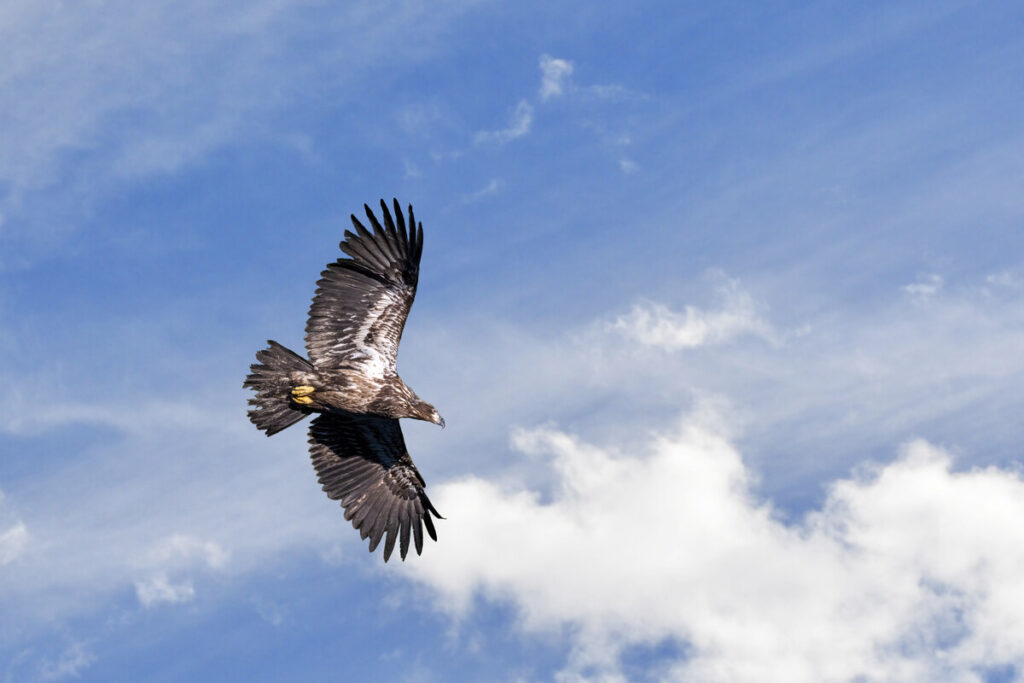
Most migrating birds in North America head south when the seasons turn. A group of young bald eagles from Arizona does the opposite. Satellite tracking shows many of them fly north for the summer and fall, sometimes all the way into Canada, before coming back home.
The findings come from a study published in the Journal of Raptor Research, shared by the Raptor Research Foundation. The researchers describe the southwestern eagles as true explorers, and they think those long trips may help the birds find food that only shows up for a short time each year.
Tracking young eagles across the map
From 2017 to 2023, a team based in Arizona fitted satellite transmitters on 24 young bald eagles that had just left the nest, plus two adults that were not breeding. Each bird was followed for as long as its tracker kept working. For some eagles, that meant up to four years of data.
Arizona’s breeding eagles are generally thought to stay near their nest areas for much of the year. Much less was known about the birds that are not raising chicks yet. Since young and old eagles face different odds of survival, following both groups gives a fuller picture of how the species is really doing.
Why going north makes sense here
The usual idea of migration goes like this: when winter comes, birds travel south toward warmer weather and steadier food. Arizona’s bald eagles run on a different calendar. They start nesting in winter, which means their “off” season, when they are free to wander, lands in summer and autumn.
The tracked eagles traveled to the northern United States and southern Canada, and eagles of different ages made these northern trips, not only the youngest ones.
Lead author Dr. Caroline D. Cappello found this timing especially intriguing. As she put it, “northward migratory behavior raises interesting questions about the recent and historical pressures that shape these movement strategies.”
The same rest stops, decades apart
One of the most striking results has to do with where the eagles stopped along the way. The birds paused at many of the same lakes and rivers that an earlier study, back in the 1980s, had already flagged as key stopover sites for bald eagles.
That overlap suggests these watery rest areas have stayed important for generation after generation of eagles. The study also confirmed that the birds lean heavily on a route known as the Intermountain Flyway, and that lakes and rivers are central to their journeys.
The eagles’ travel also changed as they got older. Their routes became more precise and more refined over time. Most of the birds tracked for at least two years spent their first summer roaming far to the north, then returned to Arizona in the fall of the year they hatched.
Chasing a seasonal feast
Why fly so far? The researchers suggest that young eagles may be heading toward short bursts of plentiful food. Their examples include salmon gathering to spawn, nesting waterfowl, and the carcasses of large mammals.
That idea is still a hypothesis. The team notes that more research is needed to know whether the eagles are really timing their trips around these food bonanzas.
A long trip with real dangers
Big journeys come with big risks, especially in a world full of human-built hazards. One female eagle in the study had an especially remarkable early life. She crossed ten U.S. states and four Canadian provinces before appearing to settle in northern California, where it looked like she was about to claim a breeding territory of her own.
At four years old, she was killed by electrocution, which is a sadly common cause of death for large birds of prey. Cappello said her death “underscored the ongoing risks these birds face.” It was also a scientific loss. Scientists rarely get to measure how often eagles hatched in Arizona move away to live elsewhere, and her choice to settle in California would have offered a rare look at exactly that.
Electrocution is only one threat. Young raptors can also be poisoned by lead or by rodent poisons, collide with wind turbines, lose their habitat, and face an uncertain future as the climate changes.
Why it matters
Studying eagles at every life stage, including the wandering years of young birds, helps scientists give practical advice. It can point to the stopover sites that most need protection, and to the kinds of infrastructure, such as electrical systems, that could be changed to help eagles and other large raptors survive.
Coauthor Dr. Javan M. Bauder, a researcher with the U.S. Geological Survey and an assistant professor at the University of Arizona, stressed that good wildlife management depends on understanding how individuals of all ages move, not only the adults that breed.
Next, the team wants to learn whether individual eagles stick to the same routes year after year. Cappello explained that “if consistent patterns exist it could help focus conservation efforts on specific, high-use areas along their migratory route.” The researchers would also like to compare Arizona’s eagles with other animal populations that migrate north from the southern edge of their range, to better understand the costs and benefits of heading the “wrong” way.
Source: ScienceDaily