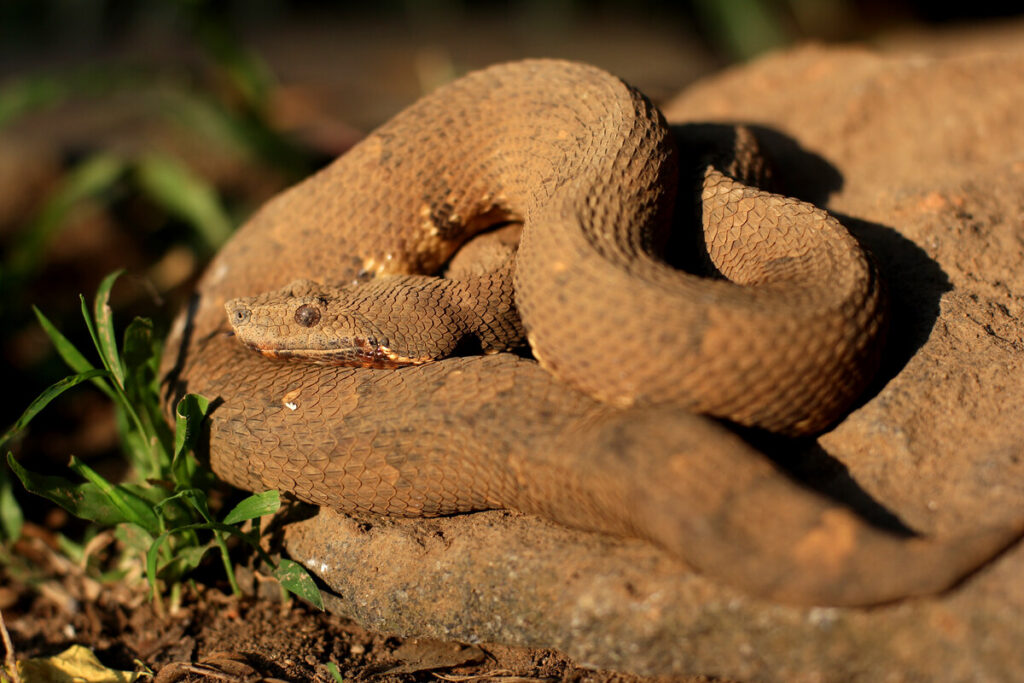
A reddish-brown snake that hunts at night in the forests of New Guinea now carries the name of a rock star. Scientists have described it as a species new to science and called it Lielaphis slashi, or Slash’s groundsnake, after the Guns N’ Roses guitarist who has loved reptiles since he was a kid.
Slash, whose real name is Saul Hudson, is best known for his guitar solos. Fewer people know that he has been fascinated by reptiles for most of his life and has long backed zoos, museums and natural history. Now that lifelong passion has earned him a spot in the scientific record.
The new species was described in a paper in the journal Zootaxa, led by researchers at the Field Museum. Slash said he was “extremely honored and humbled” by the choice and added: “It is really exciting, I never would have imagined this moment would arrive.”
A name with a childhood story behind it
The idea came from Sara Ruane, the Field Museum’s associate curator of herpetology and the senior author of the study. Herpetology is the study of reptiles. Ruane knew she wanted to be a herpetologist by fifth grade, and she was already a big Guns N’ Roses fan.
When she was 12, a copy of Reptiles Magazine arrived in her mailbox with Slash on the cover, holding his pet reticulated python. “I thought, ‘This guy is so cool,'” she recalled.
Years later, as a scientist who sometimes gets to give official names to newly recognized reptiles, she went back to that old interview. In it, Slash talked about his love for museums, zoos and natural history, and about searching for snakes outdoors as a boy. “It was all stuff that I really related to, and it made me think that he’d be a great person to name a new species after,” Ruane said.
Found one night at the foot of a tree
The story of the snake itself goes back to 2006. During a night of fieldwork in New Guinea, Chris Austin, a professor and curator of herpetology at the Louisiana State University Museum of Natural Science, came across a snake he could not identify.
New Guinea is the second-largest island on Earth, after Greenland. It sits just north of Australia and is split between Indonesia and Papua New Guinea. Its tropical forests are packed with wildlife, and much of it has never been properly studied.
Groundsnakes like this one are active at night. According to Austin, they usually turn up just after sunset near the base of big trees, where they look for food. He also gave a warning for anyone doing this kind of work: “When working at night in New Guinea you need to be very careful as there are several highly venomous species that look very similar to the non-venomous groundsnakes.”
The specimen at the heart of the study measures 28 inches long. Ruane and Austin started working together at LSU in 2016 and have been studying the island’s little-known snakes as a team ever since.
How scientists proved it was new
At first glance, the snake did not look like anything new. The lab work told a different story.
Tianqi Huang, the study’s first author and a postdoctoral researcher working with Ruane at the Field Museum, explained that several genetic tests showed the snake was distinct from similar species in the same genus. A genus is the group of closely related species just above the species level.
The team then compared physical features, such as the number of scales, with those of related snakes. They also used ecological modeling, a way of mapping which conditions an animal prefers, and found that Slash’s groundsnake seems to favor a different kind of habitat. “The combination of physical characteristics, like differences in numbers of scales when compared with other species, and the genetic evidence is what led us to realize that it is an entirely new species,” Huang said.
A snake that is still a mystery
For now, researchers know very little about how this snake lives. “It’s incredibly hard to observe snakes in the wild before they slither away, so our knowledge about L. slashi is limited,” Ruane said.
Its body offers a few clues. Snakes in this genus often have large teeth at the back of the mouth. Ruane thinks New Guinea groundsnakes may use them to hold on to small lizards with slippery scales and to eat the eggs of other reptiles. Unlike a boa constrictor, it does not wrap around its prey and squeeze.
Guns N’ Roses was once called the “most dangerous band in the world,” but its scaly namesake is no threat to people. Slash’s groundsnake does not make venom strong enough to seriously harm a human.
Why it matters
The real danger runs the other way. Ruane pointed out that the forests where this snake lives are under pressure from industries such as coffee farming and mining.
That is one reason naming new species matters so much. “We can’t conserve animals or other living things that we don’t know about,” Ruane said. Each newly described animal helps scientists see which species may be at risk as New Guinea’s forests change.
Source: ScienceDaily