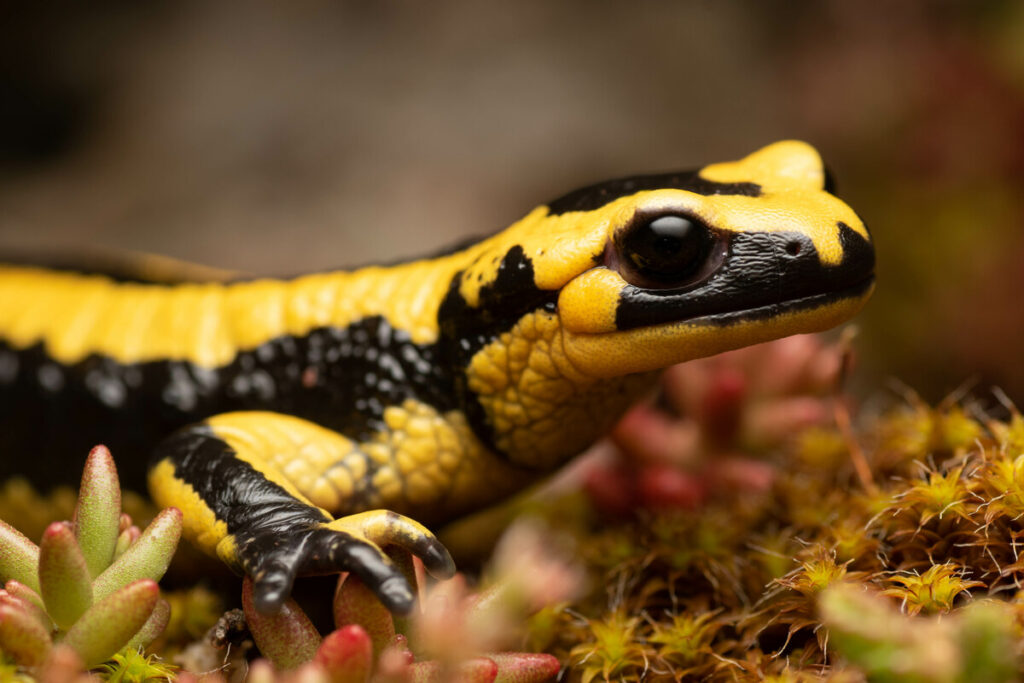
Shine an ultraviolet lamp on a fire salamander and something unexpected happens: its yellow belly and sides light up in bright green and cyan. A team of European researchers has now documented this glow for the first time, and the light seems to come from the very skin secretions these toxic amphibians use to defend themselves.
Fire salamanders are some of the easiest amphibians to recognize in Europe. Their shiny black bodies are splashed with yellow, and they ooze poisonous substances that keep predators away. They live in damp forests, along streams and in mountain areas.
A glow hidden in plain sight
The researchers found that fire salamanders fluoresce when they are hit by ultraviolet light. The effect is strongest on the yellow underside of the body and along the flanks. When the team looked for the source, they traced most of it to glands in the skin and to the fluids those glands release.
Here is the most surprising part. Once the secretions leave the salamander, they can keep glowing for more than 24 hours.
Bernat Burriel, a researcher at the Museum of Natural Sciences in Barcelona and first author of the study, was struck by the find. “It is fascinating that such a well-studied species still harbors unknown phenomena like this,” he said.
Fluorescence is not the same as making light
Humans cannot see ultraviolet light. Some materials, though, can soak up that invisible light and send part of the energy back out as colors we can see. In the salamanders, the result is a vivid green and cyan shine.
This is called biofluorescence. It only works when an outside light source is shining on the animal. That makes it very different from bioluminescence, the trick fireflies use, where the animal produces its own light through a chemical reaction.
For a long time, scientists thought biofluorescence was mostly an ocean thing, with scorpions as a rare example on land. In recent years, that idea has fallen apart. Researchers keep finding fluorescent features in land animals, including reptiles, birds and amphibians.
Why would a salamander glow
Nobody knows yet. The team suggests two main ideas, and both are still hypotheses.
The first is communication. A glow could help salamanders find and recognize each other, or size up a possible mate. Martin Kaltenpoth, director of the Department of Insect Symbiosis at the Max Planck Institute for Chemical Ecology and a co-author of the study, said the trait fits that role in several ways. “It could help salamanders detect each other in nocturnal or particularly dense environments, or act as an additional defense signal,” he said.
Moonlight may matter here. Fire salamanders are active in forests where, at night, most of the light comes from the moon and stars. According to the researchers, full moonlight carries a larger share of ultraviolet and violet light than daylight does. Under the moon, the glow could add small green and cyan highlights to the yellow markings, which might make one salamander easier for another to spot. Animals with very sharp eyesight may notice even a faint glow. People, on the other hand, need a UV lamp to see it.
An extra warning to predators
The second idea is defense. Many poisonous animals wear loud colors that say “don’t eat me.” Scientists call this aposematism. The fire salamander’s black and yellow pattern is a classic example, and a glow on top of it could act as one more warning sign.
The link between those colors and the salamander’s poison has been known for more than a century, since scientists identified samandarines. These are highly toxic compounds of a type called steroidal alkaloids, and the salamander makes them starting from cholesterol building blocks.
That long history is exactly why the glow came as such a surprise. Andrés Brunetti, a researcher at the Max Planck Institute for Chemical Ecology and a co-first author, noted that these secretions have been studied chemically for decades. “We were unaware of any published reports on fluorescence,” he said.
A mystery molecule
The team still does not know which substance makes the salamander glow. The evidence points to a molecule that has never been identified in fire salamanders before.
“Identifying it will be key to understanding its origin and function,” said Salvador Carranza, a researcher at the IBE (CSIC-UPF) and a co-author of the study. The researchers are now working to isolate and describe the compounds that could be behind the effect.
Why it matters
The International Union for Conservation of Nature lists the fire salamander as “vulnerable” on its Red List. Losing their habitat, and seeing it broken into smaller pieces, is a growing threat to these animals.
Knowing whether the glow helps with communication, mating or avoiding predators could show scientists what fire salamanders need, which may support conservation work. The study is part of an amphibian conservation project in Catalonia supported by the Barcelona Zoo Foundation. The results were published in Royal Society Open Science.
It is also a lesson in looking again. A familiar animal, studied for over a hundred years, still had a hidden feature that only showed up under a new kind of light.
Source: ScienceDaily