Long before smartphones, some unknown ocean animal may have carried its own GPS. Microscopic magnetic fossils pulled from the floor of the North Atlantic, dated to 97 million years ago, look built to read both the direction and the strength of Earth’s magnetic field. That makes them the oldest direct evidence yet of animals finding their way by magnetism.
Tiny fossils with big shapes
Scientists call them magnetofossils. Each one is about the size of a single bacterial cell, far too small to see without powerful instruments. Under the microscope, they come in surprising forms: some look like spearheads, others like spindles, bullets or needles.
Researchers have long suspected that a living thing made them. What they could not say was which creature produced them, or what job the little structures were meant to do. One earlier idea was that these giants of the magnetofossil world worked as protective spines. Computer models hinted at something more interesting, though: the shapes seemed to have unusually clever magnetic properties.
A team from the University of Cambridge and the Helmholtz Zentrum Berlin has now taken the first 3D images of the magnetic structure hidden inside these fossils. The results were published in the journal Communications Earth & Environment.
How animals sense the magnetic field
Being able to feel Earth’s magnetic field is called magnetoreception. Birds, fish and insects all use it to travel huge distances, yet it is still one of the most mysterious senses in nature. Nobody fully knows how the body pulls it off.
A popular explanation involves magnetite, a magnetic mineral. If an animal grows tiny crystals of it inside its body, those crystals could line up with the planet’s field and act like miniature compass needles.
Some bacteria in lakes and other watery places already do a simple version of this. Inside each cell sits a chain of magnetic particles that turns the microbe in line with the field, so it can swim to the water depth it likes best. Professor Rich Harrison of Cambridge’s Department of Earth Sciences, who co-led the new research, explained why that design works so well: “At just 50-100 nanometers wide, these particles are the perfect compass needles. If you want to create the most efficient magnetic sense, smaller is better.”
That is what made the ancient fossils puzzling. They are roughly 10 to 20 times bigger than the particles bacteria use. “It looks like this creature was carefully controlling the shape and structure of these fossils, and we wanted to know why,” Harrison said.
A magnetic tornado inside each fossil
Seeing inside such large particles used to be impossible, because ordinary X rays could not get through them well enough. The team relied on a newer technique, magnetic tomography, created by co-author Claire Donnelly at the Max Planck Institute in Germany. The measurements themselves were made at the Diamond X-ray facility in Oxford.
The method maps magnetic moments, which are the tiny magnetic fields made by spinning electrons. What the images showed was unexpected. The magnetic moments twist around a line running through the middle of the fossil, forming a spiral that looks a lot like a tornado.
According to Harrison, this kind of vortex is ideal for navigation. When the strength of the surrounding field changes slightly, the structure responds with a small “wobble,” which could give its owner detailed clues about where it is.
“This magnetic particle not only detects latitude by sensing the tilt of Earth’s magnetic field but also measures its strength, which can change with longitude,” he said.
The vortex is also very stable, so small disturbances in the environment would be unlikely to throw off its readings. “If nature developed a GPS, a particle that can be relied upon to navigate thousands of kilometers across the ocean, then it would be something like this,” Harrison said.
So who made them? Eels are a suspect
The fossils still do not come with a name tag. But knowing what they were probably for narrows the search. “This tells us we need to look for a migratory animal that was common enough in the oceans to leave abundant fossil remains,” Harrison said.
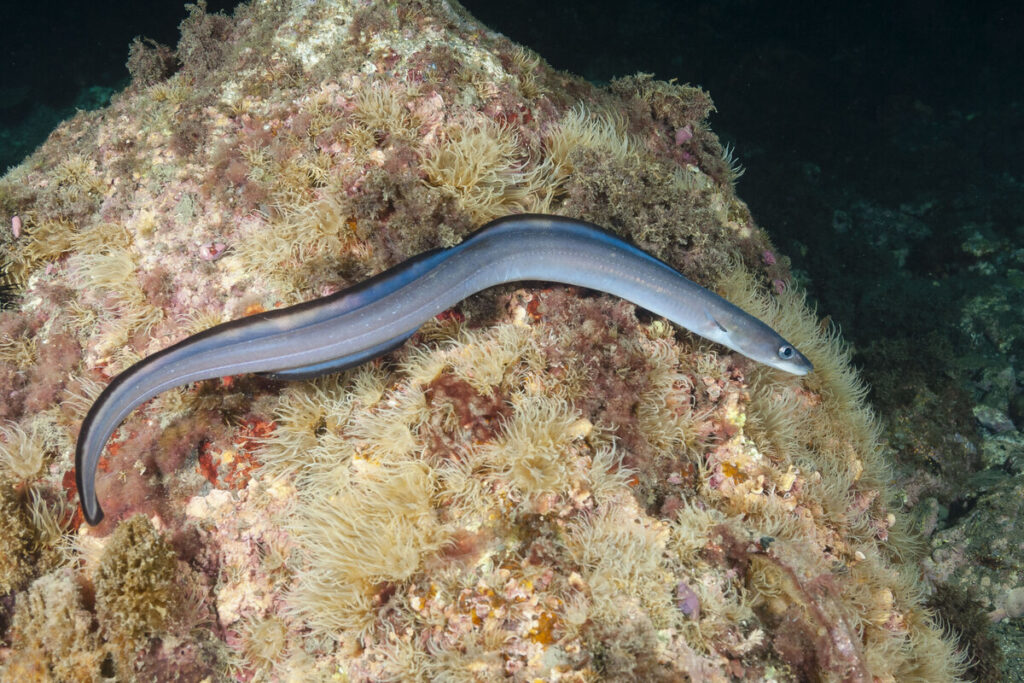
He points to eels as one possible candidate. Eels appeared around 100 million years ago, and they remain some of the most secretive animals alive. Today, European and American eels leave freshwater rivers and travel thousands of kilometers to breed in the Sargasso Sea. Scientists know eels can sense the magnetic field, but not exactly how.
Magnetite has been found in eels. However, nobody has yet captured images of those particles inside eel cells and tissues. They are so small, and could be tucked away almost anywhere in the body, that finding them is a real challenge.
Why it matters
Until now, the idea that ancient animals steered by magnetism was mostly an educated guess. These fossils suggest that at least one creature was doing it 97 million years ago, and doing it with impressive precision.
They may also capture a key moment in the story of how this sense evolved. “Giant magnetofossils mark a key step in tracing how animals evolved basic bacterial magnetoreception into highly-specialized, GPS-like navigation systems,” Harrison said. The next chapter will be finding the animal that carried them.
Source: ScienceDaily