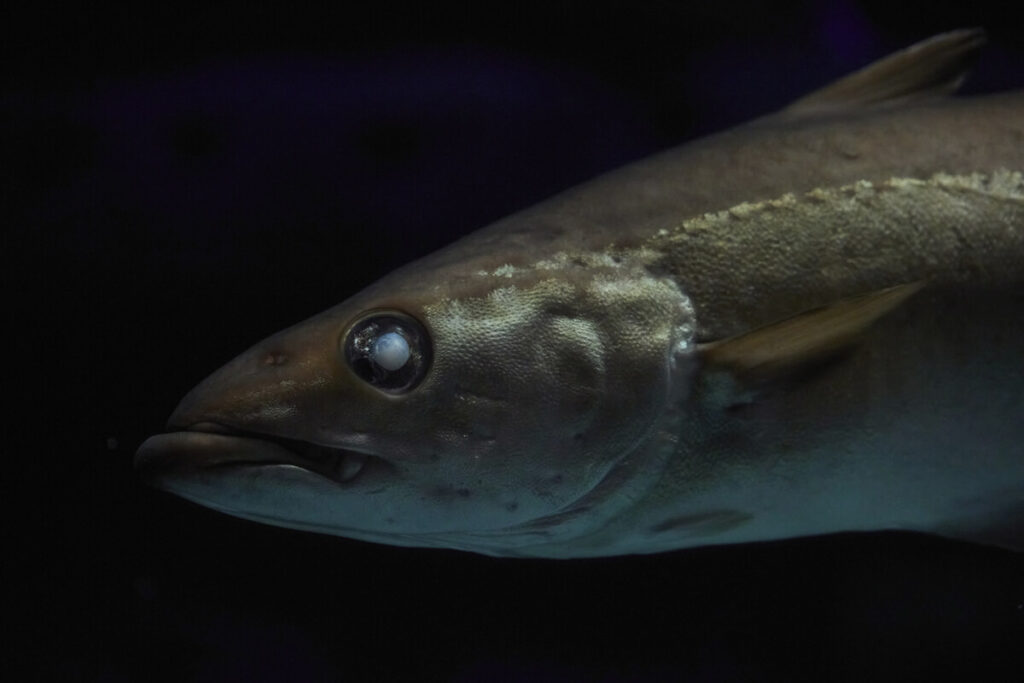
Scientists in the Pacific Ocean have filmed one of the strangest fish in the sea, a barreleye with a transparent head, in 4K video for the first time. It was only the eleventh time MBARI scientists have met this fish in nearly four decades of ocean exploration.
A surprise at the end of a long day
The sighting came during an expedition aboard the research vessel David Packard. Researchers from MBARI were about 90 kilometers (55 miles) offshore, working with the remotely operated vehicle Doc Ricketts. At around 600 meters (1,970 feet) below the surface, the fish drifted into view.
The team was actually there to study gelatinous animals such as jellyfish, siphonophores and comb jellies. The barreleye showed up as the day’s work was ending. The vehicle’s pilots were already steering it toward the surface when research specialist Shannon Johnson spotted the fish and asked them to stop.
Word spread fast. Scientists who had gone to the wet lab to sort their samples hurried back to the control room, and crew members joined them. Senior scientist Steven Haddock said the moment felt special:
“Seeing a barreleye fish is a rare treat. Crew from across the ship joined the science team in the control room, mesmerized by this remarkable animal.”
How a see-through head helps it hunt
The barreleye, Macropinna microstoma, is more than a curiosity. Its body is built for finding food in the twilight zone, where sunlight is faint and prey is hard to spot.
Earlier observations by MBARI scientists Bruce Robison and Kim Reisenbichler showed how it works. The fish can hang almost motionless in the water, using its large fins for stability and fine control, rather than swimming around in search of a meal. Its tubular eyes normally point upward, watching for the faint silhouettes of animals passing overhead.
When something edible appears, the eyes can rotate inside a clear dome of tissue that covers the top of the head. That lets the fish keep its target in sight as it shifts position to strike.
The gelatinous dome has a second job. Barreleyes can feed on small crustaceans caught in the stinging tentacles of siphonophores, colonial animals related to jellyfish. According to the research team, the dome helps protect the fish’s sensitive eyes while it picks its meal from those tentacles.
What the 4K camera caught
The scientists watched the fish for about 20 minutes. The 4K camera on Doc Ricketts recorded unusually sharp views of its anatomy and movements, and the team changed the vehicle’s lighting to make the transparent head shield easier to see.
Pilot and technician Cameron Law also brought the vehicle close enough to film with its virtual reality camera. That 3D stereo footage could later be used in education and public outreach programs.
Haddock said the fish is a reminder of how animals adapt to life in the midwater:
“So many of them survive by looking for subtle optical cues, like a shadow passing overhead, and this sets off evolutionary competition, pitting bioluminescent camouflage against increasingly sophisticated visual capabilities.”
Why the sighting is so rare
MBARI has made roughly 7,000 remotely operated vehicle dives over nearly 40 years and collected more than 41,000 hours of deep-sea video. Even so, researchers have recorded just 11 encounters with this species. The previous one happened in 2021. This one was the institute’s first 4K footage of the fish and its first sighting from the David Packard, its new flagship research vessel.
MBARI has also met other members of the barreleye family. This summer, researchers working with Schmidt Ocean Institute in the mid-Atlantic Ocean recorded another unusual deep-sea species, the binocular fish (Winteria telescopa).
Why it matters
Much of the ocean’s midwater is still unexplored, and each rare encounter adds to what scientists know about how animals live where light is scarce. The expedition was supported by the David and Lucile Packard Foundation.
Source: ScienceDaily