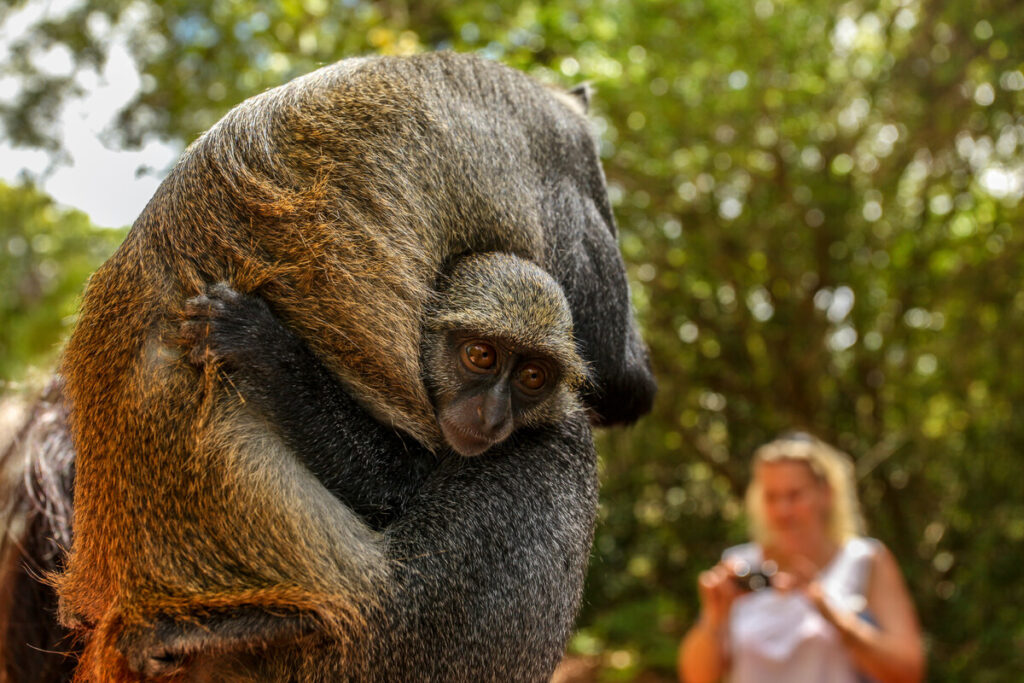
A roloway monkey named Masaya was close to losing her foot. Surgeons at a veterinary school saved it instead, and a few months later she gave birth to a healthy daughter. For one of the rarest monkeys on Earth, that is more than a happy zoo story.
A foot problem that would not go away
Masaya is 15 years old and lives at Chester Zoo in England. Her foot started giving her trouble before she even arrived there in 2023, and the problem kept coming back.
The zoo vets tried several ways to find out what was wrong. They took X-rays, ran ultrasounds and collected small tissue samples called biopsies. None of it gave a clear answer. Their best guess was a stubborn abscess, a pocket of infection that may have started with an old injury from a thorn.
By 2025 the swelling had grown worse, and a lump about the size of a golf ball had formed on her foot. The team needed a much more detailed look inside.
A monkey goes to vet school
So the keepers did something unusual. They took Masaya to the University of Liverpool’s Small Animal Teaching Hospital for a CT scan, a type of 3D X-ray that shows bones and soft tissue in fine detail.
Moving a monkey is not like taking a dog to the vet. The zoo had to pack everything she could possibly need on the trip. Charlotte Bentley, Veterinary Officer at the zoo’s Animal Health Center, summed it up: “It’s not every day you take a monkey to vet school.”
After the scan, the vets agreed that surgery was the best option. Zoo veterinarians and surgeons from the university worked together to cut out the mass while keeping as much of the foot as they could.
The team could not find a single earlier case of this operation being done on a roloway monkey. It worked anyway. Masaya lost one toe but kept all the others, along with the rest of her foot.
Rachel Burrow, a veterinarian and lecturer at the University of Liverpool, helped with both the scan and the surgery. Her usual patients are cats and dogs, so this case stood out. “This was the last chance to save Masaya’s foot before amputation,” she said. Today, she added, Masaya is “comfortable, active, and using the limb well.”
Then came Lagertha
A few months after the operation, Masaya had a baby girl. Keepers named her Lagertha, after a Viking queen. She is Masaya’s third daughter.
Zoe Edwards, a primate keeper at Chester Zoo, described the newborn as tiny but already curious about her home and about the people who look after her. The keepers say she shows some of her mother’s personality too.
The healed foot matters here. Being able to use it normally may play a big part in how well Masaya can carry and care for her baby. An amputation could have changed how Masaya held her baby and how she went about her normal life. Edwards said the way the foot healed was “a huge relief.” She also praised Masaya’s skills as a parent: “Masaya is a very experienced mum and she’s parenting magnificently.”
Today mother and daughter share their habitat at Chester Zoo with four other monkeys.
Why one monkey matters so much
Roloway monkeys are critically endangered. According to the International Union for Conservation of Nature (IUCN), fewer than 2,000 are left in the wild. They live in the forests of Ghana and Ivory Coast in West Africa, where they face two big threats: the loss of their habitat and poaching.
Very few roloway monkeys live in zoos, either. Chester Zoo is one of only two places in the UK where the species can be seen, and Edwards noted that Europe’s zoos have only a few breeding females.
That is why Masaya is part of the European Endangered Species Programme. This is a breeding plan that zoos run together, designed to help protect the species from dying out.
What this means
When a species is this rare, every healthy mother counts. In Edwards’s words, Masaya is very important “not just to her family, but to her whole species.”
Her story also shows how zoo vets and university hospitals can team up when an animal needs care that no one has tried before. An operation with no known precedent in her species ended with a new baby for a species that has very few to spare.
Source: ScienceDaily