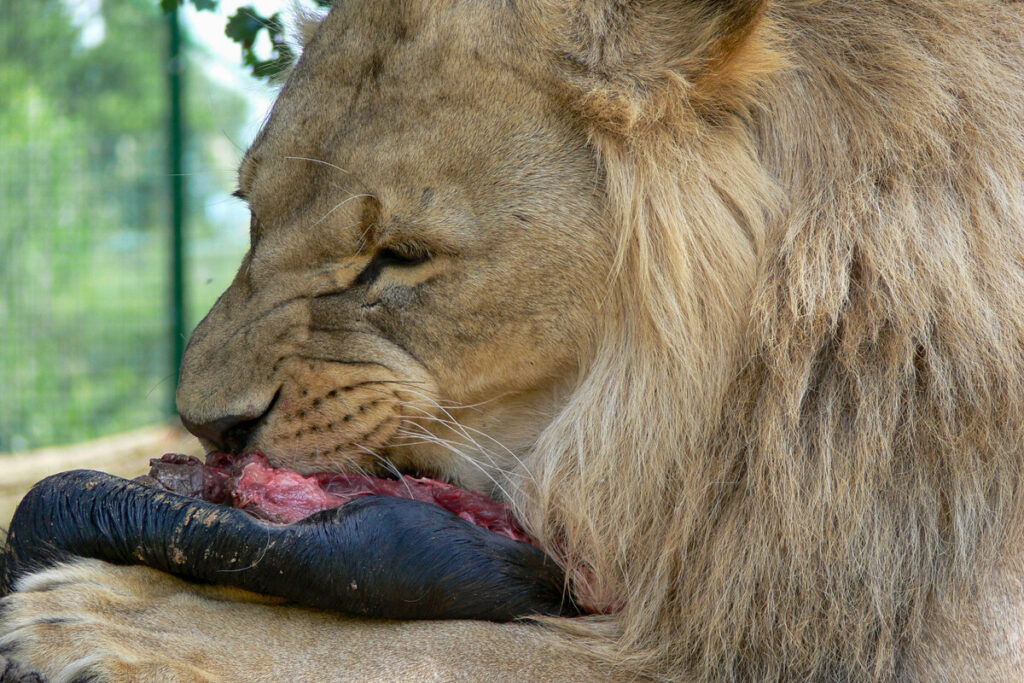
What happens when lions living in a zoo are handed a whole carcass instead of a neat portion of meat? Researchers in South Australia tried it with three adult male African lions, and the big cats slipped into a feast, rest and wake-up rhythm that looks a lot like the one wild lions follow.
The work comes from Adelaide University and Monarto Safari Park, and it was published in the journal Applied Animal Behaviour Science. It is a small study, but a very detailed one, and it says something useful about how mealtime shapes the way big carnivores spend their days.
A new item on the lion menu
The lions at Monarto already ate on a schedule built around days of eating and days of fasting. For the experiment, the animal care team kept that routine and added something new: a whole carcass every nine days.
These were big meals. Over the experimental phase, the three males were given roughly 200 kg (about 440 pounds) of carcasses. The food stayed in their enclosure for up to three days. After that, the lions moved into a stretch of resting and digesting before the next feast.
To see what really changed, the team set up eight infrared cameras and filmed the lions around the clock for three months, both before and after carcasses joined the menu. The researchers describe the result as one of the most detailed 24 hour records ever collected for African lions in human care on this kind of diet.
Eating took almost three times longer
On carcass days, the change was easy to spot. The lions spent almost three times as long eating as they usually did. They came back to the food more often and stayed with it longer, tearing, pulling and working at the carcass instead of finishing a ready-cut meal in a few minutes.
Lead author Lesia Hryhorenko, from Adelaide University’s School of Animal and Veterinary Sciences, explained why that matters. “Wild lions don’t eat at the same time every day. They experience natural periods of feasting and fasting depending on hunting success,” she said.
She added that a carcass is about more than nutrition. “It gives lions the opportunity to engage in behaviors such as tearing, pulling and manipulating food over extended periods, which are important components of their natural feeding ecology.”
Then came the long nap
Once the big meal was over, the lions did what full lions do best: they lay down. They spent a lot more time resting after a carcass than on ordinary days. Then, as the fasting days went by, they slowly became more active again.
Feast, long rest, then rising activity: that loop closely matches the rhythm scientists have recorded in wild lion populations. In other words, a change in what landed in the enclosure brought the lions’ whole week a little closer to life in the wild.
The team also checked whether sharing such a large meal caused trouble within the group. It did not. The researchers saw no increase in aggression and no disruption to the lions’ social stability during carcass feedings.
Why the lions paced
Many carnivores in human care pace, walking the same route back and forth. This repetitive habit is often linked to anticipation, so the researchers wanted to know whether hungry lions paced more.
The answer was a little surprising. Pacing went up slightly over the study, but it did not climb steadily as the lions went longer without food. Instead, it peaked around predictable moments, such as when keepers arrived or when the lions were moved between parts of their habitat.
That pattern suggests the pacing may have been tied more to familiar daily routines, and to expecting food, than to hunger itself. It is a reminder that animals in human care learn the schedule around them very well.
What this means for zoo animals
Co-author Associate Professor Alexandra Whittaker said the study shows why behavior needs to be watched over long periods, not just for a few minutes after a meal.
“Our results show that feeding schedules can influence behavior for days afterwards, making it essential to look at behavioral patterns across the entire feeding cycle rather than a single feeding event,” she said.
The study only followed three lions in one park, so it cannot say how every lion would react. Still, it points to a simple idea: how and when a carnivore is fed can shape its behavior for days, not just at dinnertime. The researchers say future work could pair this kind of behavior tracking with physiological measurements, to build a fuller picture of how different feeding strategies affect animal welfare.
Source: ScienceDaily