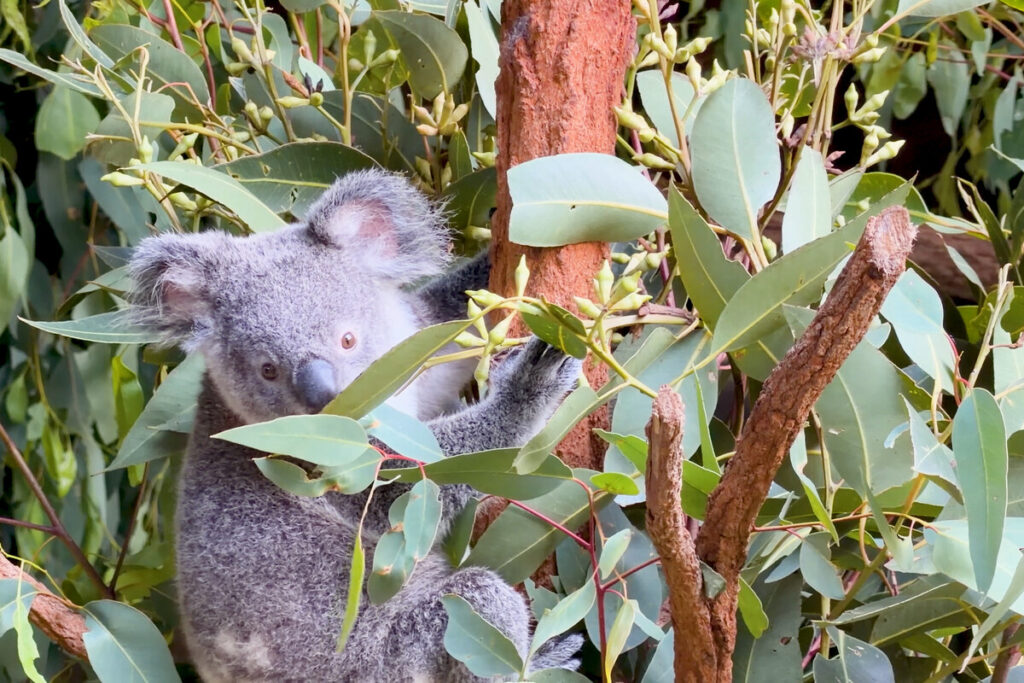
Koalas suffered a severe population crash about 100,000 years ago, tens of thousands of years before people reached Australia. A new DNA study suggests that climate change and shrinking habitat, not humans, caused that first collapse.
A new timeline for koala history
Researchers from the University of Sydney and Texas A&M University studied the genetic history of the koala (Phascolarctos cinereus). Their results, published in Molecular Biology and Evolution, challenge earlier work that placed the start of koala declines after modern humans arrived in Australia about 65,000 years ago.
PhD student Toby Kovacs, who led the research, said: “The study rewrites the timeline for the koala’s genetic history in Australia.”
Kovacs explained the idea this way: “By calculating the mutation rate of modern koala populations, we can estimate and build the genetic timeline backwards all the way to 100,000 years ago to get a glimpse of genetic diversity and the sizes of ancient koala populations.”
Fossils cannot say exactly how many koalas lived 100,000 years ago, so the team turned to genomes. Genetic data keeps clues about how large past populations were and how much diversity they held.
How scientists read the past in koala DNA
The key was the mutation rate, the number of new genetic changes that appear in each generation. Earlier studies had borrowed rates from distant relatives such as humans and mice. This team measured it directly by sequencing the genomes of four parent and offspring trios and counting the new mutations.
The koala rate came out at about half the human rate. It is also the first direct estimate for koalas, or for any member of the marsupial order that includes wombats, kangaroos and possums.
The researchers then applied that rate to 457 koala genomes. This gave a more accurate way to trace how populations grew, shrank and split apart over thousands of years.
What happened to koalas, step by step
The new analysis suggests a major decline began around 100,000 years ago. Numbers then hit a critical genetic bottleneck nearly 60,000 years ago. That timing matches a harsh stretch of the most recent glacial period, long before any contact with humans.
Australia swung between cold, dry glacial periods and warmer, wetter interglacial periods. Those cycles made the continent more arid and more prone to fire. Around 70,000 years ago, the growing Nullarbor Plain turned a huge region into semi-arid shrubland. That cut the amount of suitable koala habitat and separated eastern and western populations.
The western population eventually disappeared. A small eastern group survived the hardest conditions. When the climate improved, that surviving group spread out. Between 16,500 and 6,000 years ago it divided into five genetically distinct populations, and those gave rise to the koalas living along Australia’s east coast today.
What this means for koalas today
The study does not let people off the hook. Kovacs was clear about that: “It’s important to make clear many of the threats facing modern koala populations are caused by humans, which includes habitat loss and hunting.”
Recent estimates suggest koala numbers in Queensland and New South Wales have kept falling, while Victoria appears to be recovering. Koalas have been officially listed as endangered in Queensland, New South Wales and the Australian Capital Territory since 2022.
Kovacs said the past offers a warning: “Koalas experienced large population retractions in the past, as the climate changed and suitable habitat disappeared. The surviving koalas are again experiencing a similar retraction, but this time due to human-driven land clearing, bushfires, hunting and disease.”
Looking at how koalas handled earlier crashes and recoveries may also help scientists design better conservation strategies for the species today.
Knowing whether a population is shrinking helps conservationists act early, before it loses genetic diversity and faces a higher risk of inbreeding. The team now wants to know whether other Australian species, including close relatives of extinct giant animals, also declined before humans arrived.
Source: ScienceDaily