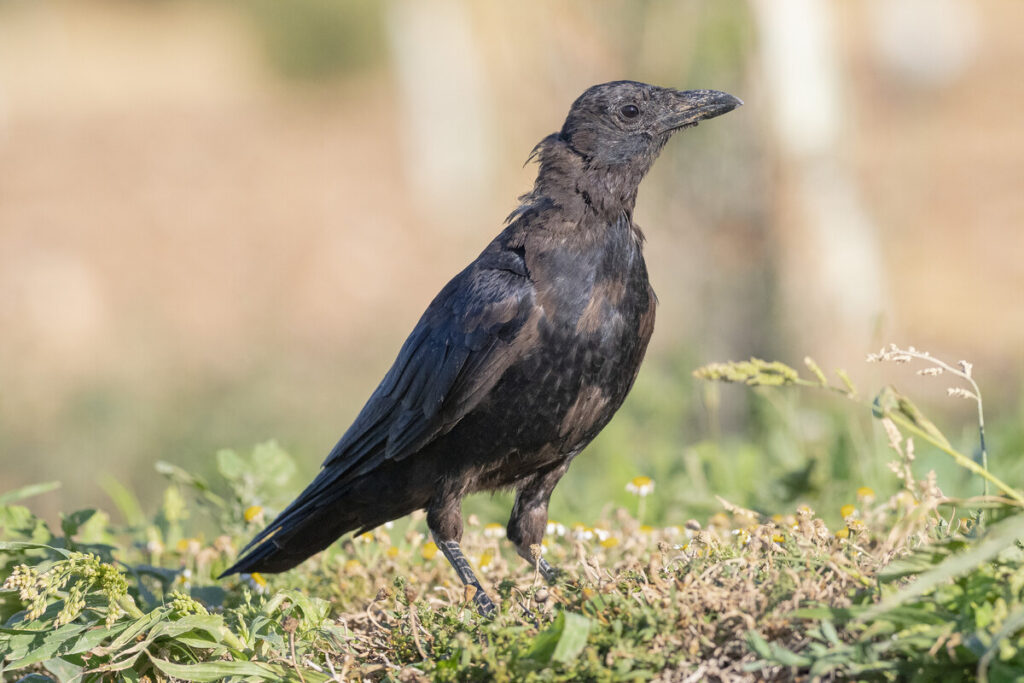
Crows can make a visual decision in about a quarter of a second, roughly twice as fast as humans and monkeys. In a new study, two carrion crows needed an average of just 235 milliseconds to work out which way a pattern of moving dots was drifting, and they still got it right.
The work comes from the University of Tübingen in Germany and appears in the journal Science. Researchers Philipp Schmidbauer and Professor Andreas Nieder, both of the university’s Institute of Neurobiology, wanted to see how a bird brain handles a quick choice.
A simple test with moving dots
The crows watched a touchscreen filled with moving dots. Their job was to decide whether most of the dots were traveling left or right, then peck a target on the matching side of the screen.
Some patterns were easy to read. Others were hard to make out. Even then, the birds did better than random guessing. “Even when the patterns of motion were hard to recognize, the crows’ decisions were still better than random choices,” Schmidbauer reports, “and with clear signals, they achieved an accuracy of nearly 100 percent.”
A decision begins in 70 milliseconds
To see what was happening inside the birds’ heads, the team recorded the activity of single brain cells while the crows worked. They focused on a region called the nidopallium caudolaterale. This area helps process information and make decisions, much like the prefrontal cortex in the human brain.
The signals showed up almost at once. Just 70 milliseconds after the dots appeared, neurons linked to the two possible answers already behaved differently. This happened well before the birds moved to peck.
As the crows weighed the dots, the activity kept building until it reached a threshold tied to making a choice. It reflected both how clear the motion was and which direction the bird finally picked.
Different brains, similar rules
Bird brains are built very differently from ours. Unlike mammals, birds do not have a cerebral cortex arranged in layers. Even so, the crows seemed to follow the same basic approach to weighing evidence that people and other primates use.
Nieder explains it this way: “These findings show that neuronal dynamics in the avian brain are consistent with established models of decision-making in humans and non-human primates.”
In this visual task, the crows finished the process twice as fast as primates.
Why speed may matter for a bird
The researchers suggest that the crows’ quickness could reflect how birds live. Animals that fly and use their beaks to handle objects need to read what they see and respond with precision. “Birds rely on their vision to carry out precise, rapid maneuvers during flight and to guide their beaks towards objects when foraging,” Nieder says.
What this means
The study shows that a very different kind of brain can reach the same kind of decision as ours, and do it faster in this test. It also leaves a puzzle. The exact biological reason for the crows’ speed advantage is still unknown, and further studies will be needed to explain how brains organized so differently can make comparable visual decisions so much faster than those of humans and monkeys.
Source: ScienceDaily