Bonnethead sharks have one of the oddest heads in the ocean, and males and females don’t wear quite the same shape. For years, scientists thought the boys grew their pointier look once they became adults. A new study from Florida suggests the story actually runs the other way: every young bonnethead starts out pointy, and the head rounds off with age.
Meet the bonnethead, the hammerhead’s little cousin
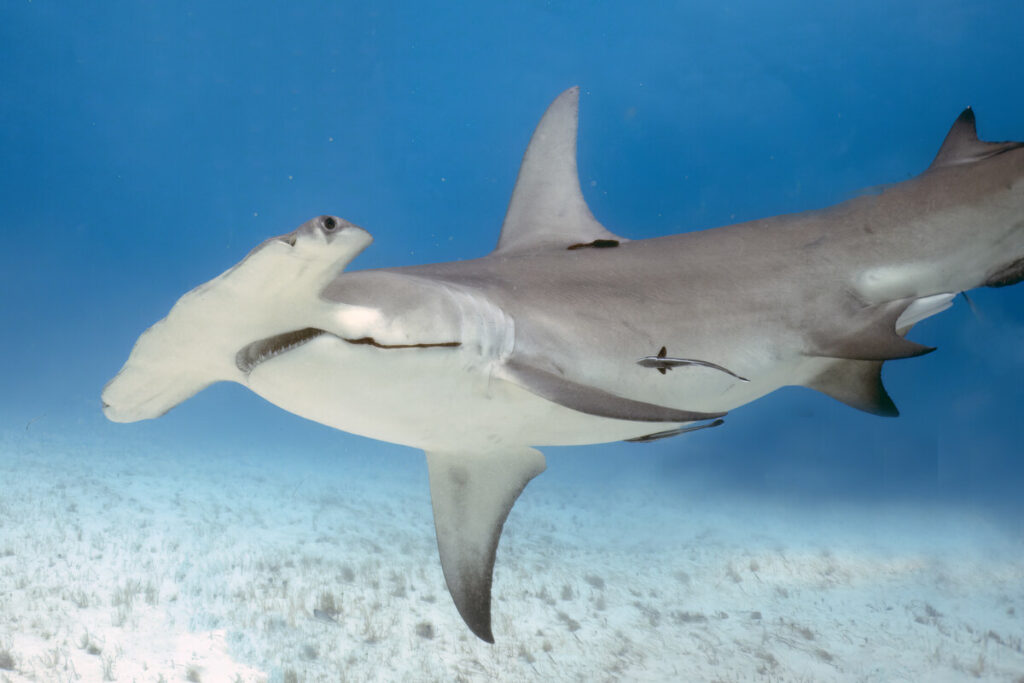
Bonnetheads are small sharks in the hammerhead family. Instead of a wide hammer, they have a flat, shovel-like head that curves in a gentle arc at the front.
What makes them special is that you can often tell a male from a female just by looking at that head. Males usually show a small point along the front edge, while females have a smoother, rounder curve. Scientists call this kind of difference between the sexes sexual dimorphism, and bonnetheads are the only shark species known to show it so clearly in the shape of the head.
The old idea did not hold up
Earlier work had pointed to a simple explanation: males sprout their pointier snout when they reach adulthood. The new research, led by Kathy Liu during her master’s degree at the University of Miami Rosenstiel School of Marine, Atmospheric, and Earth Science, found something different.
When the team compared sharks of different ages, they saw that young males and young females both had pointier heads. As the sharks got older, the head became more rounded in both sexes. The change was simply much bigger in females, which is why grown-up females end up looking so different from grown-up males.
“Our findings show that the pointed head shape is not a feature that develops in males when they reach maturity,” Liu said.
How the team measured 144 shark heads
From May 2022 to May 2023, the researchers studied 105 bonnetheads in Biscayne Bay, on Florida’s Atlantic side, and 39 more around Tampa Bay, on the Gulf side. Sampling both coasts let them check whether the same growth pattern showed up in two separate populations.
Each shark was caught, measured, and gently handled for a short time. The scientists took a tiny muscle sample, then photographed both sides of the head against a special grid board before letting the animal go. Back in the lab, software helped them measure exactly how curved each head was. This approach gave precise numbers while keeping each shark out of the water as briefly as possible.
Is it about what they eat?
A natural guess is that males and females grow different heads because they hunt in different ways or chase different food. To test that, the team looked at chemical markers in the muscle samples of 137 sharks. These markers, called carbon and nitrogen isotopes, act a bit like a long-term food diary. They show where in the food web an animal has been feeding over time, not just what it ate for its last meal.
The results showed that the Biscayne Bay and Tampa Bay sharks barely overlapped, so the two groups were feeding in different ecosystems. The diet of each shark also shifted as it grew. The researchers note, though, that this does not prove the two populations ate entirely different prey, because the same kind of prey can carry a different chemical signature depending on where it lives.
The key point is what happened inside each bay. Males and females living in the same bay relied on many of the same food sources. So diet does not seem to explain why their heads grow differently.
“Our results suggest there is another cause behind the differences in head shape between male and female bonnetheads,” said co-author Catherine Macdonald, an associate professor and director of the Shark Research and Conservation Program at the Rosenstiel School.
So what is the pointy head for?
That is now the open question. Scientists still don’t know what advantage a pointed head gives a bonnethead.
The researchers offer one possible idea. A pointier head might help young, small sharks swim more efficiently. As females grow bigger to carry and support their young, that benefit may matter less, and their heads round out more. It is only a hypothesis for now, and the team says future studies on how bonnetheads swim and how their heads form before birth will be needed to test it. That work could also show when the difference between males and females first appears.
Why it matters
This study is a nice reminder of how science works. A tidy explanation can sit around for years until someone measures more animals and finds it doesn’t fit.
The photo method used here is simple enough to repeat elsewhere. The researchers suggest using it on bonnetheads in other parts of their range. Comparing populations from different places could reveal local differences that are easy to miss, and that kind of knowledge can help managers design protection plans that fit each region.
The study was published in the journal Integrative Organismal Biology.
Source: ScienceDaily