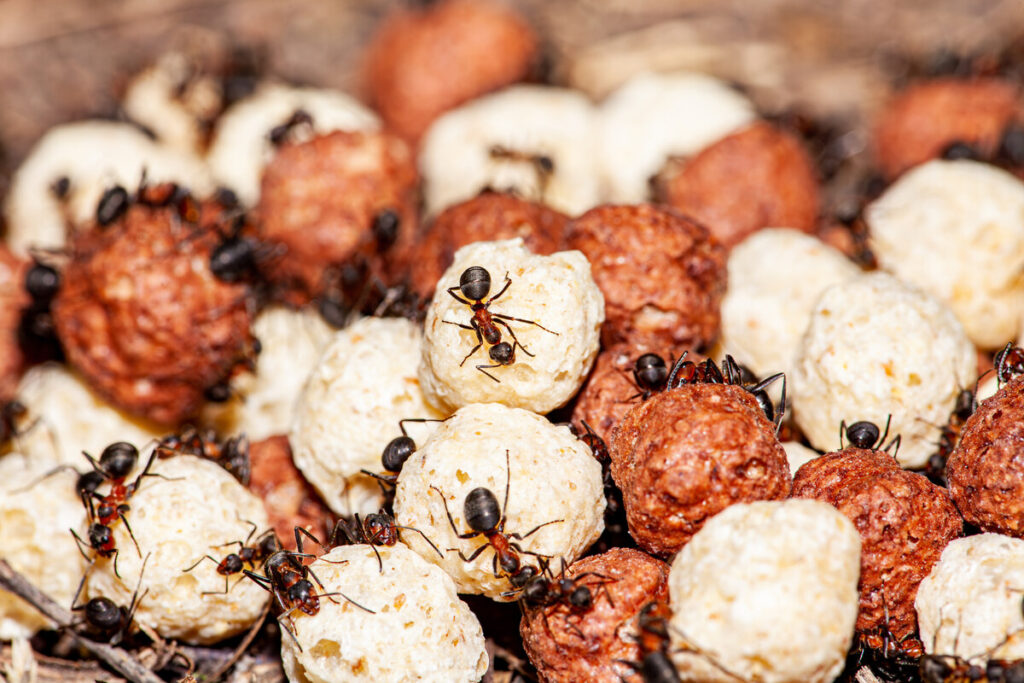
Parenting did not appear out of nowhere. A new study in Nature suggests that, in ants, the urge to care for young is built on brain signals that first helped animals decide when to eat.
For much of evolutionary history, many animals reproduced and then left their offspring to fend for themselves. How caregiving emerged from those uninvolved beginnings has long puzzled scientists. Researchers at Rockefeller University looked for an answer in clonal raider ants, and what they found points to a surprisingly thrifty evolutionary process.
Why ants make a useful test case
Parental care shows up in many forms. Mammals feed their young with milk, birds protect and maintain nests, and ants tend developing larvae. One leading idea is that evolution reused systems that already existed instead of inventing new ones. Earlier work in mammals hinted that certain neuropeptides, small molecules the brain uses to communicate, may have shifted from managing hunger to encouraging parental behavior.
Proving that link has been hard. Fruit flies and roundworms, two staples of neuroscience, do not look after their offspring. Mice do, but the mouse brain is complex, with roughly 100 million cells. An ant brain has about 60,000. That smaller size means scientists may be able to study the circuits behind caregiving in much more detail, and faster.
Two molecules, two opposite jobs
The team built an automated system that paired individual ants with individual larvae, so they could track hundreds of caregiving interactions. They also identified 70 neuropeptides in the ant brain and tested many of the synthesized molecules to see whether any changed how the ants behaved.
Two signals stood out, and they pushed behavior in opposite directions. Neuropeptide F (NPF) encouraged ants to care for larvae. Allatostatin A (AstA) made ants more likely to leave the larvae and start foraging.
Ant colonies divide labor by age. Younger ants usually stay in the nest and nurse the brood, while older ants tend to head out for food. The brain chemistry matched that pattern. Young ants had higher NPF and lower AstA in important parts of the brain, and older ants showed the reverse. When the researchers changed the activity of either molecule, the ants changed what they did. That suggests the molecules do more than travel alongside caregiving. They can help decide whether an ant nurses or forages.
Hunger and caregiving share a circuit
The same two molecules also responded to hunger, much like related signals do in mammals. Ants that had been deprived of food developed higher NPF and lower AstA, which made them behave more like caregivers. Once the ants were fed, the balance flipped, and they became less focused on larvae and more inclined to forage.
Daniel Kronauer, head of the Laboratory of Social Evolution and Behavior at Rockefeller, put the logic simply: “We learned that parental behaviors build on the neural circuitry for feeding, and that makes some sense. Parental behavior is a lot about feeding, not just yourself, but your offspring.”
What this means
The findings support the idea that parental care evolved by adapting brain systems that already handled finding and eating food. Rather than creating caregiving from scratch, evolution may have stretched feeding behavior so animals became motivated to nourish their young as well as themselves. “Our work is a prime example of how evolution seldom invents things from scratch,” Kronauer said. “Evolution takes what it has and works with that, sometimes in very surprising ways.”
Study co-author Tomas Kay said he is amazed that similar parenting behaviors have appeared so many times in so many animal lineages. “Our paper suggests that the evolutionary routes to these sorts of behaviors are far more constrained than we may have naively imagined,” he said.
Next steps
The team now wants to pinpoint the specific neural circuits that NPF and AstA act on, which could show how chemical signals turn into caregiving. Because mammals appear to use some of the same neuropeptides when raising young, comparing ants and mammals could reveal a shared biological strategy across distant branches of the animal kingdom.
The ants may also help with another question. Their predictable shift from nursing to foraging could help researchers study how a healthy brain changes with age. Kronauer noted that far more research goes into late-stage brain disease than into normal changes across a healthy lifespan, and said he suspects age-dependent shifts like these occur in other animals too.
Source: ScienceDaily