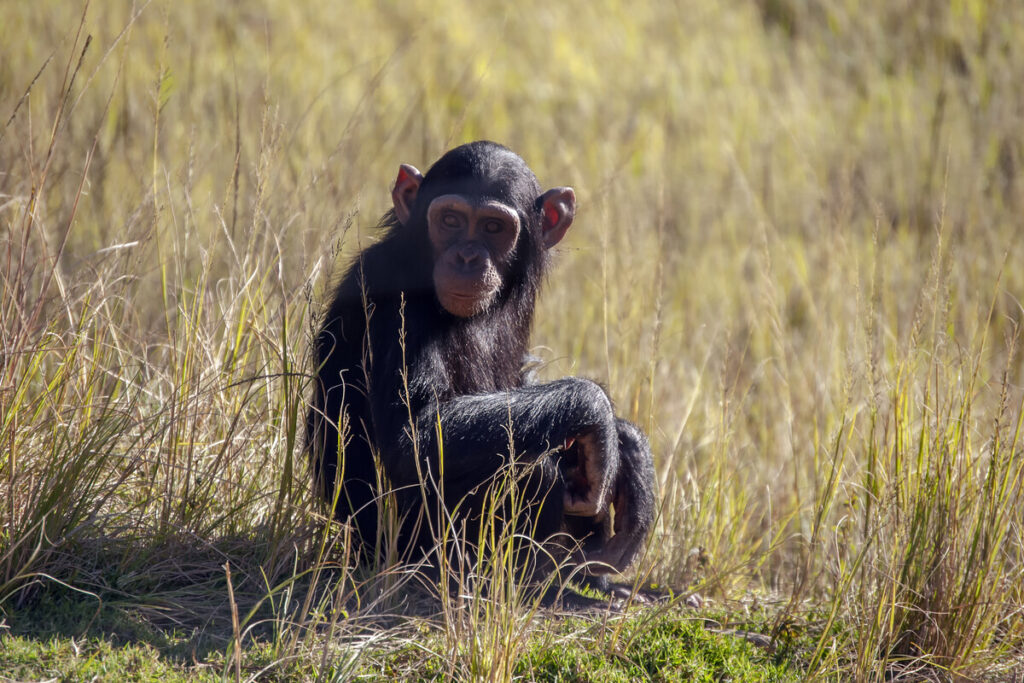
In a remote corner of Guinea-Bissau, wild chimpanzees walk up to certain trees and hurl rocks at them, again and again, while hooting at the top of their lungs. Researchers have now found that many of these throwing spots have stayed in use for more than ten years, and they are still trying to work out what the apes are saying.
A tree with scars and a pile of stones
Picture a walk through the savanna-woodland of Boé National Park. Every so often you might pass a tree whose trunk is covered in rough, knotted scars. Around its base sits a heap of rocks. No chimpanzee is in sight, but the clues are clear: this is one of their throwing sites.
Scientists call the habit accumulative stone throwing. Camera footage shows western chimpanzees, most often grown males, tossing rocks at one particular tree and then coming back to the same tree to do it again. Over time the stones pile up, which is where the name comes from.
It is a rare sight. So far, the behavior has been seen in only four chimpanzee groups, all in West Africa.
What it sounds like
This is not a quiet activity. While they throw, the chimps let out a pant hoot, a loud call that chimpanzees use to communicate over long distances. Some of them also slap their hands and feet against the tree’s wide, flared roots, a drumming display known as buttress drumming.
Both the pant hoot and the drumming are already part of the classic show that male chimpanzees put on. That is why researchers think stone throwing could be a twist on this familiar display, with rocks added to the mix.
Why scientists think it may be culture
Having rocks and trees nearby is not enough to create a throwing site. Plenty of places have both, and the chimps there never do it. Combined with how few groups show the habit, this points to something learned and passed along within a community, in other words a possible piece of chimpanzee culture.
Earlier studies suggested the throwing is a way of communicating. It might even carry a symbolic meaning, with the sites acting like markers for important places inside a group’s territory. Still, nobody knows yet what the sites mean to the chimps or why they bother.
What makes the habit stand out is the setting. Some primates use stones as tools to get food, for example to crack open nuts. Here, the stones seem to serve a social purpose instead, a rare case of stone tool use outside of feeding.
Listening in without being seen
Researchers Robyn Nakano and Ammie Kalan described their latest field trip in a piece written for The Conversation. Their team stayed in Béli, a small village where a Dutch nonprofit called Chimbo runs a base with local people, then cycled and hiked 22 kilometers into the bush to set up camp.
The Boé chimpanzees are not used to people and run off if humans approach on foot. So the team relied on hidden equipment. They placed two video cameras at each throwing site and spread audio recorders around the area to catch the sounds nearby.
Daily rounds meant swapping memory cards and batteries, checking the gear, measuring the trees and making 3D scans of the thrown rocks. Along the way they also noted chimp nests, signs of feeding, calls and sightings.
Sites that last for years
One finding is already clear. Most of the sites first spotted by the Pan African Program, and checked again by the team in 2017, were still being used during the latest visit. Chimpanzees can keep returning to the same throwing tree for over a decade.
The new video and sound recordings should help answer the bigger questions: which chimps throw, whether they are young or old, male or female, and who is watching when they do. Knowing the audience could reveal the message being sent.
Because chimpanzees are our close relatives, the researchers hope the behavior may also offer hints about how complex communication and stone tool use first appeared in human evolution.
Why it matters
Chimpanzee habitat in Guinea-Bissau faces pressure from industry, especially mining. During their trip, the team came across bore holes left by exploration for bauxite, the ore used to make aluminum.
The researchers acknowledge that mining could bring economic growth to the country. They also warn it can destroy habitat and cause pollution that harms chimpanzees, other wildlife and local people, as has already happened in neighboring Guinea. They call for stronger environmental oversight.
In their view, the stone piles are more than a curiosity. They are lasting traces of chimpanzee culture, and losing them would erase a part of primate heritage. By drawing attention to behaviors like this one, the team hopes to support efforts to protect chimpanzees and the wider web of life around them.
Source: ScienceDaily