The sandy beaches of Ecuador may be turning into a refuge for the world’s largest sea turtle. Researchers counted an unprecedented number of eastern Pacific leatherback nests there in the 2025-2026 season, far from the turtles’ traditional nesting grounds.
A nesting surprise more than 1,000 miles from home
Eastern Pacific leatherbacks have long nested in Mexico and Costa Rica. The new nests were found on several Ecuadorian beaches, more than 1,000 miles away from those traditional sites.
That is a big change. “Historically, observing female Eastern Pacific leatherbacks on Ecuador’s beaches was a rare or unusual event, but our findings suggest they are adapting their reproductive cycle to thrive and survive in coastal Ecuador,” says Juan José Alava, an adjunct professor at Simon Fraser University’s School of Resource and Environmental Management and a lead co-author of the study.
Could cooler water be the draw?
The team went through more than 45 years of records from Ecuador’s coast. They included sightings of mature females, nesting attempts, nest counts, hatching success and turtle strandings. The researchers then compared everything with El Niño and La Niña events, which bring warmer and cooler sea surface temperatures.
Over the past decade, leatherback activity and nesting in Ecuador have increased during La Niña events, when waters in the southeastern tropical Pacific cool down. The study, published in the journal Chelonian Conservation and Biology, suggests the turtles may be responding to rising ocean temperatures by seeking cooler coastal environments.
The new beaches seem to work well. The number of eggs per nest and the share that hatched were similar to those at established nesting sites farther north. According to Alava, some Ecuadorian nests even produced more hatchlings than usual.
A turtle built for warm and cold water
Eastern Pacific leatherbacks are unusual among sea turtles because they can thrive in both warm and cold environments. Every year they travel thousands of miles between tropical nesting beaches and feeding areas in subpolar Pacific waters, where jellyfish are an abundant summer food. Leatherbacks have even been recorded off Canada’s west coast, with more than 150 documented records in British Columbia between 1931 and 2024.
Bella’s story
On a moonlit January night in 2026, a female the researchers named Bella came ashore at Ecuador’s Playa de Crucita. Artificial light from nearby streetlamps confused her as she searched for a place to lay eggs. She crossed a rocky breakwater and ended up on a sidewalk. With no suitable spot, she went back to the sea without nesting.
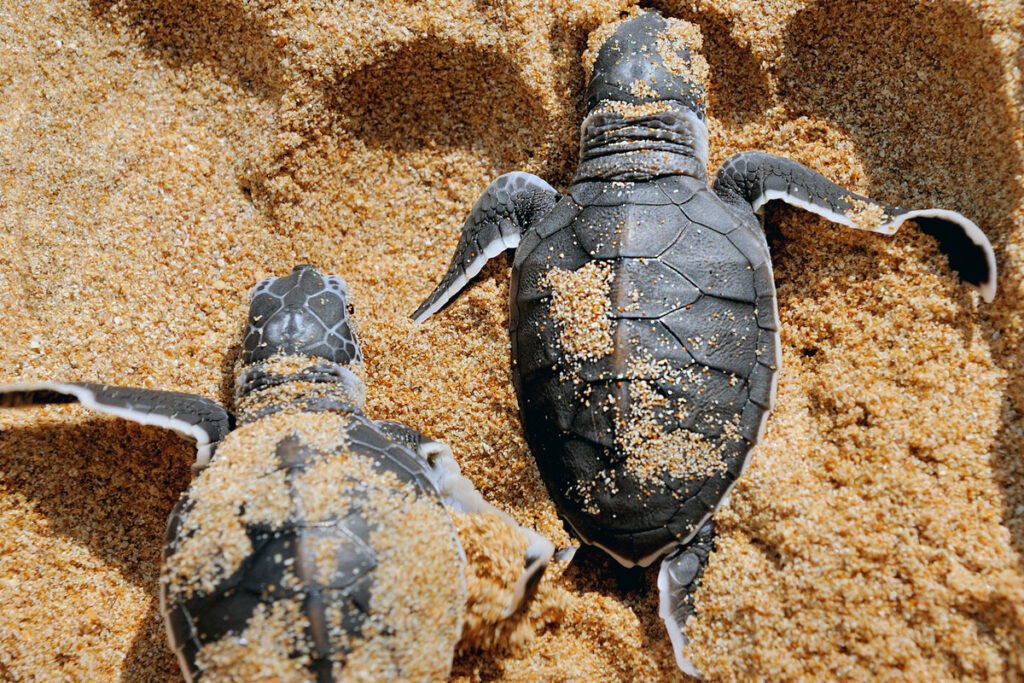
Two nights later she tried again on a quieter stretch of beach. This time she dug a nest, laid 47 eggs, covered them with sand and returned to the water. Several weeks later, 44 hatchlings crawled toward the ocean.
The researchers had fitted Bella with a tracking tag, which showed that she nested four to five times during 2026 alone. One nest stayed where it was, and the others were moved to the San Jacinto hatchery. In the end, 134 of her 146 eggs produced hatchlings, a hatching success rate of 91.8%.
Why it matters
The good news comes with a warning. Since the 1980s, the eastern Pacific leatherback population has fallen by more than 90%. Warm El Niño episodes, made stronger by human-caused climate change, have played a part. The turtles also face accidental capture in fishing gear, plastic pollution, collisions with vessels, egg harvesting and the loss of nesting habitat.
“It signals new hope for a subspecies of leatherback on track for extinction in the eastern Pacific within 60 years,” Alava says. Protecting these animals will take continued monitoring, coordinated conservation, ways to reduce accidental catch in fisheries and careful management of Ecuador’s coast. He adds that “management and conservation efforts should be championed in close consultation and participation with local and traditional ecological knowledge through coastal, community-grounded interventions.”
Source: ScienceDaily