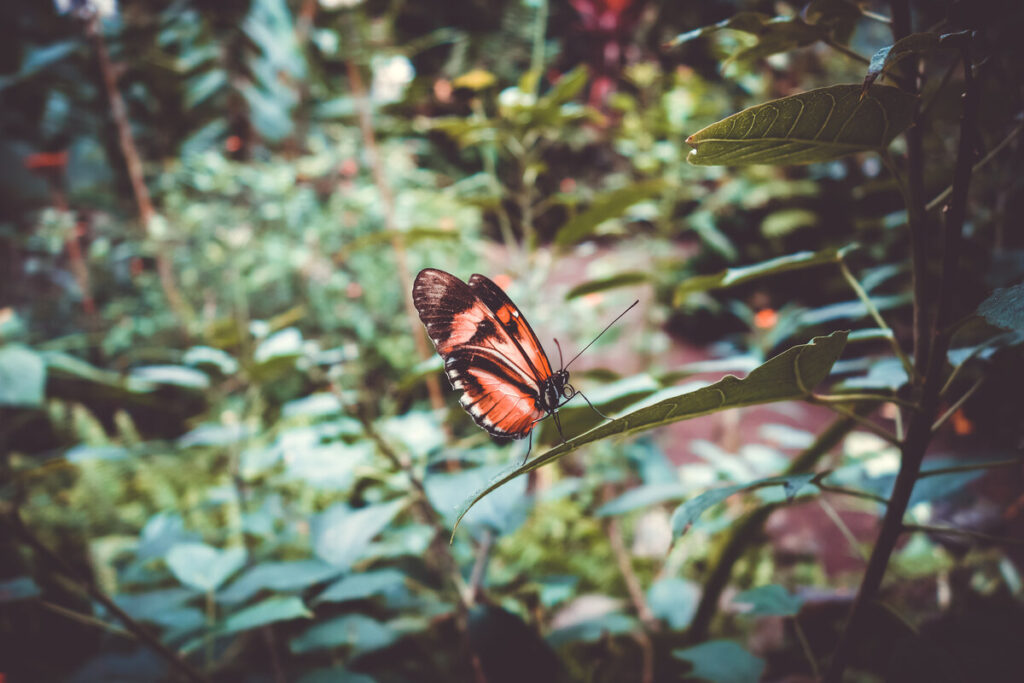
A butterfly seen across Central and South America has been hiding a secret for more than two centuries. Scientists long thought the genus Colobura held a single widespread species, but a third one looks almost identical to its relatives and lives in the same places.
The newly described species, Colobura cryptica, was reported in the journal Zootaxa by a team led by Anisha Sapkota, a doctoral student at the Florida Museum of Natural History. The researchers combined DNA analysis with tiny differences in wing pattern and in the ultraviolet light the wings reflect.
A common butterfly with a hidden identity
Colobura butterflies are among the first insects many visitors notice in the tropics of the Americas. “If you go to the neotropics, Colobura is one of the first butterflies you see,” Sapkota said. Their caterpillars feed on the leaves of Cecropia trees, and the butterflies range from parts of the Andes and the Brazilian Amazon to the Atlantic Rainforest and the Caribbean.
After Carl Linnaeus described Colobura dirce in 1758, scientists treated the whole genus as one species for more than 200 years. That began to change in 2001, when a second species was formally recognized. Now there are three.
A caterpillar clue and a long-running argument
Adult Colobura are very hard to tell apart. The main difference is a gray stripe on the underside of the front wings, which can be a little wider or narrower and may or may not touch a yellow band.
The caterpillars give better hints. They have velvety black bodies and yellow spines with sharp barbs, plus small cream-colored markings underneath that may look like teardrops or rings. In 1852, Dutch entomologist Jan Sepp suggested that the different markings meant two separate species. Other researchers disagreed, and that view held for about 150 years.
In 2001, Keith Willmott and colleagues revisited Sepp’s idea and described a second species, Colobura annulata. “We assumed that was the problem solved,” said Willmott, now a curator at the Florida Museum’s McGuire Center for Lepidoptera and Biodiversity. He later had hints of a third species, “but I thought it was too implausible.”
About 25 years later, his colleague Andrés Orellana found hungry caterpillars stripping a young Cecropia tree in Venezuela. They had no cream-colored markings at all, and Orellana sent photos to Willmott.
An invisible clue in the wings
Sapkota studied DNA barcodes from a long-running butterfly and moth survey in Costa Rica, then sequenced older museum specimens from across tropical Central and South America. She also spent hours looking for physical differences in preserved butterflies.
Eventually she noticed a faint violet shimmer on the underside of some wings. “I checked it with a spectrometer and found that even though the butterflies didn’t look violet to me, it reflected UV light,” she said. All three species reflect ultraviolet light, but at different wavelengths. One subspecies of C. dirce reflects at 362.2 nm and another at 390.6 nm, for example.
The DNA, the caterpillar markings and the ultraviolet readings agreed. Colobura contains three species, not two.
Three species, one forest
The three ranges overlap. C. dirce is the most widespread, from Mexico to southeastern Brazil. C. annulata also covers a large area but is absent from the Greater Antilles. C. cryptica has the smallest known range, from southern Mexico to the foothills of the Andes.
Yet the DNA shows no sign of hybridization among them. That raises a puzzle, because new species often form when populations are separated, for example by a mountain range. Here, the researchers suspect the butterflies may use the forest in different ways. “There could be vertical stratification between these butterflies,” Sapkota said, with C. dirce usually in the undergrowth and the other two in the canopy. She added that “we do not know for sure” because earlier studies gave mixed signals.
How do look-alikes find the right mate?
Many moths and some butterflies use scent to recognize their own kind, which suggests sight may matter here. Because the three species look nearly the same to us, the ultraviolet differences could be a signal. Many butterflies can see ultraviolet light, and similar wing signals are known or suspected in garden whites, sulfur butterflies and wood tiger moths. Sapkota is testing whether Colobura use them, but there is no clear answer yet.
What this means
The discovery shows how much can remain unknown about a widespread, easy-to-spot animal. Open questions include how the butterflies choose mates, whether they really live at different heights, and what first drove them apart. For Sapkota, answers will need fieldwork: “Someone has to go [to] the field to find it out themselves.”
Source: ScienceDaily