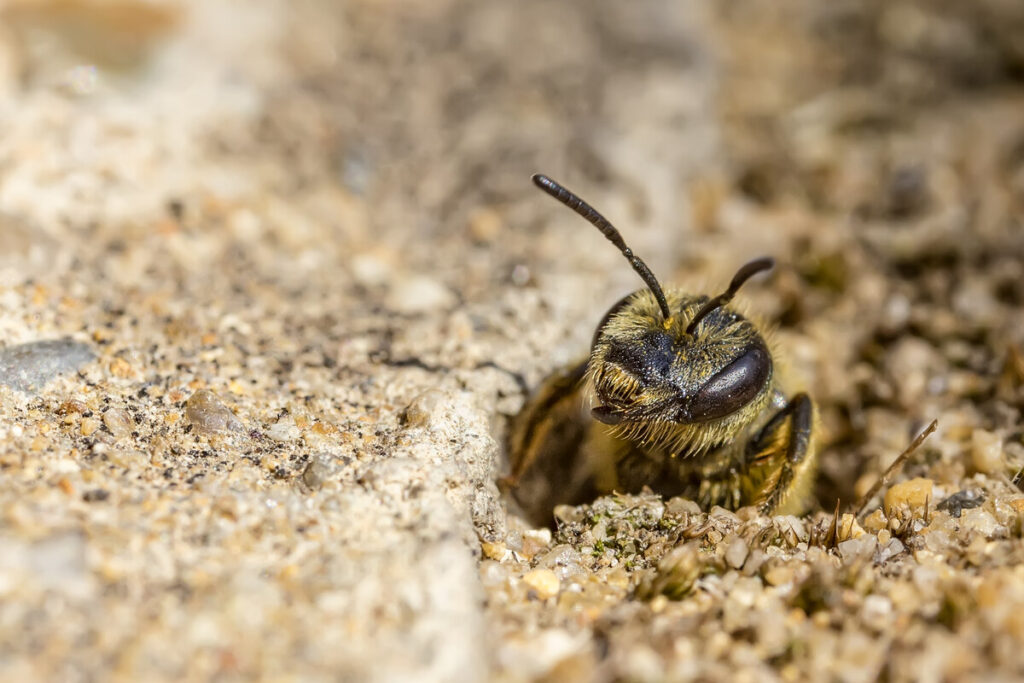
Walking to work in the spring of 2022, a Cornell lab worker noticed bees everywhere in an Ithaca, New York cemetery. A new study says the grounds hold about 5.5 million wild bees nesting underground, one of the largest and oldest bee aggregations ever documented.
A jar of bees and a surprise
Rachel Fordyce parked at Ithaca’s East Hill Plaza to save money and cut through East Lawn Cemetery on foot to reach her job in a Cornell University entomology lab. One spring day she saw bees all over the ground. She scooped a few into a jar and showed them to her supervisor, entomology professor Bryan Danforth. “These are all over the cemetery,” she told him.
The insects turned out to be Andrena regularis, the regular mining bee. It is a solitary wild bee that digs nests in the soil and pollinates both crops and wild plants.
How many bees is 5.5 million?
The researchers estimate that roughly 5.5 million bees live in an area of about 1.5 acres. They say that is comparable to more than 200 honeybee hives, and more than three times the human population of Manhattan.
Lead author Steve Hoge, who worked on the project as an undergraduate in Danforth’s lab, said: “I’m sure there are other large bee aggregations that exist around the world that we just haven’t identified, but in terms of what is in the literature, this is one of the largest.” The study appeared in the journal Apidologie.
Counting bees without counting bees
No one can tally millions of insects by hand, so the team used emergence traps. These are small mesh tents, each covering less than a square meter of ground, that funnel insects rising out of the soil into glass jars. “You capture a whole community of animals coming out of the ground with this approach,” Danforth said.
Between March 30 and May 16, 2023, the team set up 10 traps around the cemetery. They collected 3,251 insects from 16 species of bees, beetles and flies, and the regular mining bee dominated the catch. By scaling up the numbers from each trap across about 6,000 square meters of ground, they estimated a population between 3 million and 8 million, with an average of 5.5 million.
Males first, females later
The traps also showed a pattern in timing. Male bees emerged first during warm spells in April, and females followed several days later. “The males come out first and wait for the females, so that they have the best opportunities to mate and pass on their genes,” Hoge said.
Females dig underground nests and stock chambers with pollen and nectar before laying eggs. The larvae develop below the surface and emerge as adults. Hoge noted that this species spends the winter as an adult, which is fairly unusual, and that helps explain why the bees appear so early in spring, “timed to the apple bloom.” In New York they usually emerge in April, once daytime temperatures regularly reach around 70 degrees.
The study also recorded a freeloader. Nomad bees, sometimes called cuckoo bees (Nomada imbricata), wait until a mining bee has prepared a brood cell, then lay their own eggs inside. When the nomad larvae hatch, they kill the host larvae and eat the pollen and nectar meant for them.
Why a cemetery?
Historical records show the bee has been at East Lawn Cemetery since at least the early 1900s, and the cemetery itself dates to 1878. Researchers say cemeteries make good habitat because the land is quiet, rarely disturbed and largely free of pesticides. Sandy soil, which the bees prefer, is plentiful there, and Cornell Orchards, about a third of a mile away, may supply spring flowers.
Superintendent Keven Morse has watched deer, geese, hawks, foxes, coyotes and countless bees during his family’s 46 years helping manage the nonprofit cemetery. He said: “I just felt bad having to mow in certain areas.” By his account, three or four sections are where the bees gather most heavily.
What this means
Honeybees get most of the attention, but about 75% of bee species are solitary ground nesters like this one. “It’s the most common lifestyle for bees,” Danforth said. When Hoge began his research he found very little published on the species, and one of the most detailed references dated back to 1978.
The team argues that such bees matter for crops such as apples, one of New York’s signature commodities, and that nest sites need to be recognized and protected. “These populations are huge, and they need protection,” Danforth said. “If we don’t preserve nest sites, and someone paves over them, we could lose in an instant 5.5 million bees that are important pollinators.” Danforth and colleagues have launched a global citizen science effort asking people to report ground-nesting bee aggregations they find.
Source: ScienceDaily