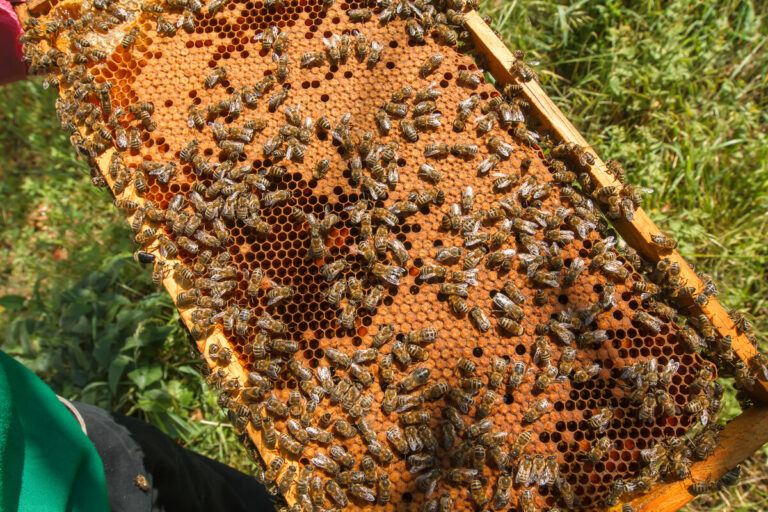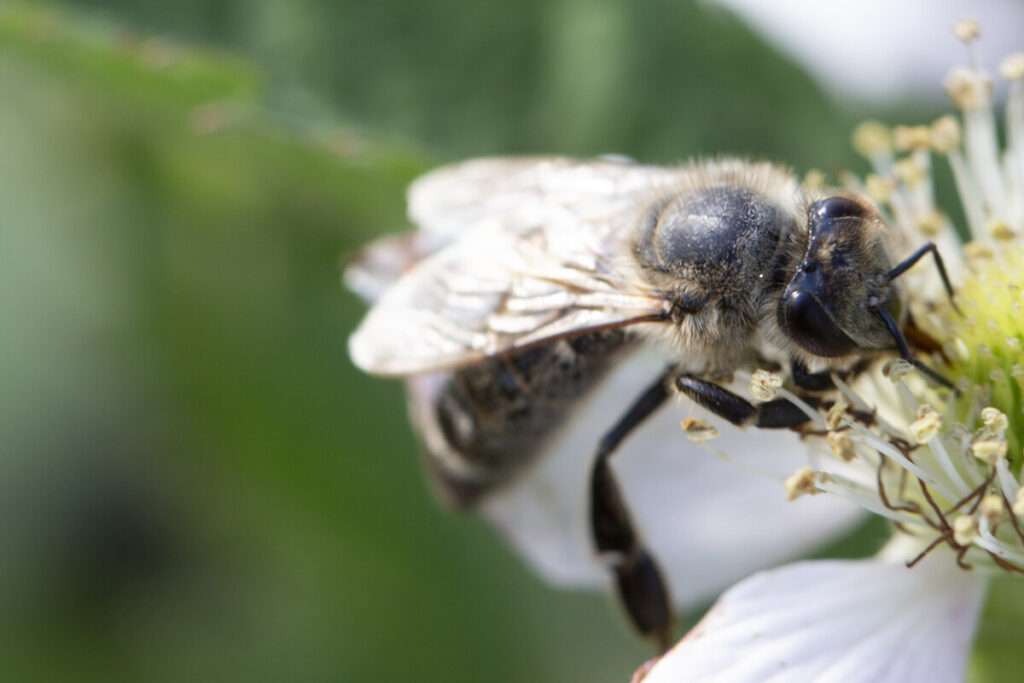
Honey bees are not just quick to reach flowers, they often fight for them. A two-year study in England found that honey bees regularly chase, shove and crowd other pollinators away from food, and that only one small wild bee seems able to stand up to them.
A two-year watch on busy flowers
Researchers at Anglia Ruskin University (ARU) spent two years watching insects at five sites in and around Cambridge, England. Every site sat within 300 meters (roughly 330 yards) of an established honey bee colony, so the bees always had a hive nearby.
The team focused on two common plants: bramble, the thorny shrub that gives us blackberries, and ivy. Both are rich sources of nectar and pollen, and both draw crowds of insects when they bloom. That makes them a natural arena for competition.
To keep things simple, the scientists sorted every visitor into one of five groups: honey bees, bumble bees, solitary bees, hoverflies, and an “other” group that included butterflies, beetles and wasps. The findings were published in the journal Ecological Entomology.
Keeping score with wins, losses and shares
Over 93 hours of observation, the researchers logged every moment when one insect interrupted another one’s meal or blocked it from a flower. Each encounter got a score, a bit like a sports match.
- A win meant one insect got the flower and pushed the other out.
- A loss was the other side of that coin: the insect that missed out on food.
- A share meant both insects fed on the flower peacefully.
The pattern was easy to read. Where honey bees were more common, there were fewer other pollinators and more squabbles over flowers. Honey bees also came out on top in a bigger share of their contests than the other insects did.
Honey bees start most of the fights
Being first in line was only part of the story. Honey bees often started the confrontations themselves, driving rivals off so they could feed.
The numbers add up. On bramble, every time the number of honey bees doubled, bumblebee numbers dropped by about 14%. On ivy, more honey bees went hand in hand with fewer solitary bees and hoverflies.
Many insects simply stepped aside. Other pollinators steered clear of honey bees in 28% of encounters on bramble and 36% on ivy. And in at least one in five of the contests honey bees won, on either plant, they physically pushed or chased the other insect away.
Lead author Victoria Buckle, a PhD student at ARU, summed up the results this way: “We found that most interactions when competing for food were instigated by honey bees and they had a greater number of ‘wins’, resulting in a loss of forage for other pollinators.”
The ivy bee fights back
Other insects rarely picked a fight. There was one clear exception: the ivy bee, a solitary bee that is not native to Britain and was first recorded in the country in 2001.
It was the only pollinator seen actively taking on honey bees. Ivy bees sometimes guarded their feeding spots by chasing off or bumping out the bigger bees, and they managed to win access to flowers.
“It is the first time, to our knowledge, such behaviors have been observed and shows ivy bees are able to ‘hold their own’ in such encounters,” Buckle said.
Why warmer weather could tip the balance
The study arrives as beekeeping keeps growing in the UK. The number of registered beekeepers rose from 19,000 in 2010 to 47,000 last year, which means more managed honey bee colonies sharing the same flowers.
Heat may add to the pressure. The researchers noticed that clashes happened more often on warmer days. One possible reason is that plants under “heat stress” can make less nectar, leaving more insects to compete for a smaller supply.
Temperature also affects each insect differently. Bumblebees and hoverflies are sensitive to high heat and may feed better when it is cool. Honey bees tend to get busier as it warms up. Earlier research found that a rise of 12°C (about 22°F) led to ten times as many honey bees leaving their nests.
Put together, these differences suggest that a warming climate could hand honey bees an even bigger edge over some wild pollinators.
What this means for bees and beekeepers
The research team is clear that this is not a case against keeping bees. The goal, Buckle explained, is to understand how competition plays out so that wild pollinators, which matter a great deal to nature, can be better protected.
“It’s important to find ways to ensure honey bees and wild pollinators can continue to coexist, particularly in locations with a high density of hives, such as urban areas,” she said.
The work is part of a wider effort to understand how pollinators compete and how to soften the effects of that competition. For now, the message is simple: a flower patch near a busy hive can be a crowded and surprisingly rough place for a wild bee.
Source: ScienceDaily