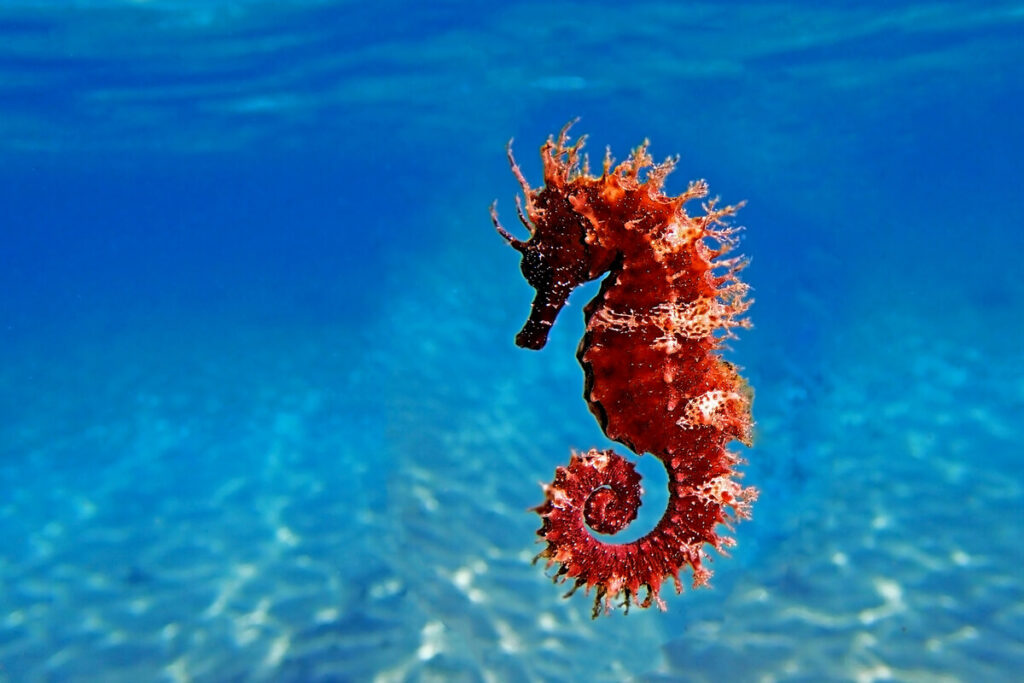
A tiny fish from the deep reefs off southern Australia looks almost exactly like a seahorse, right down to its curled tail and the brood pouch the males carry. But scans of its skeleton and a look at its genes show it is something else entirely, and nobody has ever seen one of these fish alive.
A seahorse that is not a seahorse
Picture a seahorse: a horse-shaped head bent down from the body, a tail that curls and grabs, and in the males, a closed pouch where the young develop. The helmethead sea muppet has all of that. It is also no longer than your thumb.
Its scientific name is Australyichthys aegis, and it was described in a new study in the Journal of Lost Species. The common name comes from the rounded, helmet-shaped crest on top of its head. The scientific name plays on the same idea, since the aegis was a protective shield in Greek mythology.
The helmethead has two close relatives, the bullneck sea muppet (A. minotaur) and the paradoxical sea muppet (A. paradoxus). Together, the three make up a small group the researchers nickname the sea muppets. All three had been filed as seahorses for decades, simply because they look like seahorses.
Found only by accident
Don’t expect to meet a sea muppet on a dive. Every known specimen was pulled up by chance, in fishing trawls or dredges scraping the seafloor somewhere between about 50 and 125 meters deep (roughly 165 to 410 feet).
The only helmethead ever collected came up in 2006 near the Gambier Islands, where South Australia’s Spencer Gulf meets the open sea. That dredge was actually looking for brachiopods, small animals with shells. Because the trip was focused on invertebrates, the fish ended up in the invertebrate collection of the South Australian Museum, where it went unnoticed for years.
The other specimens sit in Australian museum collections, including the Australian Museum, Museums Victoria and CSIRO. In total, the whole group is known from only seven preserved fish, collected over about 65 years along more than 2,500 kilometers (about 1,550 miles) of coastline. None has been caught in nearly 20 years.
What the X-rays revealed
With so few specimens, cutting them open was out of the question. Instead, the team used micro-CT scanning, a type of X-ray imaging similar to hospital scans but sharp enough to show very small bones. That allowed them to build 3D models of each skeleton and compare them, bone by bone, with true seahorses.
Until then, every judgment about these fish had been based on how they look from the outside. The skeletons told a different story. True seahorses have a stiff cage of fused bony plates that supports the belly, plus a bony crown on the head called a coronet. The sea muppets have neither. Their bellies are held up by a different arrangement of bones, one not found in any seahorse.
Then came a lucky break. The helmethead specimen had been preserved in ethanol instead of formalin, the only one of the group stored that way, and ethanol keeps genetic material intact. Its DNA placed the fish well outside the seahorses, on the neighboring branch of the family tree. As the researchers put it, “The genes said what the bones had already said.”
So the three species needed a new genus. The name Australyichthys combines the Latin word for southern with the Greek word for fish.
Why nature keeps building seahorses
When unrelated groups end up looking alike, biologists call it convergent evolution. It usually happens because the animals live in similar ways, not because they share a close ancestor.
In this case, the full seahorse body plan, with its bent head, gripping tail and brood pouch, has appeared at least twice inside one fish family, the Syngnathidae. That family also includes pipefishes, pipehorses and seadragons. Figuring out how the same design arose more than once could help explain why evolution keeps landing on the same answer.
A hidden corner of the ocean
All of this played out on the Great Southern Reef, a linked system of kelp forests and rocky reefs that wraps around southern Australia. Many of its species live nowhere else, and its deeper parts have barely been explored. The researchers point out that an entire genus of animals with backbones stayed hidden there, wrongly labeled, until a CT scanner sorted it out.
Because no one has ever seen a sea muppet alive, the fish now count as “lost species,” animals known only from a few preserved bodies. That label does not mean they are gone. “Calling them lost is not a prediction of extinction,” wrote Graham Short and David Harasti, the scientists behind the work. Instead, it flags them as a priority for surveys that go out searching on purpose, rather than waiting for another lucky catch.
In their words, the fish are “most likely still down there, in a part of the sea we hardly ever visit.”
Source: ScienceDaily