A small Australian jumping spider seems to sleep in two different stages, and one of them looks a lot like the REM sleep people have. During that stage, the spiders move their eyes and twitch their muscles. Whether they actually dream is still a mystery.
The finding comes from scientists at the University of Bonn in Germany, who watched the spiders closely for several days and nights. Their work, published in the Proceedings of the National Academy of Sciences, is described as the first thorough experimental proof that spiders truly sleep, rather than just sitting still for a while.
Meet a spider that hunts other spiders
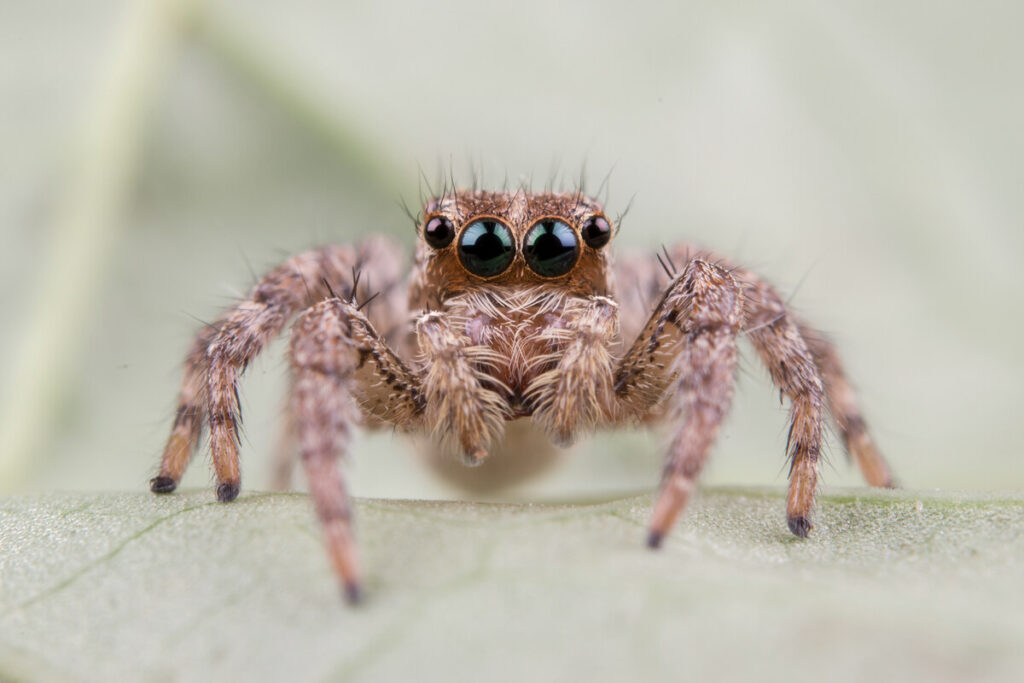
The star of the study is Portia fimbriata, a jumping spider from Australia. A full-grown adult is only about as big as a one-euro coin, but it is a surprisingly clever hunter.
Most spiders go after insects. Spiders in the Portia group prefer to eat other spiders, and they use tricks to do it. One of their favorites is a fake signal: Portia copies the vibrations of an insect struggling in a web. The owner of the web rushes over expecting an easy meal and finds a predator waiting instead.
Behavior that tricky hints at strong learning skills. That made this spider a good choice for scientists who want to know how sleep, the nervous system and thinking are connected.
Two kinds of sleep, one of them REM-like
Sleep has been studied for a long time in people and other animals with backbones. Much less is known about sleep in creatures whose nervous systems are built very differently, like spiders.
The Bonn team found that Portia fimbriata has two sleep stages that are easy to tell apart. One resembles REM sleep. REM stands for “rapid eye movement,” and in humans it is the stage linked to moving eyes, twitching muscles and vivid dreams.
During this REM-like stage, the sleeping spiders showed their own eye movements and muscle twitches. That suggests some features of sleep once studied mostly in vertebrates may also show up in spiders. In a photo released with the study, a resting spider hangs upside down beneath a web it spun itself.
The researchers are careful on one point: spotting REM-like movements does not tell us whether spiders dream. What it does show is that their sleep is more complex than scientists expected.
How a sound test told sleep from rest
Proving that a spider is asleep is much harder than checking on a napping person. A spider sitting still could simply be resting.
To find out, the team placed each spider alone in a plastic dish 12 centimeters (about 4.7 inches) across. They watched the animals under different lighting to track their daily cycles of activity and rest. Infrared cameras let them keep filming through the night without turning on visible light, recording sleeping positions, quiet rest and bursts of REM-like movement.
Then came the sound tests. The scientists played sounds and measured how fast the spiders reacted. A sleeping animal usually takes longer to respond than one that is only resting, so the reaction times helped separate real sleep from simple stillness. Because spiders sense the world in a different way than we do, the team first had to find a sound that would trigger a steady, reliable response.
The researchers also kept some spiders from sleeping to look for “sleep rebound.” That is what happens when an animal makes up for lost sleep by sleeping more afterward, much like a person who catches up on rest after a short night. Taken together, the filming and the tests gave strong evidence that this spider has regulated sleep with distinct stages.
What the study could not measure
There was one big limit. The team could not record the spiders’ brain activity. Everything they learned came from behavior, which meant gathering huge amounts of high-resolution video over many days and nights and analyzing it carefully.
They also avoided assuming that the spiders’ eye movements and twitches work the same way as human REM sleep. The resemblance is clear, but the processes behind it may not be the same.
Why it matters
Most of what we know about sleep comes from mammals and birds. Finding similar sleep features in an animal with a very different nervous system could help scientists work out when different kinds of sleep first appeared, and why.
The researchers say future studies should look beyond the usual lab animals and include species with unusual traits or much simpler nervous systems. Those comparisons could reveal whether certain sleep patterns are shared across the animal kingdom or evolved separately in different groups. Even after decades of research, many basic questions about sleep, including human sleep, remain open.
So, do spiders dream?
Nobody knows yet. The Bonn team is now comparing REM-like sleep across different spider species and checking whether spiders sleep differently in the wild than in the lab.
They also want to learn what happens inside the brains of spiders and insects while they sleep, and whether the different stages help with learning. Another goal is to see how climate change and human activity, especially artificial light at night, may disturb the sleep of spiders and their relatives.
For now, one thing is clear: even a tiny jumping spider can have a surprisingly rich night of sleep.
Source: ScienceDaily