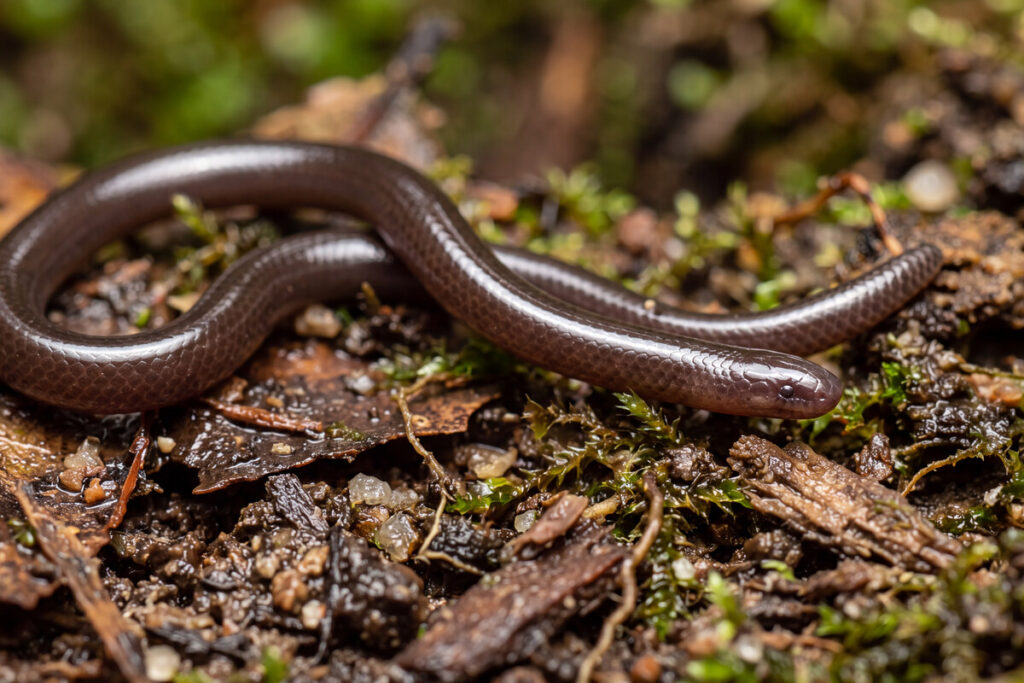
A small group of snakes from Southeast Asia has a getaway trick that sounds made up: instead of slithering away from danger, they roll. New research shows that dwarf reedsnakes can roll across the ground about four times faster than they can slither, and they do it while keeping their heads almost perfectly steady.
Meet the snakes that roll
Dwarf reedsnakes belong to the genus Pseudorabdion, a group of small snakes found in Southeast Asia. A genus is the level of classification just above a species, so it can include several closely related kinds of snakes.
Very few animals are known to roll on purpose to get away from a predator, which makes these snakes stand out. Their rolling habit was not a total secret. It had been mentioned in field guides and spotted once during field work. But until now, nobody had worked out exactly how the snakes pulled it off.
A research team including Yosuke Kojima, Ibuki Fukuyama, Mohamad Yazid Hossman, Clement Het Kaliang and Kanto Nishikawa set out to answer that question. Their study was published in the journal Current Biology, and the work was shared by Toho University.
Why rolling is hard for an animal
Rolling looks like a smart way to move fast. Wheels do it all day. But a wheel has an axle, a fixed rod it turns around, so whatever sits on top of it can stay level while the wheel spins.
Animals have nothing like that. If a whole animal spins, its head spins too, and so do its eyes and other senses. That makes it tough to keep balance, change position or steer where it wants to go. The faster an animal rolls, the harder those problems get.
So the real puzzle was not whether these snakes could roll, but how they could roll quickly and still stay in control.
Fast, and surprisingly accurate
To find out, the scientists filmed dwarf reedsnakes from several camera angles at once. That let them track how each part of the body moved during a roll.
The speeds were impressive. While rolling, the snakes hit top forward speeds between 1.72 and 3.69 meters per second, or roughly 3.8 to 8.3 miles per hour. That is about four times faster than their best speed when using lateral undulation, the side-to-side wiggle that most snakes rely on to get around.
Speed alone could just mean wild tumbling, though. The researchers also set up a narrow racetrack only 20 centimeters wide, about 8 inches. The snakes managed to follow it while rolling, which shows the movement is controlled, not a random flop across the ground.
The secret move: a sideways stroke
The videos showed that the snakes do not simply spin their whole body like a log. Their rolling is built from a repeating pattern.
First, the snake rolls along on one side of its body. Then it swings a curved section of its body down next to its head. The scientists named this downward sweep a “stroke.”
With each new cycle, two things flip. The side of the body touching the ground switches, and the stroke changes direction, going from left to right or from right to left. By repeating this carefully timed sequence over and over, the snakes turn a series of moves into one smooth, continuous roll.
A head that stays put
The most surprising finding was what the head does during all this. While the back part of the body twists and rotates a lot, the head keeps facing forward, in the direction the snake is traveling. It does not spin along with the rest of the body.
The snakes also hold their heads at a fairly constant height above the ground. This was easiest to see at higher speeds, when the snakes tended to keep their heads raised and cut down on bobbing up and down.
A steady head may help the snakes stay in control and find their way during a fast escape. And they manage it without any built-in joint or axle separating the spinning part of the body from the steady part.
What this means
In a sense, these snakes split their bodies into jobs. Most of the body does the heavy work of rotating to push the snake forward, while the head stays stable so the snake can steer.
That mix of speed, direction control and fast rotation would be hard to guess just by looking at a dwarf reedsnake’s body. The study points to a bigger idea in animal evolution: an animal’s shape does not set the full limit of how it can move. Clever behavior and precise muscle control can open up moves that a body plan alone might suggest are impossible.
For a tiny snake trying not to become someone’s dinner, that turns out to be a very useful skill.
Source: ScienceDaily