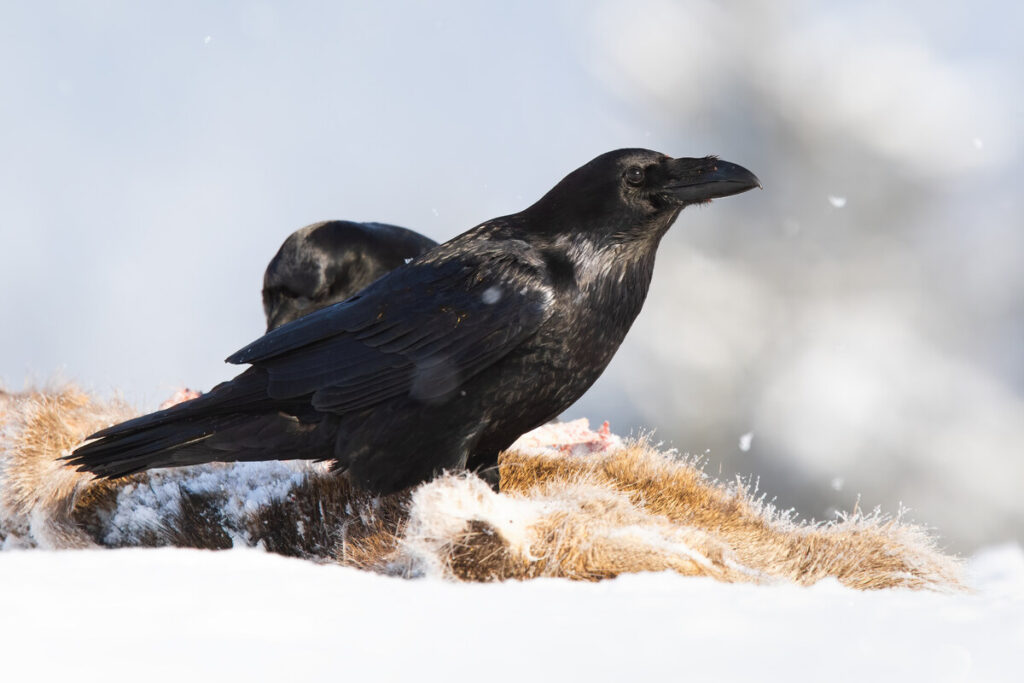
Ravens often beat everyone else to a wolf kill in Yellowstone National Park, and for years people assumed the birds simply trailed the wolves around. A new study that tracked both animals for two and a half years found something smarter: ravens remember where kills tend to happen and fly straight there.
A long-standing guess about ravens and wolves
Anyone who has watched a wolf pack bring down an elk knows the scene. Before the wolves have even started eating, ravens are already waiting close by, ready to grab whatever scraps they can. The birds show up so fast that it looked like they must be following the pack.
Dr. Dan Stahler, a Yellowstone biologist who has worked with the park’s wolves since they came back, says the link between the two animals is easy to see. “You see them flying directly above traveling packs or hopping close behind wolves as they take down prey,” he explains.
The idea made sense, because wolves create a steady supply of food for scavengers. Still, no one had ever checked it. “We didn’t know what ravens were capable of because nobody had ever put them at the center; nobody had taken the scavenger’s point of view,” Stahler says.
How scientists tracked 69 clever birds
Wolves returned to Yellowstone in the mid-1990s after being gone for about 70 years. Today, roughly a quarter of the park’s wolves wear tracking collars each year, which gave researchers a head start.
The ravens were the tricky part. The team fitted 69 of them with small GPS trackers, a large number for this kind of study, but catching the birds took some cunning. “Ravens are so observant of the landscape that they don’t step into traps easily,” says Dr. Matthias Loretto, the study’s first author. Near campsites, the researchers hid their traps among trash and fast food so the setup looked ordinary. Otherwise, Loretto says, the ravens would sense that something was off and stay away.
The scientists also studied the movements of 20 collared wolves. They focused on winter, the season when ravens and wolves cross paths most often. Raven positions were logged every 30 minutes and wolf positions every hour, and the team noted where and when the wolves killed prey, mostly elk, bison and deer.
The birds were not following anyone
Here is the surprise. In two and a half years of data, the team found only one clear case of a raven following a wolf for more than a kilometer or more than an hour.
“At first, we were puzzled,” Loretto says. If the birds weren’t tagging along, how were they arriving at kills so quickly?
The answer was in the travel patterns. Ravens kept going back to particular parts of the park where wolves made kills more often. Some flew as far as 155 kilometers (about 96 miles) in one day, heading in straight lines toward places where a carcass was likely to turn up. “They can fly six hours non-stop, straight to a kill site,” Loretto says.
A mental map of the best spots
Wolf kills are not spread evenly across Yellowstone. They tend to bunch up in certain places, such as flat valley bottoms where hunting goes better for the pack. The tracked ravens visited these busy areas far more often than spots where kills were rare.
The researchers think the birds build up a long-term picture of where food is likely to be, which they call a “resource landscape.” No raven can know when the next kill will happen, but it can learn which areas pay off most often over time.
“We already knew that ravens can remember stable food sources, like landfills,” Loretto says. “What surprised us is that they also seem to learn in which areas wolf kills are more common.”
Listening for the howl
None of this means ravens ignore wolves completely. Up close, the birds may still trail a pack for short distances. Once they are in the right neighborhood, Loretto says, they likely rely on nearby clues, such as watching how the wolves behave or listening to wolf howling, to pinpoint the kill.
So the search seems to work in two steps. Memory tells a raven which part of the park to head for, sometimes tens or even hundreds of kilometers away. Then its eyes and ears take over for the final approach.
Why it matters
The study, published in the journal Science, suggests scavengers can be much more flexible than scientists gave them credit for. Ravens are not tied to one wolf pack. They choose between many possible meals spread across a huge area.
Senior author Prof. John M. Marzluff of the University of Washington puts it plainly. “This changes how we think about how scavengers find food, and suggests we may have underestimated some species for a long time,” he says.
The project was led by the University of Veterinary Medicine Vienna and the Max Planck Institute of Animal Behavior in Germany, working with partners that included the University of Washington and Yellowstone National Park.
Source: ScienceDaily