Planting trees on farmland sounds like an easy win for wildlife. A new study from rice country in central Japan shows it is not that simple: rows of windbreak trees helped some birds, but grassland birds were more than 70 percent less abundant right next to them.
Trees that block the wind
Across many farming regions, growers plant long, narrow lines of trees along their fields. These rows are called shelterbelts, and their main job is to break the force of the wind before it reaches the crops.
Conservation programs often encourage farmers to add shelterbelts and hedgerows, because extra trees and shrubs are usually seen as good for biodiversity. Most of the evidence behind that idea, though, comes from dry cropland and grassland in Europe and North America.
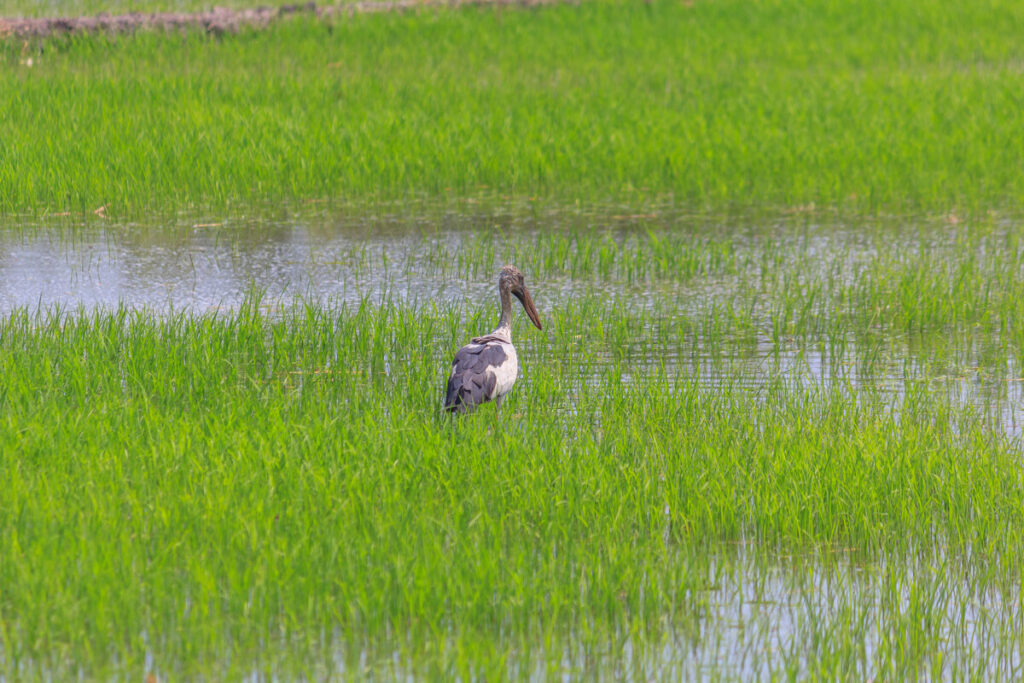
Much less is known about wet farmland, such as the rice paddies that cover large parts of Asia. Those flooded fields matter a lot to birds. Natural wetlands are shrinking around the world, and many species now use rice paddies as stand-in wetlands, including migrants traveling along major flyways.
A busy stopover for migrating birds
The research team, led by Masumi Hisano, an assistant professor at Hiroshima University’s Graduate School of Advanced Science and Engineering, worked in the farmland around Lake Kahokugata, on the west coast of central Japan. The area is a patchwork of rice paddies, lotus fields, crop fields and pasture.
Strong winds and storms hit the region every winter, so shelterbelts are a familiar sight there. At the same time, the lake is an important resting and feeding stop on the East Asian-Australasian Flyway. Some birds spend the winter there, others arrive to breed in summer, and close to 300 bird species have been recorded in the area.
The scientists wanted to know whether these tree rows help every kind of farmland bird, or whether they quietly push out the birds that need wide, open space. Hisano summed up the question this way: “Do shelterbelts and other woody linear features benefit all farmland birds equally in agricultural wetland landscapes, or do they create trade-offs by disadvantaging species that depend on open habitats?”
Winners and losers along the tree line
To find out, the team counted birds at survey points in February and March 2021, then again in June 2023. This point count method let them compare how many birds, and how many different kinds, turned up near shelterbelts and in open fields.
The answer was a clear trade-off. Birds that like shrubs and the edges of habitats did well near the tree rows. Birds of open grassland and wetland did not. Next to shelterbelts, grassland birds were far less common, and the variety of wetland species dropped sharply.
“We found that the abundance of grassland birds was more than 70 percent lower at sites next to shelterbelts compared with open sites located about one kilometer away,” Hisano said. That is a distance of a little over half a mile.
In other words, even a fairly narrow line of trees can change which birds are able to live in a landscape. Hisano offered a simple picture to explain it: “A useful way to think about this is that shelterbelts act like ecological walls.”
Why a row of trees can feel like a wall
Many grassland and wetland birds nest and feed in big, open spaces. According to the researchers, shelterbelts shrink the amount of open ground those birds can actually use. The trees may also bring the birds into closer contact with predators.
The study does not say trees are bad. Instead, the team argues that what matters is where trees go and how they fit into the wider landscape. A shelterbelt can be a home for one group of birds and a barrier for another.
“Our study provides clear, quantitative evidence that small-scale landscape features can have large ecological consequences, directly relevant to land-use planning and environmental management,” Hisano said.
What this means for farm conservation
The researchers point out that many farm conservation programs promote tree planting without looking closely at how it might reshape a whole community of birds. Their results suggest that a one-size-fits-all approach could backfire in wet farmland, especially where wetlands have already been heavily changed by people.
“Biodiversity-friendly farmland management must balance structural complexity with the ecological needs of open-habitat species,” Hisano said.
The goal, the team says, is not to plant trees everywhere, but to plan farm landscapes that mix open habitat with wooded features. Done well, rice paddies could keep producing food while still serving as vital habitat for a wide range of birds.
What scientists still want to learn
This study looked at one region, so there are plenty of open questions. The researchers want to test how the details of a shelterbelt, such as its width, height, spacing, layout and the kinds of trees in it, affect wildlife in different places and seasons.
They also hope to learn more about indirect effects, including how tree rows might change predator activity and how well birds can move between patches of habitat. The findings were published in the Journal of Environmental Management.
Source: ScienceDaily