Nobody saw a giant squid, and nobody caught one. Yet scientists now know the famous deep-sea animal lives in two underwater canyons off Western Australia, thanks to tiny traces of its DNA drifting in the water.
The find comes from a study led by Curtin University that explored the Cape Range and Cloates submarine canyons, off the Nyinggulu (Ningaloo) coast, about 1,200 km (roughly 750 miles) north of Perth. Giant squid were only part of the story. The same water samples pointed to 226 species, and some of them may be new to science.
Finding animals by the DNA they leave behind
Ocean animals constantly leave tiny traces of their genetic material in the water around them. Scientists call this environmental DNA, or eDNA. Collect some seawater, read the DNA inside, and you get a list of who has been living nearby.
That is the method the team relied on. Working aboard the research vessel R/V Falkor, run by the Schmidt Ocean Institute, on an expedition led by the Western Australian Museum, they gathered more than 1,000 samples. Some came from the surface, others from more than 4 km down, with the deepest at 4,510 meters (close to 14,800 feet).
The big advantage is that nobody has to film or net anything. Lead author Dr. Georgia Nester, who did the work during her PhD at Curtin University and now works at the Minderoo OceanOmics Centre at The University of Western Australia, says eDNA is especially handy for animals that are fragile, fast or good at hiding, the kind that slip past nets and underwater cameras.
“With eDNA, a single water sample can tell us about hundreds of species at once,” she said.
The giant squid shows up
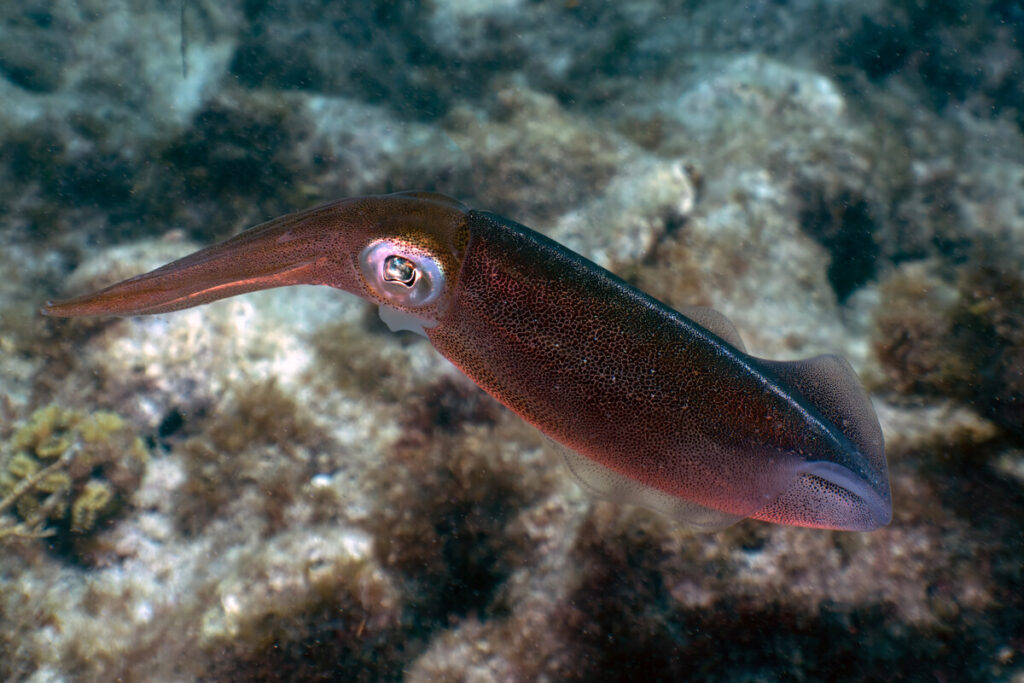
DNA from the giant squid, Architeuthis dux, turned up in six different samples, and in both canyons. That is a big deal, because these animals are almost never documented in the region. According to Dr. Lisa Kirkendale, Head of Aquatic Zoology and Curator of Molluscs at the WA Museum, Western Australia had only two earlier giant squid records, and no confirmed sighting or specimen in more than 25 years.
“This is the first record of a giant squid detected off Western Australia’s coast using eDNA protocols and the northernmost record of A. dux in the eastern Indian Ocean,” Dr. Kirkendale said.
The giant squid is a true record holder. It can stretch 10 to 13 meters (about 33 to 43 feet), longer than a school bus, and weigh 150 to 275 kilograms (roughly 330 to 600 pounds). Its eyes are the biggest of any animal on Earth, up to 30 centimeters (about 12 inches) across, about as wide as a big pizza.
Whales, sharks and a faceless fish
The squid had plenty of company. The DNA revealed two whales known for diving very deep, the pygmy sperm whale and Cuvier’s beaked whale. In total, the 226 species belonged to 11 major groups of animals, from squid and marine mammals to cnidarians (the group that includes jellyfish and corals), echinoderms (sea stars and their relatives) and some very odd deep-sea fish.
Dozens of these species had never been recorded in Western Australian waters before. Among them were a sleeper shark (Somniosus sp.), the faceless cusk eel and the slender snaggletooth.
Some of the DNA did not match anything on record at all. Dr. Nester is careful about what that means.
“We found a large number of species that don’t neatly match anything currently recorded, which doesn’t automatically mean they’re new to science, but it strongly suggests there is a vast amount of deep-sea biodiversity we’re only just beginning to uncover,” she said.
Real specimens make the DNA readable
A DNA trace only helps if scientists have something to compare it with. So the team also collected actual animals using a remotely operated vehicle named SuBastian. Taxonomists, the experts who identify and name species, worked out what each one was, and their genetic material became a local reference library for reading the eDNA results. The specimens now live permanently in the WA Museum’s Collection and Research Facility.
Every canyon has its own neighborhood
The results also showed that ocean life changes a lot as you go deeper. Even the two canyons, which sit next to each other, were home to different communities of animals.
Until this expedition, these places had barely been explored, simply because working so far down is so difficult. “These canyons are incredibly rich ecosystems,” Dr. Nester said.
Why it matters
Senior author Associate Professor Zoe Richards, from Curtin’s School of Molecular and Life Sciences, points out that the deep sea is enormous, remote and costly to study, while climate change, fishing and resource extraction are putting more and more pressure on it. eDNA, she says, is a way to learn what lives there on a large scale without disturbing the animals.
“You can’t protect what you don’t know exists,” Associate Professor Richards said.
For the researchers, the next step is practical. Combining eDNA with classic deep-sea surveys could give a much fuller picture of which species live where, and at what depth. That kind of knowledge may help with planning marine parks, keeping an eye on the environment and protecting deep-sea wildlife over time.
The study was published in the journal Environmental DNA.
Source: ScienceDaily