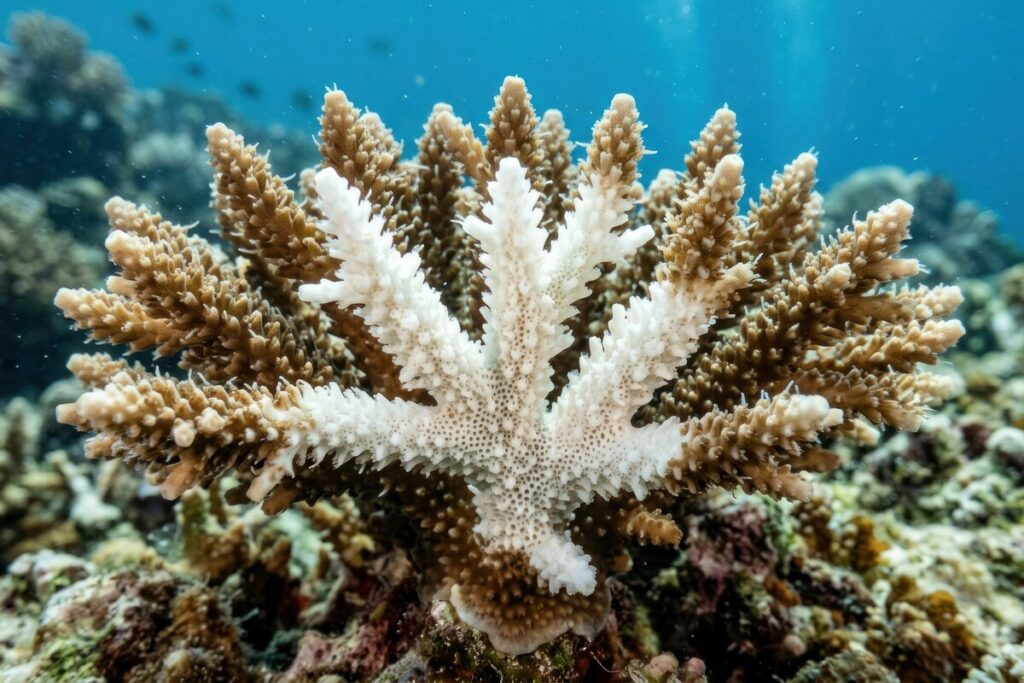
Bleached corals that look close to dying can bounce back in about seven weeks, researchers at Stanford report. All it took was a few days of contact with a healthy, genetically identical neighbor.
Coral reefs are under pressure from marine heat waves, and some estimates suggest they could disappear within decades. A study published on October 14 in Science Advances describes the fastest recovery from bleaching documented so far, and it started with a lucky accident in a lab tank.
What bleaching does to a coral
Bleaching happens when warming seas push corals to lose the helpful algae that live inside their tissues. Those algae supply much of the energy a coral needs, so without them the animal turns white and goes hungry. A weakened coral is also easier prey for harmful algae. Even survivors can take months or years to recover.
Corals may look like rocks or plants, but they are animals. In most species, a single animal makes genetically identical copies of itself, and these clones grow together into the big colonies that build reefs.
A happy accident in the lab
The idea began in 2025, when marine scientist Steve Palumbi noticed something odd in his laboratory at Stanford. Two pieces of the same coral colony, one healthy and one bleached, had fallen against each other in an aquarium. Where they touched, the bleached piece started to regain its color.
Around the same time, oceans PhD student Danny Collins was studying how coral diseases spread. Harmful bacteria can enter corals through physical contact, including contact with plastic debris. “We were curious about what would happen if we used contact to reintroduce something good – the beneficial algae from healthy corals,” Collins said.
Touch versus a small gap
Collins set up 10 pairs of coral fragments. Each pair had one healthy piece and one bleached piece from the same coral animal. Five pairs were placed so the fragments touched. The other five were kept apart by a gap of just a few millimeters.
Every bleached fragment that touched its healthy partner fully recovered within seven weeks. The ones kept apart died.
How the rescue works
The trick depends on how clones recognize each other. “Genetically identical corals recognize one another when they come into contact,” said Palumbi. “Their tissues fuse if they are from the same clone.” He compared it to organ transplants, which often work well when the donor is an identical twin.
Under a microscope, the team saw tiny channels in the two tissues line up and connect. Through these links, algae and the nutrients they make moved from the healthy coral into the bleached one. Algae were already crossing over within three days.
The researchers then tested how long the corals had to stay linked. One week was enough, and in some cases five days did the job. Pairs that were separated early still returned to full health in seven weeks, just like pairs that stayed together.
That suggests the healthy coral is not a steady supplier. Once enough algae get in, they multiply inside their new host and refill its energy supply. “They flood in and start dividing at the fastest rates seen in corals,” Palumbi said. In the second week of contact, the algae in the bleached fragments doubled roughly every four days, about ten times faster than researchers have seen in wild corals.
What this means for reefs
Scientists have tried many ways to protect reefs, including breeding heat-tolerant corals, raising young corals in nurseries, and moving communities of microbes between corals. This result adds another idea: helping bleached corals recover fast enough to survive the dangerous weeks after a heat wave.
Marine scientist Fiorenza Micheli, a faculty advisor of Collins, said bleached corals are often treated as a lost cause because natural recovery is so slow. “We hope this new research will inspire solutions that keep corals healthy long enough to enable full recovery after heat waves through slower processes such as growth, reproduction, and recruitment of new colonies.” she said.
The team is clear that this exact method cannot restore whole reefs. Every bleached coral would need a healthy, genetically identical partner, and finding and supplying those matches across a reef is not realistic. Over the coming months, the researchers plan to look for ways to deliver the beneficial algae without keeping corals physically connected. One possibility is to collect algae from healthy corals before a heat wave and give large amounts to damaged corals afterward.
Source: ScienceDaily