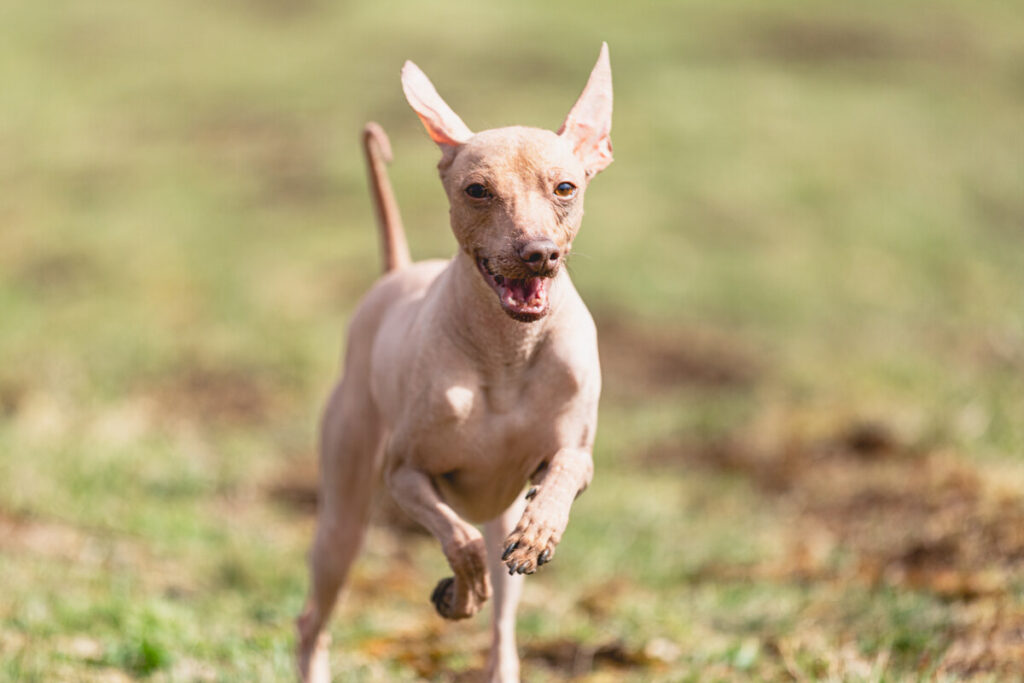
More than 1,200 years ago, on the dry coast of northern Peru, people lived alongside a very special kind of dog: slim, pointy-eared and almost bare. Archaeologists have now found the first physical remains of these Peruvian hairless dogs at Castillo de Huarmey, an ancient Wari site, including a male dog that the desert turned into a natural mummy.
The site was a burial and government center of the Wari Empire, about 190 miles north of Lima. People used the site between 600 and 1050 CE, roughly four centuries before the Inca took power. The new study, led by Weronika Tomczyk of Dartmouth’s Department of Anthropology, was published in the Journal of Anthropological Archaeology.
A breed people still love today
Peruvian hairless dogs are easy to spot. They have lean bodies, pointy ears and little or no fur. Ancient potters on the Andean coast often shaped them in clay. Peru added them to its official cultural heritage in 2000, and the American Kennel Club recognizes a version of the breed under the name Peruvian Inca Orchid.
Until now, though, nobody had found the actual bodies of these dogs at Castillo de Huarmey, a site already famous for an untouched elite tomb opened in 2012 and the graves of skilled craftspeople found in 2022.
A desert that keeps almost everything
Castillo de Huarmey sits in one of the driest corners of Peru’s Pacific coast. With almost no moisture, hair, skin, leather and cloth can survive for centuries.
That is exactly what happened here. In the northern part of the main ceremonial area, the team found three sets of dog remains that stood out. One was a skull that had dried naturally with its bare skin and ears still in place. It had also been painted with cinnabar, a bright red pigment often used in ancient Peruvian burials. Nearby lay a second, bigger skull and the almost complete mummified skeleton of a male dog, resting in a shallow pit.
The work was tricky. A strong earthquake in 1970 brought part of the complex down, and looters dug through large areas afterward, mixing up the upper layers where most animal bones were found. At first, the researchers even wondered if the mummified male had been buried only about 50 years ago.
The clue hiding in the teeth
Two details changed their minds. The dog was hairless, and all three dogs were missing their first premolars, the small teeth just behind the canines.
Those teeth had simply never grown in. Tomczyk then found that, in dogs, the same gene that removes the fur also reduces the number of teeth. Missing teeth plus a bare body pointed clearly to Peruvian hairless dogs.
“What I noticed is that some of the dog skeletons were missing teeth, and not that they lost them during their lifespan,” Tomczyk said.
Radiocarbon dating then showed that the mummified male was at least 1,200 years old, the oldest radiocarbon-dated find from Castillo de Huarmey so far.
Puppies that ate like children
Bones and teeth keep chemical traces of what an animal ate and drank. The team measured forms of carbon, nitrogen, oxygen and strontium in the dog remains and compared them with those of humans and llama-like animals from the same site.
Because dog teeth form very quickly, a tooth reflects puppyhood, while bone reflects roughly the last year of life.
Most of the dogs had eaten at least some corn, a staple food across the ancient Andes, so their meals overlapped with what people ate. The hairless dogs showed a special pattern. As puppies, their diet looked a lot like that of human children. As adults, their food became more varied.
That raises the possibility that some puppies were raised with extra care, perhaps as part of organized breeding. The researchers stay careful here. “We do not know if the dogs were intentionally fed maize or if perhaps, they were just eating leftovers or trash,” Tomczyk said.
Pets, pests or something else
In total, the digs produced 341 dog bone pieces from at least 19 dogs, plus the complete mummified male. Some were found in very telling places. The bones of a puppy only 6 to 8 weeks old lay beside a skilled craftsperson nicknamed the “Master Basketmaker.” An adult dog was buried inside the palace, and part of another puppy rested with a man who was probably sacrificed to guard a tomb.
Not every dog got the same treatment. Some seem to have been buried on purpose, while others ended up among thrown-away materials. Very few bones showed cut marks, which suggests dogs were rarely eaten.
“While we will never know if any of the three dogs were pets or how people treated them, it is evident they received different treatment than other dogs,” Tomczyk said.
Why it matters for dog lovers
The study cannot say whether these hairless dogs were cuddled companions, working animals or something else entirely. What it does show is that this breed has deep roots, and that it already held a special place in a community more than a thousand years ago.
One find says it with charm: a clay vessel shaped like a seated hairless dog with almost human features, holding what looks like a musical instrument.
Source: ScienceDaily