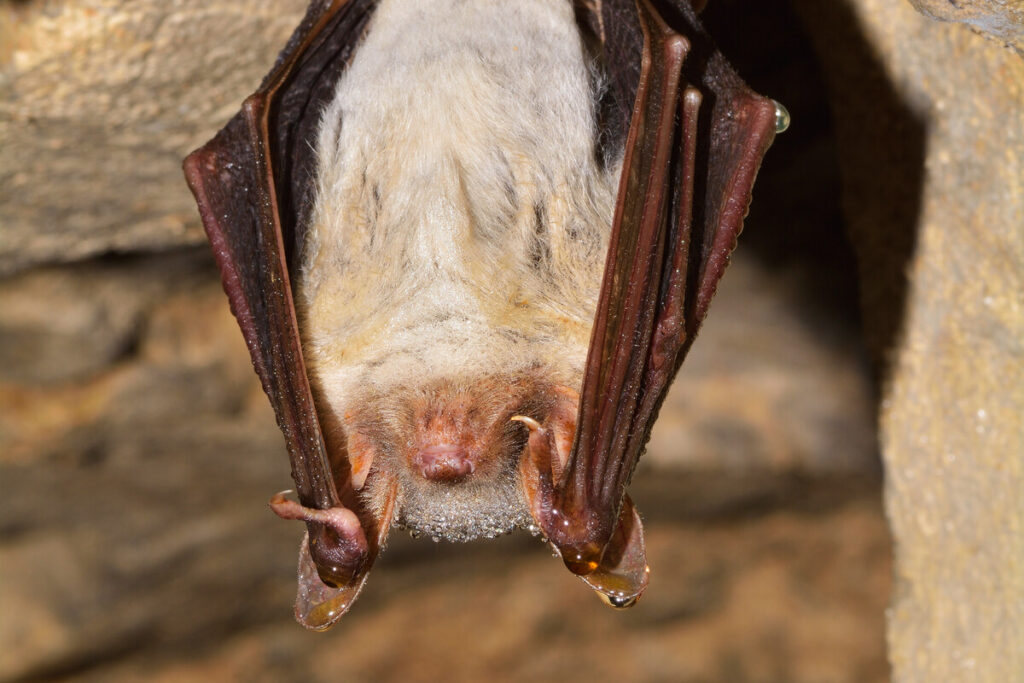
Some bats can live for half a century, a remarkable run for such a small mammal. A new genetic study of eight closely related bat species suggests their secret may be an immune system that stays on high alert and a ruthless way of dealing with damaged cells.
A bat caught again after 50 years
The research centers on a group, or genus, of bats called Myotis. Scientists know of 1,511 bat species, and about 139 of them belong to this one group. What makes these bats so interesting is how differently their lifespans play out, even between close relatives.
Take Brandt’s myotis (Myotis brandtii). One of these bats was fitted with an identification band in Europe and then caught again 50 years later. Its relative the black myotis (Myotis nigricans), which lives in South and Central America, only makes it to about seven years.
Lead researcher Juan Manuel Vazquez offered a way to picture that gap. Imagine if Neanderthals, our close relatives, had lived nine times longer than modern humans. That is roughly the kind of difference these bat cousins show.
Netting bats by night
Vazquez first got curious about bat longevity as a graduate student at the University of Chicago. Back then, scientists had very little bat DNA to study. After he became a postdoctoral fellow at UC Berkeley in 2020, he set out across the Western U.S. to collect samples himself.
Working with Berkeley undergraduates, he stretched fine mist nets over streams, ponds and rivers after dark. The team caught bats, took a tiny tissue sample from each one and let them go. Back in the lab, those samples became the raw material for reading the bats’ genomes, the full set of instructions stored in their DNA.
Long life and strong defenses go together
The results, published in the journal Nature, are the first analysis of eight Myotis genomes. The bats with the longest lives had more activity in genes linked to fighting cancer. The team also found that many genes tied to aging overlap with genes tied to defending the body against disease.
That overlap went further. Each time Vazquez flagged a gene connected to lifespan, his collaborator Elise Lauterbur often found that the very same gene played a role in how bats deal with viruses.
“There is way more overlap than you would expect just by random chance between the genes that are associated with longevity and genes that are associated with viral interactions,” Vazquez said.
Damaged cells get no second chance
To see how bat cells cope with serious harm, Vazquez grew cells from small wing samples in the lab and exposed them to toxic chemicals. He now keeps cell cultures from 259 individual bats belonging to 32 species.
The little brown bat (Myotis lucifugus), a common species and the longest-lived bat in his sample, did something the team did not expect. Rather than trying to fix the damage to its DNA, its cells ramped up the genes that tell a cell to die.
“The longest-lived bat in North America decides ‘I can’t save this ship’ and immediately switches gears to prioritize killing off the cells that are damaged,” Vazquez said. He noted that elephants, which are also long-lived and resist cancer, follow the same rule: if a cell can’t be saved, get rid of it.
The finding suggests that different animals may have found very different ways to stop damaged cells from turning dangerous.
Flying like an ultramarathon runner
Bats have been around for about 60 million years. Today they make up 20% of all mammal species and live on every continent except Antarctica.
Their immune systems run unusually hot. That lets bats keep harmful inflammation in check while living with viruses that never make them sick. Some researchers think this toughness may be linked to how hard bats work. Vazquez compares a night of hunting insects on the wing to running several ultramarathons every day.
The study also found that Myotis bats carry an unusually large number of genes for proteins that interact with DNA viruses, such as herpes viruses. Humans and other primates lean the other way, with more genes aimed at RNA viruses like the ones behind COVID and HIV.
Why it matters
That mismatch may help explain why some viruses that jump from bats to people can make us so ill. “Humans and bats are badly suited to each other,” Vazquez said, adding that care is needed in both directions, so that people don’t pass anything to bats and bats don’t pass anything to people.
The researchers hope that studying long-lived animals like bats, elephants and whales could one day point to new ways of keeping the human body healthy in old age. Peter Sudmant, an associate professor of integrative biology at Berkeley who studies the genetics of aging, put it this way:
“By looking across the diversity of life and the remarkable longevities of different species, we hope we can better understand the interplay between DNA damage and the immune system to enable us to have full and healthy life spans.”
For now, those are clues rather than answers. Vazquez is continuing this work at Pennsylvania State University, while Sudmant is digging into how bat cells control their immune responses.
Source: ScienceDaily