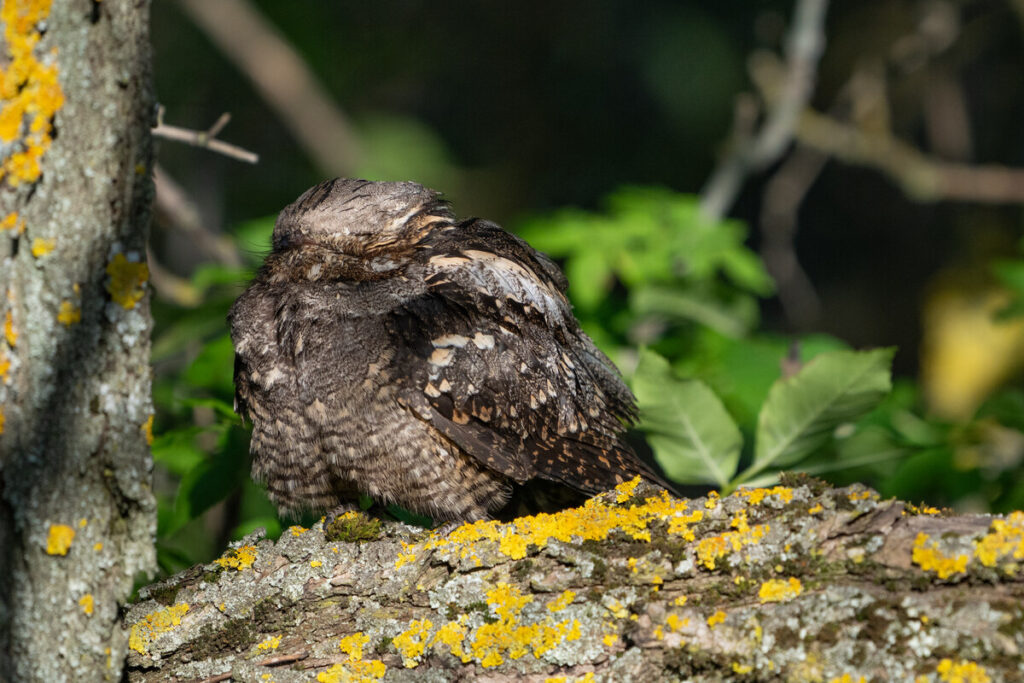
The European nightjar flies all the way between Europe and southern Africa every year, yet its wings are not tuned for fast, efficient cruising. A new wind tunnel study suggests those wings are a compromise: great for slow, twisting insect hunts, less great at speed. And on the way up, they push the bird forward in a way scientists mostly linked to bats and insects.
A long-distance traveler with a night job
The European nightjar (Caprimulgus europaeus) does its hunting after dark, snatching insects out of the air. It is also a serious traveler, making a huge trip each year between Europe and southern Africa.
That means one pair of wings has to do two very different jobs. On migration, the bird needs to cover enormous distances. While hunting, it needs to fly slowly and make sharp turns to grab its prey. Researchers at Lund University wanted to know how the nightjar’s wings handle both demands.
Testing nightjars in a wind tunnel
To find out, the team flew nightjars in a wind tunnel. A wind tunnel blows a steady stream of air past a flying animal, so it can stay in one spot while scientists watch closely. The researchers recorded how the birds moved at different speeds and measured the swirls of air left behind their wings.
Those air patterns act a bit like footprints of flight. They help reveal how the wings are producing their forces.
Wings that favor agility over speed
The nightjar has broad wing tips. These probably help it steer and stay in control when it flies slowly, which is exactly what a bird chasing insects at night needs.
But the study found a cost. As the nightjar speeds up, those same broad tips make its wings less efficient at producing lift, the upward force that keeps a bird in the air. In other words, the wings that make it a nimble hunter are not the best tool for fast flying.
That goes against a common idea: that birds which travel very far must have wings shaped mainly for efficient long-distance flight.
“This runs counter to the intuitive image of a long-distance migrant as a perfectly optimized flying machine,” said Christoffer Johansson, an associate professor at Lund University. He described the nightjar’s wings as “a compromise between several different demands.”
A surprising push on the upstroke
Every wingbeat has two halves. The downstroke pushes the wing down, and the upstroke lifts it back up. The upstroke is often seen as the more passive half, mostly there to get the wing ready for the next push.
The nightjar does something different. Even while lifting its wings, it keeps producing thrust, the force that moves it forward. Using the upstroke this actively had mainly been linked to bats and insects, not birds.
Bats, insects and birds have very different evolutionary histories. Seeing a similar trick in all of them suggests that very different animals may arrive at the same answers to the problems of flying.
“It can be actively used to generate thrust when the wings cannot be folded very much,” Johansson said of the upstroke.
What this means
The nightjar is a good reminder that evolution does not always build a perfect tool for one task. When an animal uses the same body parts for several jobs, nature can settle on a design that balances them. For this bird, that means wings that can carry it across continents and still let it hunt insects at low speed.
The findings could matter for people too. Drones and other small flying machines with flapping wings face some of the same limits as birds, including how much their wings can fold during each beat. Learning how nightjars squeeze extra thrust out of the upstroke could help engineers design better flapping aircraft.
What scientists want to learn next
The team now wants to see whether other birds and flying animals use this upstroke trick, or whether it is something special to the nightjar.
Johansson said the work “could help us understand which aerodynamic principles are specific to the nightjar and which are more general.”
The study, led by L. Christoffer Johansson with Gabriel Norevik, Sonja Friman and Anders Hedenström, was published in PLOS Biology.
Source: ScienceDaily