Around 47 million years ago, a truly enormous snake may have lurked in the swamps of what is now western India. Scientists named it Vasuki indicus, and their best estimates put it somewhere between 36 and 50 feet long, which could make it a rival for Titanoboa, the most famous giant snake of all.
A giant found in a coal mine
The fossils turned up at the Panandhro Lignite Mine, in the Kutch area of Gujarat. Two paleontologists from the Indian Institute of Technology Roorkee, Debajit Datta and Sunil Bajpai, studied the bones and described the new species in 2024 in the journal Scientific Reports.
They did not find a full skeleton. What they had was a backbone in pieces: 27 vertebrae, the small bones that link together to form a snake’s spine. Several were in excellent shape, and a few were still joined to each other the way they were in life. Everything about the bones points to an adult snake, not a youngster that might have kept growing.
The name has a story too. In Hindu tradition, Vasuki is the serpent king that the god Shiva wears around his neck. The second half, indicus, points to India.
How do you measure a snake you can’t see?
Each vertebra is big by snake standards. The largest were about 2.5 inches long and close to 4.4 inches wide. Those wide, chunky bones suggest a body shaped like a thick tube, strong enough to carry a huge amount of weight.
To turn a handful of bones into a full body length, the team compared them with the vertebrae of living snakes whose size is already known. They tried two different methods. One gave a length of about 36 to 40 feet. The other gave about 48 to 50 feet.
The researchers openly flag that gap. Rebuilding an extinct animal from part of its spine always comes with uncertainty, and different methods can land far apart. So while Vasuki clearly belongs among the biggest snakes ever found, nobody can say yet whether it was actually longer than Titanoboa, the giant that lived in what is now Colombia about 60 million years ago and is thought to have reached roughly 43 feet.
A slow hunter that waited for dinner
A snake that heavy was probably not built for speed. Based on its size and the shape of its backbone, the researchers think Vasuki moved slowly and hunted by ambush. Instead of chasing prey, it would have stayed hidden and waited for an animal to wander close enough to grab.
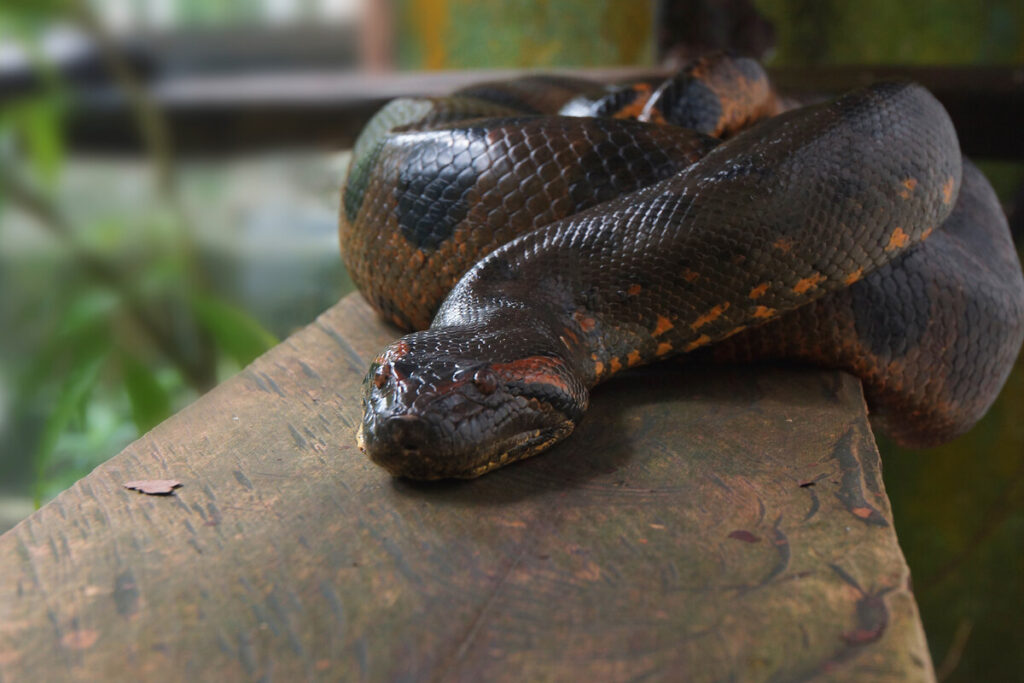
That would make it a bit like today’s anacondas and big pythons. These snakes wrap their muscles around a catch and squeeze until its blood stops flowing properly. Vasuki may have hunted the same way, though the fossils can’t reveal exactly what it ate or how it attacked.
Its body also hints that it was not a full-time swimmer. It may have spent a lot of its life on land or in shallow, swampy water. The area around the fossil site was once full of wetlands and marshes, a good hiding place for a giant waiting in ambush.
Why a warm world may have helped
Back in the Middle Eocene, this part of India was tropical, with average temperatures estimated at about 82°F. That matters for snakes. They are cold-blooded, which means they rely on the heat around them to keep their bodies running. Warm surroundings can help large reptiles stay active, digest food and grow.
Heat is only part of the story, though. How much food is around, what kind of habitat is available and the family history of a species also shape how big an animal can get. A separate 2025 study on fossil anacondas from Venezuela backs this up: anacondas were already about 17 feet long some 12.4 million years ago and have stayed roughly that size ever since, even as the climate changed. In other words, a warmer planet does not automatically mean bigger snakes.
A lost family of snakes
Despite the comparison, Vasuki was not a close relative of modern anacondas or pythons. It belonged to the madtsoiids, a family of snakes that lasted for about 100 million years before dying out completely. Members of this group lived in India, Africa, Europe, South America and Australia.
Its nearest known cousins are two other fossil snakes, one from ancient India and one large species from North Africa. That pattern suggests this line of giant snakes began on the Indian subcontinent and later spread out. As India drifted north and crashed into Asia around 50 million years ago, new land connections may have let these snakes move through southern Europe and Asia and eventually reach Africa.
What this means
Vasuki was not alone. In a 2025 follow-up study, Datta and Bajpai described more fossil snakes from the same region and era, including water-dwelling species and another madtsoiid that seems to have shared Vasuki’s marshes. Some of these snakes lived along tidal coasts, others in swamps.
Put together, the finds show that ancient India hosted a whole community of snakes filling different roles, with Vasuki as one of its giants. Its exact length, look and habits are still open questions, but each new fossil from western India helps fill in a world where huge serpents ruled the warm wetlands.
Source: ScienceDaily