Some tropical trees grow little apartments inside their stems and rent them out to ants, paying them with food in return for protection. On the island of Borneo, scientists have now found predatory wasps moving into those apartments instead, and the takeover is far more common where people have cleared the forest.
A deal that has lasted millions of years
The trees at the center of this story belong to a group called Macaranga, and the species studied here is Macaranga pearsonii. Plants like these are known as “ant-plants,” because they are built to live with ants.
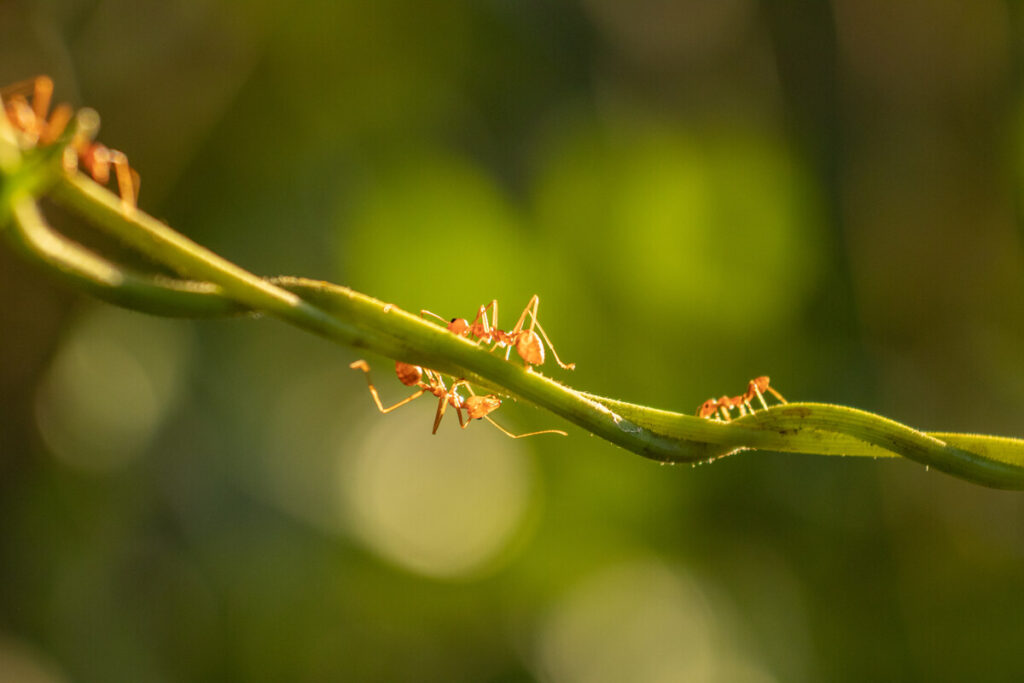
The arrangement works a bit like a contract. The tree grows hollow chambers in its stems where an ant colony can settle in. It also makes small, nutritious food bodies for the ants to eat. In return, the ants fight off hungry insects, such as caterpillars, that would otherwise chew up the leaves.
Scientists believe this partnership has been running for at least 10 million years. That is why researchers were surprised to find signs that it is starting to break down.
Opening the stems revealed a wasp nursery
An international team, including researchers from Queen Mary University of London, the Royal Botanic Gardens, Kew, and the Biology Center of the Czech Academy of Sciences, looked at young trees in Malaysian Borneo. Some grew in forests that had been logged. Others grew in oil palm plantations.
Lead author Dan Lestina spotted something odd while checking the trees. Many stems looked as if they had been hollowed out in an unusual way. When the team cut them open, they found the space packed with flies, and the flies were being eaten alive by wasp larvae.
“Adult wasps hunt and paralyze the flies, then store them inside the plant’s cavities as food for their young,” Lestina explained.
In other words, the rooms the tree had grown for its bodyguards were being used as pantries for baby wasps. The study was published in the journal PeerJ.
Wasps did best in plantations
The researchers noticed a clear link between the wasps and places changed by people. Trees growing in oil palm plantations were much more likely to hold wasps than trees growing in logged forest.
There was a second pattern too. Wherever wasps had moved in, the ant colonies were consistently much smaller. That could mean the wasps are pushing the ants out entirely. The team is careful on this point, though: experiments would be needed to show whether that is really what is going on.
According to co-author Dr. Kalsum M. Yusah, the scientists still don’t know whether this wasp is a local species or one that arrived from somewhere else. What they can see is where it thrives: “Its spread is clearly linked to disturbed landscapes.”
Why it matters for the forest
Macaranga trees are often among the very first plants to pop up after land has been cleared or damaged. They help kick off the slow process of a forest growing back.
If these trees lose their ant guards, insects may be able to munch on them more freely. Weaker trees could then mean a slower comeback for the whole forest.
“If the plants lose their ant defenders and become less healthy, it could hinder forest recovery following disturbance,” Dr. Yusah said.
What this means over the long run
Senior author Dr. Tom Fayle, from Queen Mary University of London, pointed to a slower kind of change. Growing hollow stems and food bodies takes effort. If wasps keep taking over those spaces, the trees may get less out of the deal.
“If these structures become less valuable to the plants because wasps exploit them, the plants may stop investing in them,” Fayle said. He added that these quiet, long-term effects of human activity are much less understood than the simple loss of species.
The ants and their trees are just one example. Tropical forests are full of thousands of close partnerships between species. If disturbed land makes it easier for newcomers to barge into those partnerships, others could wobble too, weakening plant defenses and changing which species end up in charge.
The researchers see their findings as an early warning. Long before any species vanishes, a forest can start shifting in small ways that are easy to miss. Here, the first clue was hiding inside the hollow stems of a young tree, where a partnership millions of years old may be starting to come apart.
Source: ScienceDaily