Green sea turtles have a reputation as long-distance travelers, so scientists expected a group tagged in the Galápagos to head off across the Pacific. They did not. For the full length of the tracking study, every one of the tagged turtles stayed inside the Galápagos Marine Reserve, mostly in shallow water near the islands.
Two kinds of green turtle in one place
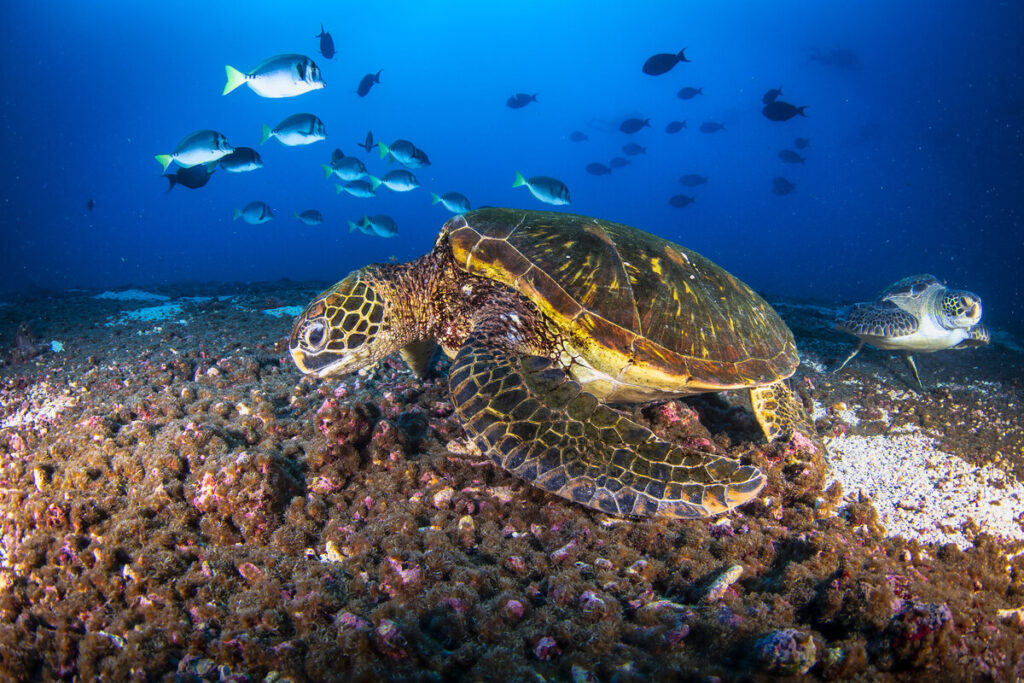
Green sea turtles are a bit different from the six other sea turtle species alive today. Once they grow up, they eat mostly plants. Young turtles munch on a mix of plants and small animals, then slowly switch to a menu of seagrasses and algae as they mature.
Scientists also split the turtles in this study into two forms that are genetically distinct. The “yellow morph” usually lives in warm parts of the western Pacific. The “black morph” lives in the eastern Pacific, off the west coast of the Americas and south of southern California.
The Galápagos Islands are the only place known where both forms share the same waters. There, yellow and black turtles swim side by side and graze on the same kinds of sea plants. They are not identical, though. Young yellow turtles tend to grow faster than young black ones, a hint that their bodies may work differently in ways scientists have not fully pinned down.
Following nine turtles by satellite
The research team wanted to know where the yellow turtles spend their days, how much space they use and whether they hop between islands inside the reserve, a protected area of 198,000 sq km (about 76,000 square miles).
In 2015, the scientists carefully caught nine adult turtles in shallow water near four islands: seven males and two females. Each turtle got a nickname and a small electronic tag that sent its position to the Argos satellite system orbiting overhead. Some turtles were followed for up to 418 days. Tracking usually stopped when a tag fell off or went quiet.
The study was published in the journal Frontiers in Amphibian and Reptile Science. Its corresponding author, Dr. John W. Rowe of Alma College in the United States, summed up the surprise:
“We expected them to migrate to distant beaches in the western Pacific to reproduce, yet interestingly, none of our satellite-tagged turtles even left the Galápagos Marine Reserve over the three years of our study.”
Home bodies with favorite islands
The turtles clearly liked the shallow water along the coast. A few swam as far as 25 km (about 15 miles) from shore now and then, but most stayed much closer to land.
Five of the nine turtles spent most of the study around just one island. Others had a small circuit. Bernardo and Sara went back and forth between Isabela and San Cristóbal, while Leandro moved between Isabela and Española.
The explorer of the group was Ainoa. After being tagged near San Cristóbal, she traveled to Santa Cruz and then on to Isabela.
The team also spotted a seasonal rhythm. Trips between islands only happened during the cooler months, from April through October. On average, each turtle used a home range of about 1,498 sq km (roughly 580 square miles), though the size varied a lot from one animal to the next.
The females may still leave one day
The researchers are careful about what their results show. The tags captured only a slice of each turtle’s life, so longer trips could still happen at other times and simply did not show up in the data.
That matters most for the females. Yellow morph females are not known to lay eggs on Galápagos beaches, so the team thinks they will eventually set off for the western Pacific beaches where they hatched. Black morph females are a different story, as coauthor Dr. Juan Pablo Muñoz Pérez of the Universidad San Francisco de Quito in Ecuador explained:
“Some female black-morph green turtles do nest in the Galápagos: depending on the individual, those may be year-round residents in the archipelago, travel to other nearby oceanic islands, or even to feeding grounds off Central and South America.”
Why it matters for protecting turtles
Because some turtles move between several islands, guarding a single favorite feeding spot may not be enough to keep them safe. The researchers stress that the coastal waters around the islands, and the routes the turtles use to travel between them, all need protection.
Rowe put it simply: “Since individual turtles may rely on waters around multiple islands, the quality of habitat that is available for foraging should be maintained intact across all islands, and not allowed to degrade anywhere.”
For a turtle famous for crossing oceans, these Galápagos residents show that home can be a handful of islands and a patch of shallow sea.
Source: ScienceDaily