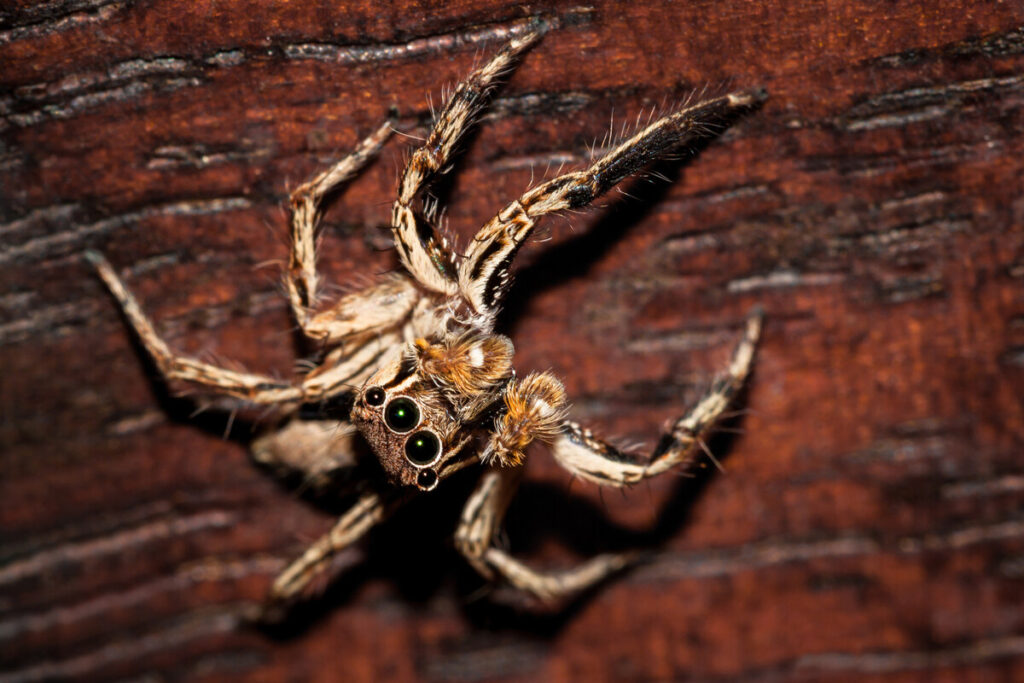
A tiny trapdoor spider from the California coast has a genome roughly 50% larger than the human genome. The species, named after comedian Stephen Colbert, is only about the size of a quarter, yet its DNA is packed with surprises.
A secretive hunter under the dunes
The spider is called Aptostichus stephencolberti. It lives only in coastal dunes along a limited stretch of Central California, from the San Francisco Bay area to Monterey. Visitors may walk right past one without ever knowing it.
Female trapdoor spiders spend their entire lives underground. They live in silk-lined tunnels with a hinged door at the entrance that blends into the sand. From inside, the spider can sense what is happening outside.
When an insect or other small animal comes near, vibrations alert the spider. At just the right moment, it bursts through the hidden door and grabs its meal. These spiders are skilled ambush hunters, but their venom is not dangerous to people. Of the more than 50,000 known spider species, only about 30 to 50 have venom known to be toxic to humans.
A genome bigger than ours
Researchers reported the spider’s genome in the Journal of Heredity. It is the first time scientists have sequenced the genome of a spider from this family. The spider’s DNA runs to 4.6 billion base pairs, or 4.6 gigabases. “At 4.6 gigabases, or 4.6 billion DNA base pairs, it’s not the largest genome among the spiders, but it’s significant,” said corresponding author Jason Bond, a professor in the Department of Entomology and Nematology at the University of California, Davis.
The spider also has 52 chromosomes, compared with the 46 chromosomes in typical human cells. But a bigger genome does not mean more genes. About 77% of this spider’s genome is repetitive DNA, short sequences that appear many times over.
The team also noted something unusual about spider chromosomes. Spiders lack the conventional repetitive DNA sequences linked to telomeres, the protective caps at the ends of chromosomes. That difference could help explain why spider chromosomes seem to evolve faster than those of vertebrates. As Bond put it, “It lends itself to broadening our understanding of spider genome composition and consequently how genomes have evolved across the animal Tree of Life.”
Why a spider carries Colbert’s name
The name goes back to 2008. Colbert learned that Bond had named a trapdoor spider after rock musician Neil Young. Not wanting to be left out, he turned it into a segment on The Colbert Report called “Who’s Not Honoring Me Now?” and publicly demanded a spider of his own. Bond agreed. The “t” in Colbert is silent, by the way.
Rising seas and invasive species
The genome work is part of the California Conservation Genomics Project, a state-funded effort to build a library of genetic information that can guide conservation decisions.
Trapdoor spiders rarely wander far from their burrows, so it is hard for populations to move between habitats. Their dune homes are already split into isolated patches. Researchers hope the genetic data will help them spot distinct populations that may need special protection.
“We Californians love our beaches and trapdoor spiders share them with us,” Bond said. “We’re hoping to understand how things like climate change, fire and urbanization might be impacting the genetic diversity of species.” The spider’s narrow range makes it especially vulnerable. Rising sea levels could erase parts of its coastal habitat, and invasive species are another serious threat. In Bond’s words, “They’re going to be incredibly sensitive to sea-level rise, but they’re also very sensitive to invasive species.”
What spider genes could mean for medicine and farming
Better genetic maps may also help scientists explore the chemicals in spider venom. Some compounds found in spider venoms have shown promise as possible painkillers, while others might help control agricultural pests. Many spider species are still poorly understood at the genetic level, so there may be more to find. “We don’t really know what’s out there in terms of untapped natural product diversity for venoms,” Bond said.
The study also involved researchers from UC Santa Cruz, UCLA and Virginia Tech, with support from the California Conservation Genomics Project and the National Science Foundation.
Source: ScienceDaily