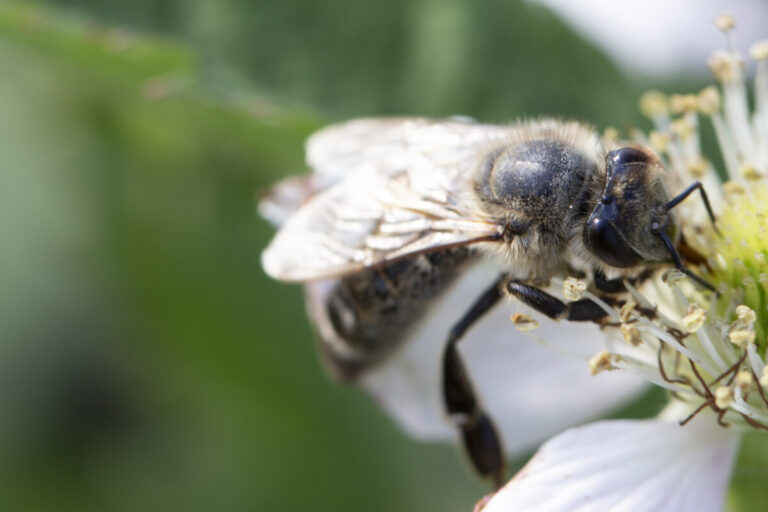
Pollen is the main protein source for honey bees, yet most of it does not carry the right mix of nutrients for them. A new study led by the University of Oxford shows that bees cope in two clever ways: they eat less when a meal is out of balance, and they turn pollen into a much better food for their young inside the hive.
Why pollen is a tricky meal for bees
Bees live almost entirely on what they collect from flowers. Nectar gives them sugar for energy, and pollen gives them the protein they need to grow and raise new bees.
There is a catch, though. Plants did not make pollen to feed bees. It carries the male cells a flower needs to make seeds, so there is no reason its nutrition should line up with what a bee’s body requires.
The researchers focused on essential amino acids. These are the small building blocks of protein that an animal cannot make on its own, so it has to get them from what it eats. For a bee, a good protein meal is one where these building blocks come in roughly the same proportions as in its own body.
A big pollen test with 99 plants
To see how well pollen measures up, the team compared the amino acid makeup of honey bee tissue with pollen from 99 flowering plant species found in the UK, spread across 26 plant families.
Most of the pollen samples turned out to be a fairly poor match for what honey bees actually need.
Next, the scientists made artificial foods in the lab. Some copied the amino acid balance of different pollens. Others copied the balance found in bee tissue. Young worker bees, freshly emerged as adults, were given these diets to see how they reacted.
The bees clearly preferred food that matched their own bodies. On it they ate more, put on more body weight and chose to take in a larger share of protein.
One amino acid that works like a brake
The team suspected that one building block in particular, histidine, was shaping the bees’ appetite. Bees do need histidine, but only a little of it.
To test the idea, the researchers made diets with either a lot or a little histidine compared with leucine and isoleucine, two amino acids that matter for bee growth and development. When histidine made up a larger share, the bees cut back on eating overall. They took in less protein and less sugar, rather than eating more to make up for what was missing.
The researchers think this may be a safety system that kicks in after digestion, stopping bees from loading up on too much of an amino acid that might harm them. In rats, for example, extra histidine can be turned into histamine, a chemical that acts on parts of the brain that help control how much an animal eats.
Lead author Professor Geraldine Wright, of the University of Oxford’s Department of Biology, said the old picture of pollen needs updating: “Although pollen is often assumed to be a near-perfect food for bees, it is the male gamete of plants and, unlike nectar, it is rarely produced solely as a reward for pollinators.” In her words, “This creates a conflict of interest between the plant and the pollinator.”
How the hive cooks up better baby food
Honey bees have a second trick, and it matters most for the larvae, the baby bees growing in the comb.
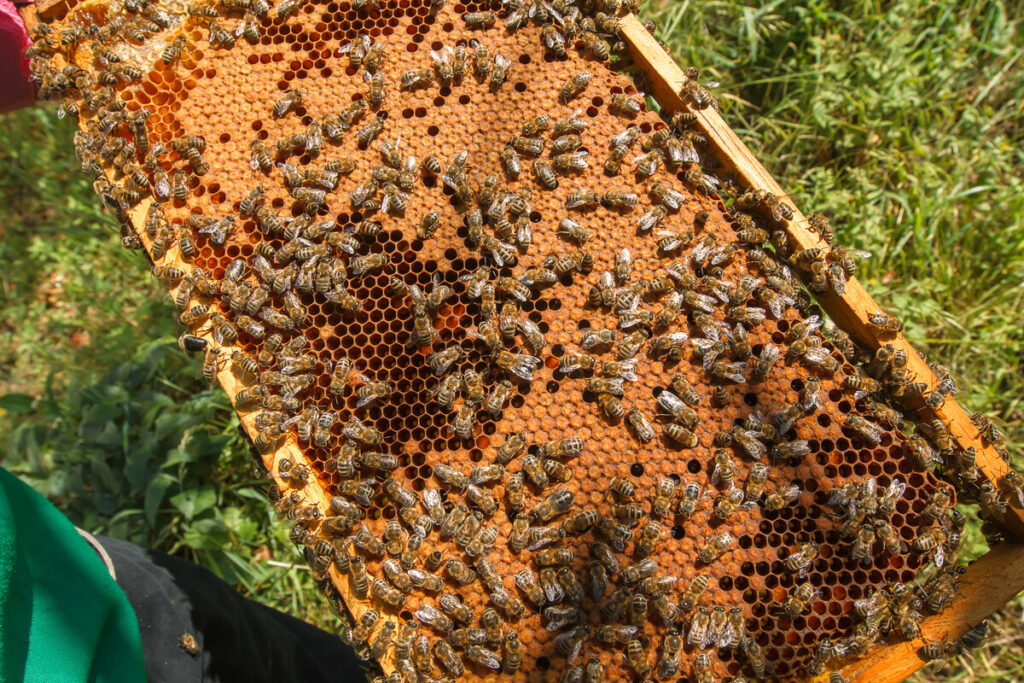
Workers bring home pollen from many flowers and store it in the hive as “bee bread.” Nurse bees, which look after the young, eat this mix. Their bodies then turn its nutrients into secretions made in special glands, including royal jelly, which they feed to the larvae.
When the scientists checked these foods, bee bread had a better balance of essential amino acids than most single types of pollen. Royal jelly came even closer to the balance found in bee tissue. In other words, by mixing pollen from many plants and passing it through the nurse bees, a colony may be able to fix the weak spots of each pollen on its own.
“We predict that honeybees have evolved to create glandular secretions which are the perfect food for their larvae, providing them with the ratios of essential amino acids that maximize growth,” Wright said.
Why it matters for wild bees and gardens
Not every bee has this kitchen in its home. Many wild bees, such as bumblebees and solitary bees, hand pollen straight to their young without processing it first. Where only a few kinds of flowers grow, these bees may struggle to get the right balance of amino acids, both for themselves and for their offspring.
For farmers, conservation groups and gardeners, the study suggests that helping pollinators may take more than planting lots of flowers. The quality of the pollen, and how many different plants provide it, may count too.
“Our results suggest that planting for pollinators should not only focus on providing flowers throughout the season, but also on ensuring a diversity of pollen sources,” Wright said. “A varied diet may be essential for bees to obtain the right balance of nutrients.”
The study was published in the journal Current Biology. Besides Oxford, it involved scientists from the University of Southampton, Lancaster University, Newcastle University and The Hebrew University of Jerusalem.
Source: ScienceDaily