Setting a rescued animal free sounds like the perfect happy ending. But when scientists followed nine rescued Bengal slow lorises after their release in Bangladesh, only two were still alive at the end, and the biggest danger came from other lorises.
The study, published in the journal Global Ecology and Conservation, was led by Hassan Al-Razi of the conservation group Plumploris e.V. Bangladesh, with primatologist Professor Anna Nekaris OBE of Anglia Ruskin University and researchers from the University of Western Australia. Its message is simple but uncomfortable: a release is not automatically a rescue.
Big eyes, big trouble
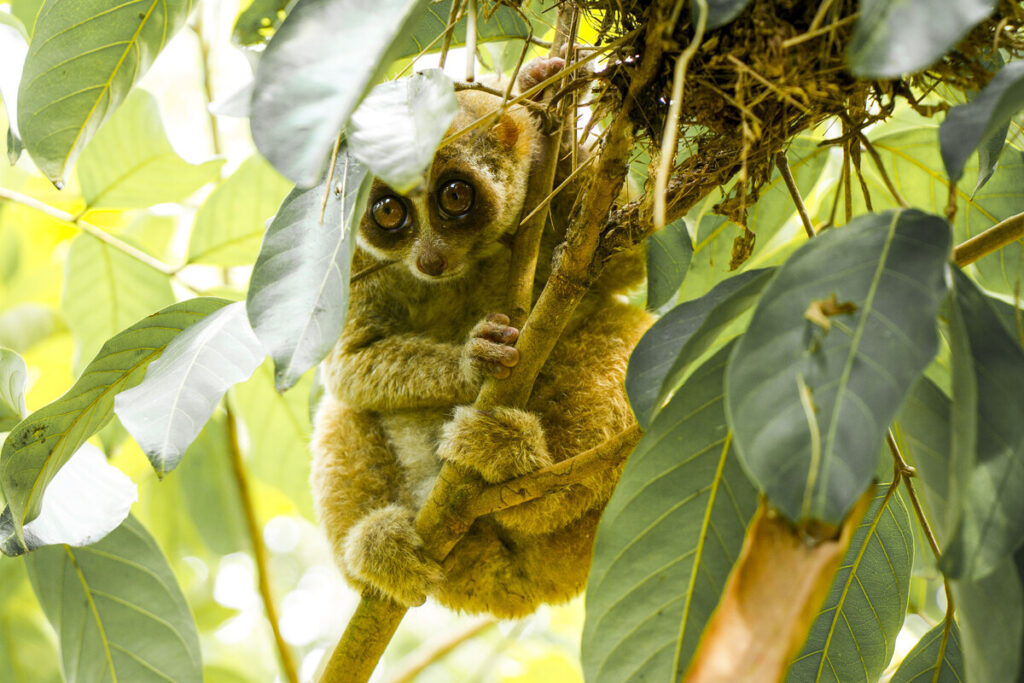
Slow lorises are small, slow-moving primates with huge round eyes and soft, gentle-looking faces. Sadly, that cute look is exactly what puts them in danger. Demand for them as pets has made slow lorises some of the most trafficked primates on the planet.
Every slow loris species is listed by the International Union for Conservation of Nature as Vulnerable, Endangered or Critically Endangered. Because of that, animals taken from smugglers or rescued from captivity are often returned to the forest, with the hope of boosting wild populations.
Following nine lorises into the forest
To find out what really happens after release day, the team put radio collars on nine Bengal slow lorises (Nycticebus bengalensis) and set them free in a national park in northeastern Bangladesh. This park had already been used for earlier wildlife releases.
The outcome was grim. Three of the lorises died within 10 days, and four more were dead within six months. Only two survived.
The researchers managed to recover four of the seven bodies. In every one of those cases, the evidence pointed to the same culprit: other slow lorises. The animals had clear bite wounds on their heads, faces, fingers and toes, signs of fatal fights over territory.
A tiny primate with a toxic bite
Slow lorises may look cuddly, but they are fiercely protective of their home ranges. They also hold an unusual record. They are the only venomous primates in the world, and they use specialized teeth to deliver a toxic bite.
So when a newcomer is dropped into a patch of forest that already belongs to resident lorises, conflict is likely. In this study, those encounters appear to have been deadly.
Who survived, and why
The team spotted a few patterns. Lorises that had spent longer in captivity tended to survive for fewer days once they were back in the wild. The released animals also moved around more and seemed more on edge than wild Bengal slow lorises usually do.
The two survivors had something in common: they roamed over larger areas than the lorises that died. The researchers think this suggests their survival depended on getting away from established territories and steering clear of the locals.
Why it matters
When big, famous animals such as big cats are released, they are often watched closely afterward. Smaller species rarely get the same attention, so nobody knows how most of their releases turn out. This study is a rare look at what happens next, and it is a warning.
Professor Nekaris, who also leads the Little Fireface Project, said: “It’s assumed that returning confiscated or rescued animals to the wild is always a positive conservation story. Our research shows that for highly territorial species like slow lorises, releasing them into areas that are already densely populated can be a death trap.”
She added that the public’s expectations play a role too: “Many rescued endangered species are often released because the public expects it, but for animals such as the Bengal slow loris, this is not always the best course of action.”
Al-Razi explained that rescue and release has become more and more common in Bangladesh, but that sites are often picked for the wrong reasons. “For forest-dwelling species, release sites are often selected based on logistical convenience rather than ecological suitability,” he said. In his view, some forests have turned into dumping grounds for rescued animals and are no longer good places to release them.
What this means for future rescues
The researchers are not saying that animals should never go back to the wild. Instead, they argue that a good release needs careful planning, not just good intentions. That means checking whether a release site is really suitable, judging the condition of each individual animal, studying the habitat in detail, monitoring released animals over the long term and following rehabilitation guidelines designed for each species.
The study focused on Bengal slow lorises, but Al-Razi believes the same problems likely affect many other species. For anyone who loves happy rescue stories, it is a reminder that the best ending is the one that actually works for the animal.
Source: ScienceDaily