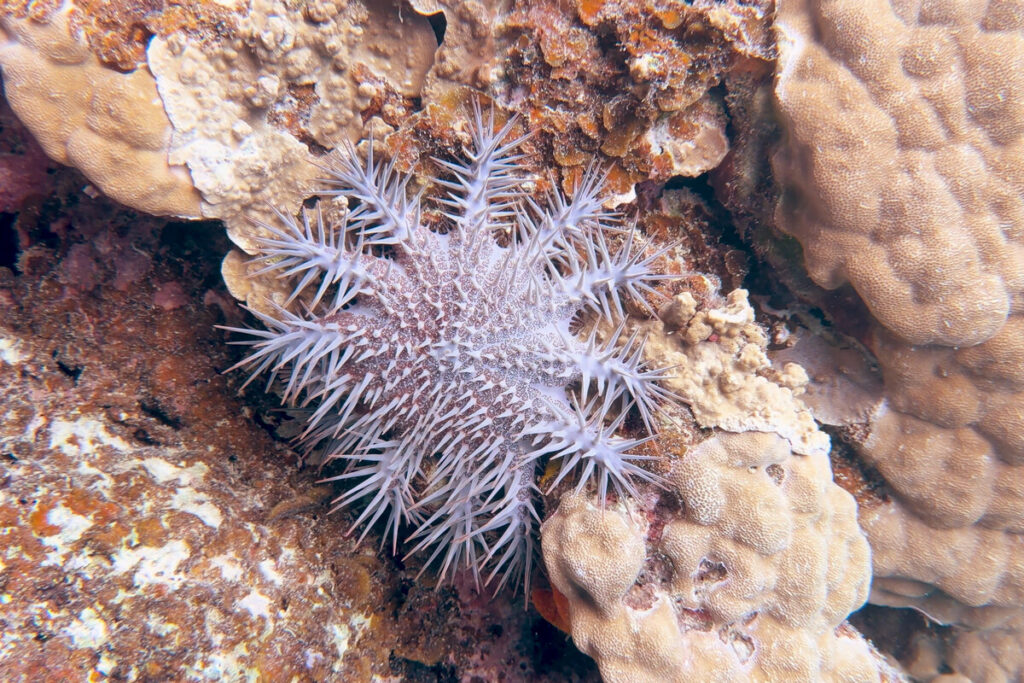
Crown-of-thorns starfish have a terrible reputation on the Great Barrier Reef, and for good reason. Yet a new study from the University of Sydney suggests that when their numbers stay low, these spiny coral eaters may actually help keep the reef varied and healthy.
Meet the reef’s most feared starfish
Crown-of-thorns starfish, often shortened to COTS by scientists, are covered in sharp spines that carry toxins. They feed on coral, and when their populations explode, they can strip large stretches of reef bare.
These starfish are native to Australia’s Great Barrier Reef. Since the 1960s, the reef has gone through four major outbreaks, coming around once every 15 years. Part of the problem is that the animals that eat crown-of-thorns starfish are becoming harder to find. Those natural predators include tritons, a type of large sea snail, and several kinds of reef fish. With fewer of them around, the reef is more exposed to these destructive booms.
So it may come as a surprise that researchers now think these starfish also have a helpful side.
What happens after a starfish eats
The team, led by Dr. Shawna Foo, wanted to know what becomes of a coral after a crown-of-thorns starfish has fed on it. They looked closely at feeding scars and at the living coral tissue left behind, working from the University of Sydney’s One Tree Island Research Station on the Great Barrier Reef.
The study sites sat inside protected areas. There, healthy fish populations help hold starfish numbers down, so these spots do not see the huge outbreaks that hit other parts of the reef.
What the researchers found was unexpected: in nearly 75 percent of the feeding events they observed, some living coral tissue survived.
“At One Tree Reef, COTS appear to consume a relatively consistent amount of coral during each meal and move on, rather than demolishing the entire coral colony,” said Dr. Foo, a University of Sydney Horizon Fellow in the School of Life and Environmental Sciences. “This meant live coral tissue remnants were frequently left behind.”
In other words, a starfish at normal numbers behaves less like a bulldozer and more like a picky diner that takes a portion and wanders off.
How a coral eater can make room for more corals
Not all corals grow at the same speed. Some fast-growing kinds can spread across big areas and crowd out slower species that need space too.
The study found an interesting pattern in which corals bounced back. Surviving pieces of fast-growing Acroporidae corals did not grow back over the spots where the starfish had fed. Regrowth showed up mainly in slower-growing Montipora and Porites corals.
“By feeding on fast-growing corals such as Acropora, low-density COTS populations create space for slower-growing coral species to persist, helping to increase coral diversity,” Dr. Foo said.
That means a small number of crown-of-thorns starfish may stop a few dominant corals from taking over, leaving room for a richer mix of species. It is a very different picture from the idea that every bite a starfish takes is bad news for the reef.
Why outbreaks are still a big problem
None of this means crown-of-thorns starfish are harmless. The researchers are clear that large outbreaks are still a serious threat. When the starfish multiply in huge numbers, they can wipe out wide areas of coral, and reefs can be left struggling to recover.
The real question is how many starfish there are. At natural, manageable levels, they act as ordinary coral predators. In outbreak numbers, they drive lasting reef decline. The researchers stress that these two situations need to be kept apart.
What this means for protecting the reef
Most of the work took place in protected areas with plenty of fish and little risk of a major outbreak. Even so, the findings could help scientists and reef managers fine-tune how they control crown-of-thorns starfish.
One common tool is culling, which means removing starfish from the reef. The study suggests that once an outbreak has been brought under control, the aim may not need to be getting rid of every last starfish. According to the researchers, culling works best alongside strong marine management that protects the animals that eat crown-of-thorns starfish, so their numbers stay in check naturally.
A big idea from ecology
Professor Maria Byrne, a co-author of the study, linked the results to a well-known concept in ecology.
“The results are consistent with the intermediate disturbance hypothesis, an important framework in ecology and conservation,” she said.
The idea behind this hypothesis is simple. Ecosystems can benefit from disturbances that are occasional and moderate, because those shake-ups keep any one species from becoming too dominant.
Crown-of-thorns starfish may be a real-life example of this balancing act. Left unchecked, they can devastate a reef. Kept at low numbers, they may help protect the very variety that makes coral reefs so special.
Source: ScienceDaily