For nearly 40 years, a group of small mammals from the age of dinosaurs was known mostly from scattered teeth, and those teeth sent scientists down the wrong path. A remarkably complete fossil from Mongolia’s Gobi Desert now shows these rabbit-like animals were not early relatives of today’s placental mammals after all.
A puzzle built from teeth
The animals in question are called zhelestids. Paleontologists have known about them for close to four decades, but almost everything they had to work with was a lone tooth here or a broken jaw there.
Those teeth were unusual. Many mammals living in the Cretaceous had sharp, pointy teeth for crunching insects. Zhelestid teeth were lower and rounder, better suited to chewing plants.
That clue led some researchers to a bold idea: maybe zhelestids were an early, unknown group of hoofed mammals. Others wondered whether they belonged to the placental mammals, the huge group that today includes most living mammals, people among them. A third camp suspected they were a separate branch that only happened to evolve similar features.
Studies using a “molecular clock,” which estimates when groups split apart by comparing the DNA of living animals, had suggested that placental mammals might have appeared well before the Cretaceous came to an end. So the placental idea seemed plausible. What was missing was a real skeleton.
Meet Tamirkhan, the “Cretaceous rabbit”
That skeleton has finally turned up. Researchers from the American Museum of Natural History, Stony Brook University, the University of Arizona and Arcadia University have described a new species, Tamirkhan balcarceli, in the journal Nature.
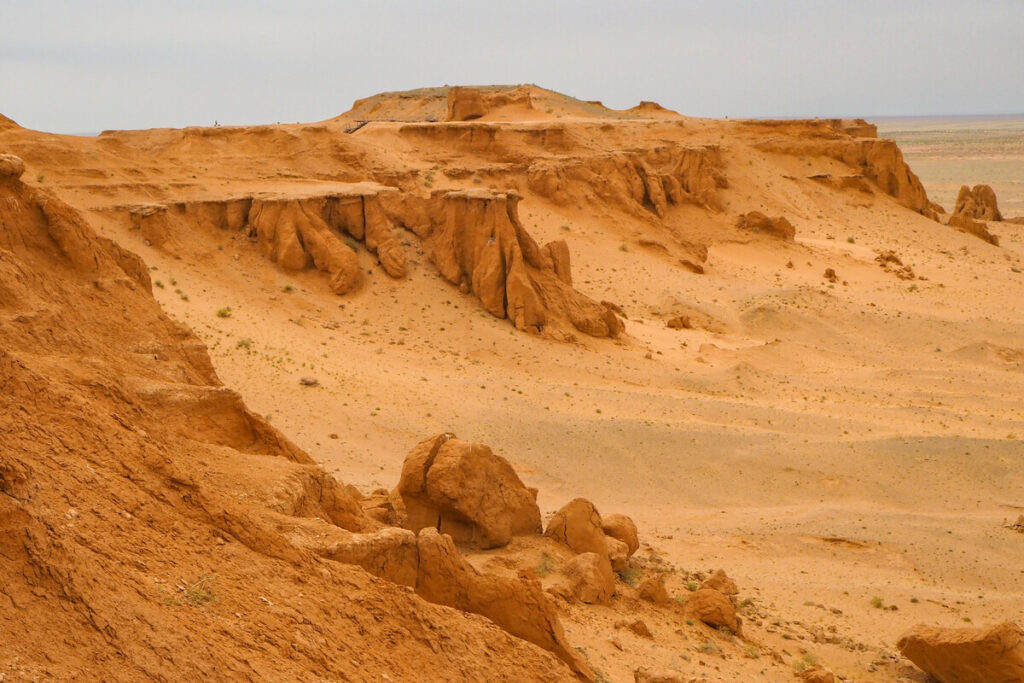
The fossil was found in the eastern Gobi Desert back in 2004 by Andres Giallombardo, then a graduate student on an expedition sponsored by the museum. He is now the study’s lead author. It is the most complete zhelestid ever found, so for the first time scientists can see what one of these animals looked like from nose to tail.
Tamirkhan was tiny, roughly 6 to 7 inches (about 15 to 18 cm) long including its tail. Its back legs were long and slender, which gave it a rabbit-like look. That is why paleontologists sometimes jokingly call zhelestids “Cretaceous rabbits,” even though they were only distant relatives of the bunnies hopping around today.
“It was the thrill of a career to find a new species so completely preserved that also solves a longstanding scientific problem,” Giallombardo said.
What the full skeleton revealed
Tamirkhan did have the low, rounded teeth that zhelestids are known for. But the rest of its body told a different story.
It had long front teeth that kept growing throughout its life, plus several skull features typical of zalambdalestoids. Those were small, shrew-like mammals that ate insects. Its legs pointed the same way.
“Tamirkhan’s hind legs are long and slender with distinctive ankles, traits that are unmistakably zalambdalestoid,” said Shawn Zack, a paleontologist at the University of Arizona and one of the study’s authors.
Putting all of this together, the team concluded that zhelestids were not placental mammals and were not even especially close to them. They belonged inside the zalambdalestoid group instead.
Why teeth can be misleading
So why did the teeth look so much like those of plant-eaters? The researchers think it is a case of convergent evolution. That is when animals that are not closely related end up with similar body parts because they live in similar ways.
The finding also hints that Cretaceous mammals may have been less varied in body shape than their teeth alone would suggest.
More than two centuries ago, the French naturalist Georges Cuvier claimed that one tooth could be enough to work out what an entire animal looked like. Maureen O’Leary, a paleontologist at Stony Brook University and a research associate at the museum, says Tamirkhan shows the limits of that idea.
“While teeth remain among the most informative fossils available, this work demonstrates that teeth cannot always tell us how the whole animal looked,” she said.
What this means
Paul Velazco, a comparative biologist at Arcadia University and a coauthor, put the bigger lesson simply: “Molecular models based on living animals can predict the past, but fossils provide the evidence needed to test those predictions.”
Fossils like this one are rare. The Gobi, along with sites in Kazakhstan, Kyrgyzstan and Uzbekistan, is one of only a handful of places where zhelestids have been preserved at all. Michael Novacek, a curator of paleontology at the museum who has helped lead yearly Gobi expeditions with the Mongolian Academy of Sciences since 1990, says the desert regularly gives up surprisingly complete mammals from this period.
To figure out where Tamirkhan fits on the mammal family tree, the team used MorphoBank, an online research platform that scientists have been filling with fossil species since 2013. One little “rabbit” from the Gobi has now redrawn a branch of that tree.
Source: ScienceDaily