In the 1960s, a survey off the coast of Benin spotted what looked like a deep coral reef and decided it was probably dead. Six decades later, scientists went back with modern cameras and found something else entirely: living coral, healthy by all appearances, with fish moving in and out of it.
The team, led by Gérard Zinzindohoué of the Institut de Recherches Halieutiques et Océanologiques du Bénin, described the find in the journal Frontiers in Marine Science. It is, as far as they know, the first confirmed living coral ecosystem of its kind on the continental shelf of the Gulf of Guinea, the large bend in the coastline of West Africa.
A reef that was written off in the 1960s
The old surveys were not looking for coral at all. Their main goal was to find good places to fish. Along the way, they noted a structure that seemed to be a coral reef more than 50 meters (about 165 feet) below the surface, and they concluded it was most likely dead.
Zinzindohoué and his colleagues had a different idea. They suspected the site might hold what scientists call a mesophotic coral ecosystem. That is a long name for a simple idea: coral that lives deeper than the familiar shallow reefs, where far less sunlight reaches the seafloor.
“Unlike typical shallow reefs, it does not always form a single continuous reef structure,” Zinzindohoué explained. “Instead, it can appear as patchy or scattered coral communities spread across the seafloor.”
Finding it again with sonar and cameras
Using the decades-old records as a guide, the researchers scanned 11.5 kilometers (roughly 7 miles) of seafloor with sonar, a tool that maps the bottom of the ocean by bouncing sound off it. Two spots sent back signals that looked like they could belong to a reef.
Next, they sent down an underwater drone and the Deep Sea Camera System, provided by the National Geographic Exploration Technology Lab. The system works a bit like trail cameras for the ocean floor, recording whatever passes in front of the lens.
The work was not smooth. Zinzindohoué described long days on the water, equipment trouble and plenty of doubt. When the first pictures finally came in, the mood changed fast. “It was a mix of excitement and disbelief, because after all this time thinking about this reef, suddenly there was something real in front of us,” he said.
Who lives on the reef
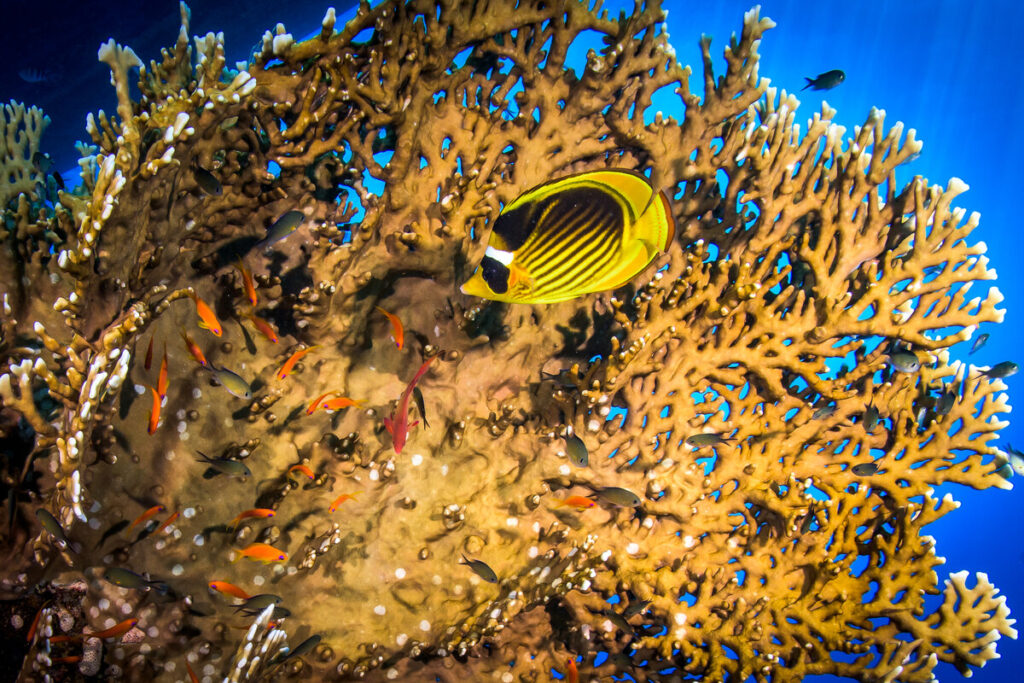
The footage showed eight different types of coral and eight species of fish using the reef as a place to hide and to feed. The list reads like a guide to West African sea life:
- golden African snappers
- blackbar soldierfish
- Guinean angelfish
- West African goatfish
- the Monrovia doctorfish
- three-banded butterflyfish
- two species of damselfish
Instead of one solid wall of coral, the reef seems to be made of separate patches. Each patch grows on rocky parts of the seabed where conditions suit it. That fits the patchy pattern Zinzindohoué expected from a deep coral community, and it may help explain why the reef was so easy to miss or misread.
Dead and then revived, or never dead at all?
This is the big open question. Right now there is no way to tell whether the coral seen in the 1960s really was dead and later came back, or whether the first survey simply got it wrong.
The team is also careful about what the pictures can prove. No physical samples of the coral have been collected yet, so the coral types identified from the camera footage still need to be confirmed. Old reports hinted that a coral barrier might stretch about 40 kilometers (roughly 25 miles) along the coast, but the scientists checked only a small slice of that area.
“This is still an initial exploration,” Zinzindohoué said. He added that with unlimited funding, his first step would be to return with a proper program of scientific diving and sampling.
Why it matters
The discovery suggests that other coral communities along the West African coast may be out there, overlooked, forgotten or simply never recorded. Zinzindohoué sees the Benin reef less as a rare exception and more as a sign of how little is known about these waters.
“If we were able to find this reef again after 60 years, how many others are still undocumented or simply forgotten?” he asked. At the same time, he warned against assuming hidden reefs are everywhere. “Each discovery needs to be confirmed,” he said.
For him, the most exciting part goes beyond the coral itself. A reef like this one can hold clues about how the ocean in this part of the world has changed over time. “It feels like we have only just started to read an archive that has been there for a very long time,” he said.
Source: ScienceDaily