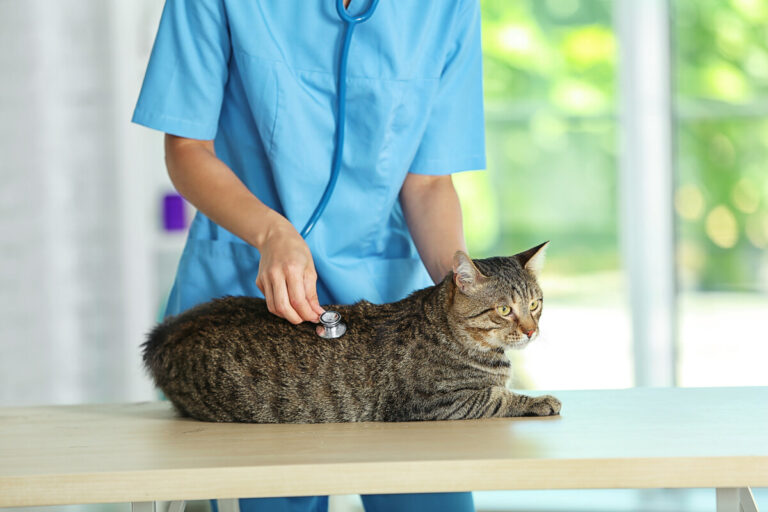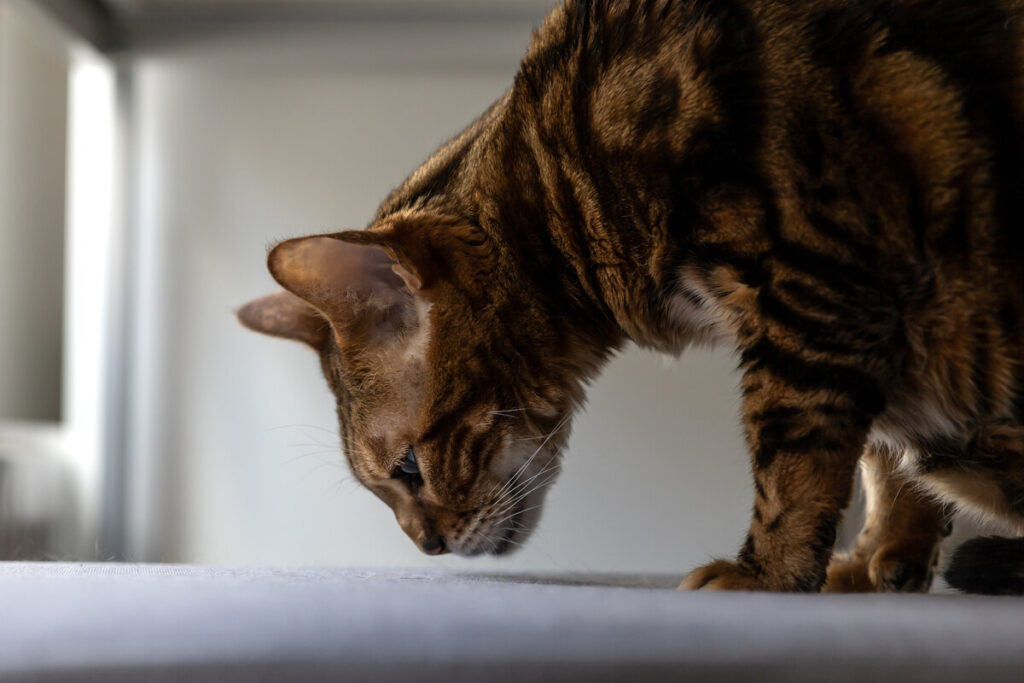
When a cat sniffs a spot where another cat has peed, it may be reading a name tag. Scientists have found a set of 13 unusual fatty acids in cat urine that forms a pattern unique to each cat, and other cats appear able to tell those patterns apart.
The problem with smelly messages
Many animals leave scent marks, but smells don’t sit still. Odor molecules drift away, fall apart or change over time. So how can a cat that walks by hours later still figure out who left the message?
A team of researchers from Japan, Germany and Spain, led by Iwate University in Japan, set out to answer that question using pet cats. Their study is set to appear in the journal Current Biology.
Cats remember who’s who
First, the team checked that cats can tell one cat’s urine from another’s. When cats smelled the same sample again and again, they got less curious each time. Then the researchers swapped in urine from a different cat, and the sniffing picked right back up.
Even more surprising, cats still seemed to recognize a urine smell they had met before after breaks of several months. That hints that cats may hold on to scent memories for a long time.
The scientists also watched for a famous cat face called the flehmen response. It is that open-mouthed look a cat sometimes makes while investigating a smell. Cats made this face more often when they smelled urine from a stranger than when they smelled their own. As a sample became familiar, the face showed up less, and it came back when a new cat’s urine was offered.
“After confirming that cats can distinguish individual urine odors, we used the flehmen response as a clue to identify urinary molecules that may contribute to individual scent recognition,” said Professor Masao Miyazaki of Iwate University, who led the project.
A chemical fingerprint made of fats
Following the cats’ reactions, the team zeroed in on a group of fats in the urine called branched-chain fatty acids, or BFAs. They found 13 of them. The scientists found no earlier reports of these same BFAs in other mammals’ excretions or secretions.
The key was not just which BFAs were there, but how much of each one. Every cat had its own mix. Those mixes were quite different from cat to cat, yet stayed fairly steady when the same cat was tested on different days. Related cats tended to have closer patterns, but even family members could still be told apart.
These fats also last. Many of the chemicals behind the familiar smell of urine change quickly once it hits the ground. BFAs are only semi-volatile, which means they evaporate slowly. In samples kept at 25 °C, each cat’s BFA pattern stayed fairly stable for at least 24 hours.
To check that cats really notice these patterns, the researchers kept everything else in the urine the same and changed only the BFA part. Cats that had grown bored with a sample started sniffing eagerly again as soon as the BFA mix was switched. That suggests the fatty acids carry real information about who a cat is.
A clue to a century-old kidney mystery
Among the tissues the team checked, BFAs appeared in the kidney and nowhere else. They were found in tiny droplets of fat inside the outer layer of the kidney.
Cats have a lot of these droplets, and scientists have wondered for more than 100 years what they are for. The new results raise the idea that they may work like a storage tank for BFA-containing fats, helping keep a cat’s scent signature steady even when its diet or body changes for a while.
“Lipid droplets in the cat kidney have been known for more than a century, but why cats have so many of them has remained a mystery,” Miyazaki said. “Our findings suggest that one of their functions may be to support a stable chemical signature in urine.” How these stored fats end up in urine is still an open question.
What about lions and tigers?
The researchers also looked at wild members of the cat family. They detected BFA-related compounds in the urine and kidney droplets of lions, tigers, leopards, jaguars, lynxes and the Iriomote cat. The exact patterns differed from species to species, and so did the amount and placement of the kidney droplets.
That suggests this chemistry may be common across the cat family and has shifted over the course of evolution. Still, no one has yet shown that big cats use these compounds to recognize one another.
Why it matters
Scientists already knew how mice do it: special proteins in their urine help hold on to identity information. But a protein system like that has not been found in many other mammals. Cats may rely on a different trick, a slow-fading blend of fatty molecules backed by a reserve in the kidney.
The work is basic research for now, but it could one day help with managing cat urine odor. It may also help researchers understand why fat building up in organs is normal in some cases and linked to disease in others. And if BFA patterns prove reliable for identifying the same animal, urine found in the wild could become a gentle way to keep track of rare wild cats without catching them or even seeing them.
Source: ScienceDaily