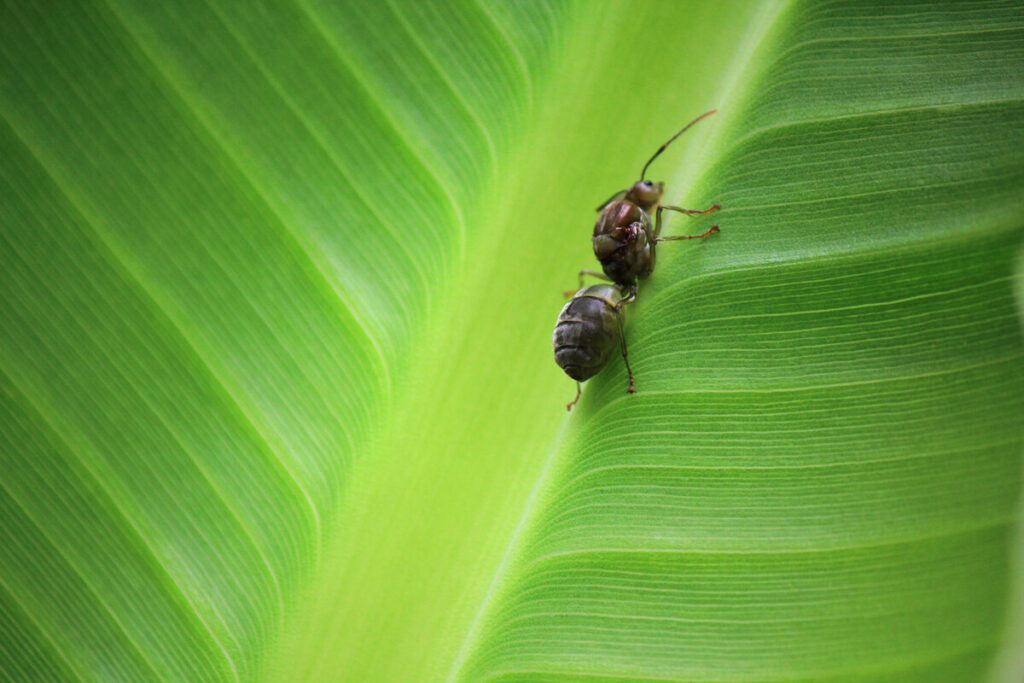
A small dose of caffeine helped Argentine ants learn where a sugary reward was hidden and reach it faster. Researchers hope the finding could one day make poisoned ant baits work better.
Argentine ants are among the most damaging and expensive invasive species in the world. People usually fight them with poisoned bait, but that approach often falls short. Colonies may ignore the bait, or abandon it before the poison has spread very far.
A team led by Henrique Galante, a computational biologist at the University of Regensburg, wondered if a familiar stimulant could help. Caffeine is already known to boost learning in bees. Would it do something similar for ants?
A tiny bridge and a drop of sugar
The researchers built a simple but careful experiment. Each ant crossed a small Lego drawbridge onto a test surface, a sheet of paper laid over acrylic. There it found a drop of sugar solution. Some drops were plain. Others contained caffeine at 25 ppm, 250 ppm or 2,000 ppm.
Those doses were chosen for a reason. According to Galante, the lowest is about what plants naturally contain, the middle one is similar to some energy drinks, and the highest matches the dose that kills half of the bees that eat it, so it is likely to be quite toxic.
An automated system tracked every ant, recording how long each trip took and how direct the path was. In all, 142 ants took part, and each one made four trips. Between trips the ants could unload the food they had collected, and the surface was swapped out so the ants could not simply follow their own scent trails.
What the caffeinated ants did differently
Ants that got plain sugar showed little improvement over the four trips. They did not seem to be learning where the reward was. Ants that got low or moderate caffeine doses, however, quickly became more efficient.
At 25 ppm, foraging time dropped by 28 percent with each visit. At 250 ppm, it dropped by 38 percent. The study gives an example: an ant that first needed 300 seconds to reach the sugar could get that down to 113 seconds at the lower dose, and to just 54 seconds at the middle dose by its last trip. The highest dose did not help in the same way.
Interestingly, the ants were not simply running faster. Their walking pace stayed the same at every dose. What changed was the route. Caffeinated ants took straighter, less winding paths to the reward.
Galante explained it this way: “What we see is that they’re not moving faster, they’re just being more focused on where they’re going.” He added that this suggests the ants know where they want to go, which means they have learned the location of the reward.
The trip home was a different story. Caffeine did not change how efficiently the ants traveled back to the nest, although all of the ants got a little better over time no matter what they ate.
Why better learning could mean better pest control
The idea is to work with how ant colonies naturally behave. As Galante put it, “the faster they go and come back to them, the more pheromone trails they lay, the more ants will come, and, therefore, the faster they will spread the poison in the colony before they realize it’s poison.”
In other words, an ant that learns a bait location quickly and returns often leaves behind a stronger scent trail. That recruits more nestmates, and more of the colony ends up carrying the poison home.
What comes next
The researchers caution that more work is needed before this could be used in real-world pest control. Studies are now testing caffeine-enhanced bait outdoors in Spain, and the team is also looking at how caffeine interacts with the poison itself.
For now, the result is a neat reminder that even a tiny insect can learn, and that a little chemical nudge may sharpen how it finds its way. The research was supported by the European Research Council, the Deutsche Forschungsgemeinschaft and the University of Regensburg.
Source: ScienceDaily